Category Archives: Texas birding

Birding in Telcel Land

We are close to Mexico, in fact today I biked with Penny in mid-70’s weather (sorry, that’s a bit mean for our NE friends) down the Bentsen State Park trails, and hiked a mile to the Rio Grande. Aside from hot and dry and old flood debris, it was pretty plain – except for the birds.

However, as you get close to the border, the Mexican telephone system Telcel, grabs your signal and suddenly you are getting warnings about roaming charges. It’s a little maddening, especially in the midlle of a call. I just turn my phone off until I get a few miles north.

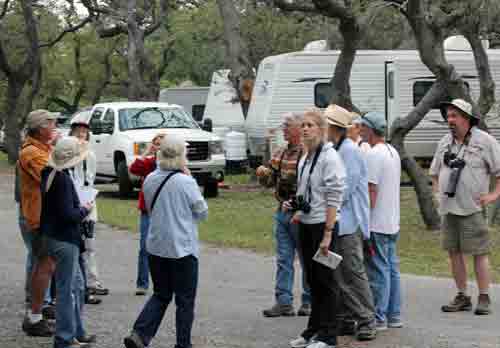
We are ensconced in a small RV park which is a first for us. It is an interesting mix of old geezers looking for the best buffet, and birders, looking for all the specialties of the Valley. Mary and I awake to the calls of Golden-fronted Woodpeckers and Great Kiskadees and periodically through the day, to the noise of fast-flying Green Parakeets.

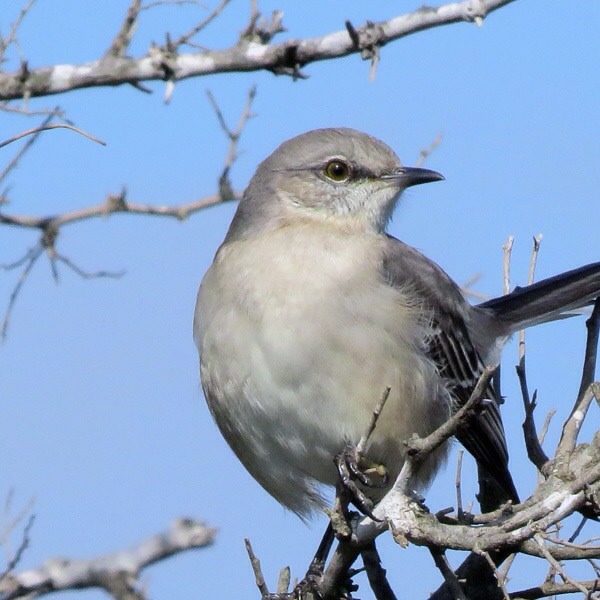
At the risk of boring our non-birding friends, here are a few shots from the last two days. The first is a Northern Mockingbird, the state bird of Texas:

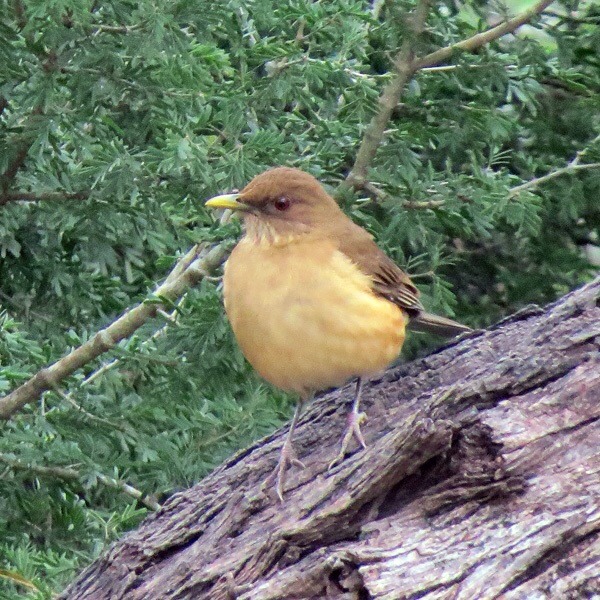
A local specialty is the rather rare Clay-colored Thrush, which acts like an American Robin but looks like its name:

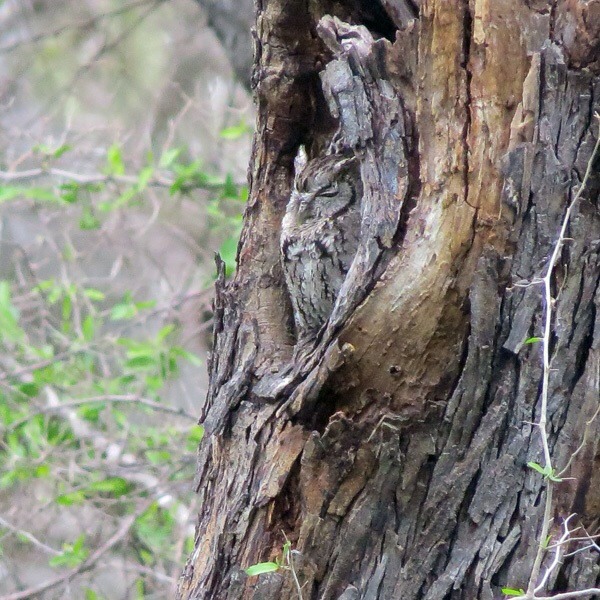
Yesterday, I went for an early bird walk in rather chilly foggy temperatures. The ranger brought us to this well-hidden Eastern Screech Owl which we likely would have just walked by:

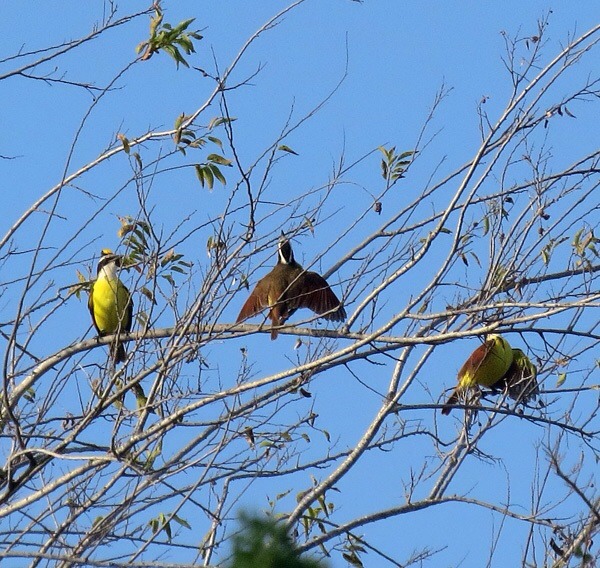
Greater Kiskadees, with their color and noise, are everywhere. These were drying their wings, as cormorants do, this morning:

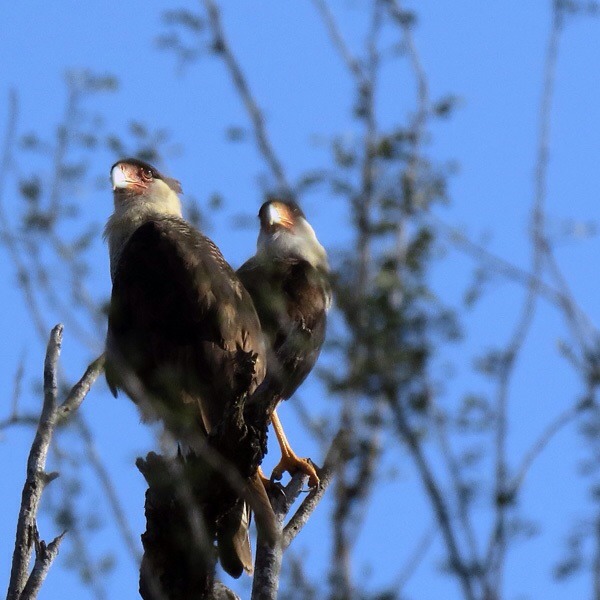
I remember the first Crested Caracaras we saw the first time we came to Texas. We could not identify this regal bird which sat on fence posts along the highway. Now, they are sort of ho-hum. Here are a couple perched in a tree this morning:

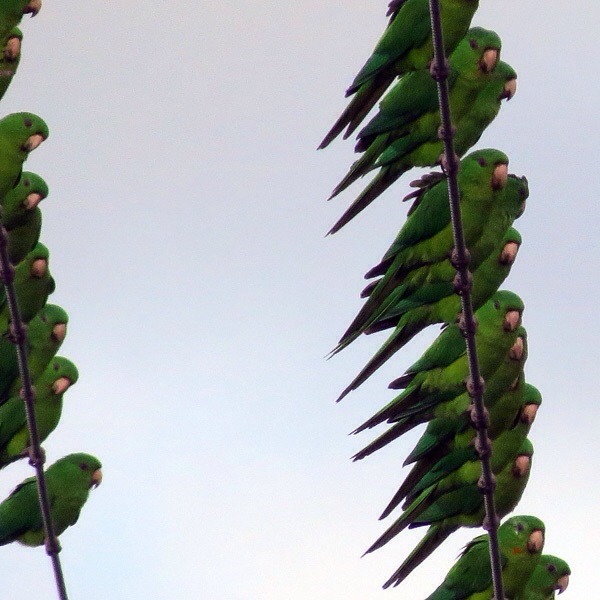
And lastly, the Green Parakeets, who came from escapees originally but have adapted to the "wild" like House Sparrows and European Starlings. Here, they paused for a bit before launching on their next frenetic flight:

This afternoon, we headed out to a "farm-to-market" busineess to get some fruit – a large bag of Pink Grapefruit and one of Navel Oranges. We won’t be getting scurvy on this trip. Bon voyage.

Southern Birding – Why We Travel

I think it was the dozen Eastern Bluebirds I saw as we drove in to Harrison Bay State Park in Tennessee, or else the flock of Pine Warblers at Clarko State Park in Missisippi, but about the turn of the year, it was obvious that "We are not in Kansas anymore." In the first four days of the year, I picked up 65 species, mostly birding as I walked the dog after the day’s travel.

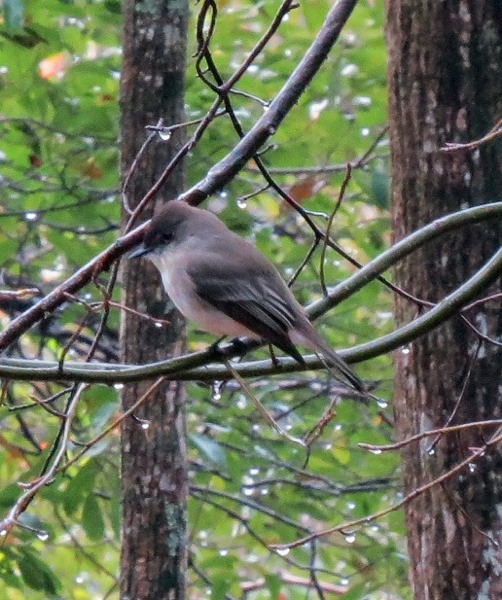
One of the birds I see at every stop is the Eastern Phoebe – this is a Mississippi bird:

As a pilot, I was trained to keep a continuous scan pattern going, and I try to apply it driving. Check the road, the mirrors, the speed, and the fields and air for birds. I know the dangers of texting or talking on a phone – it is obvious when I see speed changes or lane weaving. Birding can be just as distracting if you are the driver so I stick to stuff in front of us. On a stretch on I-10 through Louisiana, I got Cattle Egrets, a Great White Egret that flew up in front of us, several Red-tailed Hawks, some Black-crowned Night Herons, and some Great-tailed Grackles at the rest stops.

We are in Goliad State Park in Texas and leave Monday for a two-week stay in Mission, where we will join some birder friends and immerse ourselves into the special place of the Valley. We have been without wifi for a week and our working off the iPads with crappy 4G coverage – but here, if I can upload them, are some bird shots from the last few days.

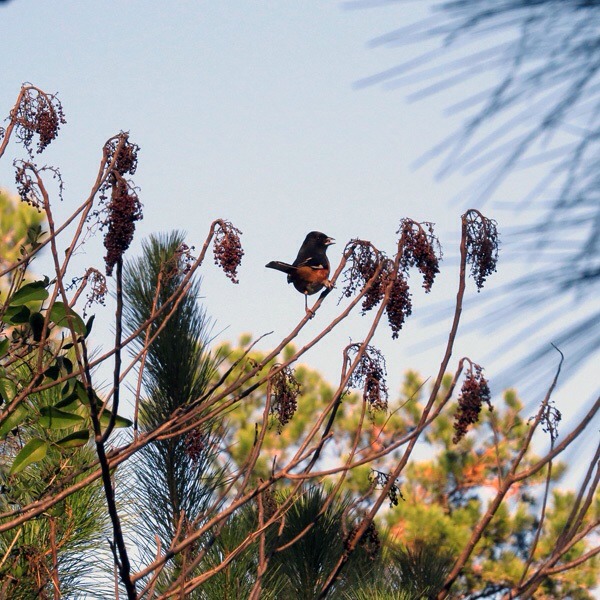
While birding with Penny on a trail at Village Creek State Park in Texas, I heard an unfamilier call and then this Eastern Towhee popped up:

Here at Goliad, there are many Ladder-backed Woodpeckers. The size of a Downy, they move a lot and are hard to photograph. This one is on the move:

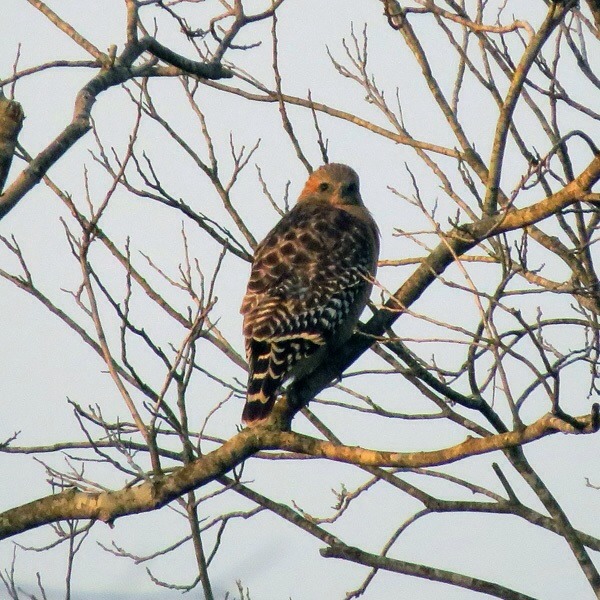
Early Sunday morning, I saw this Red-shouldered Hawk before it saw me, and I got a great look – until the dog spooked it. I was able to get a long-range shot although it was watching us like a ….. hawk:

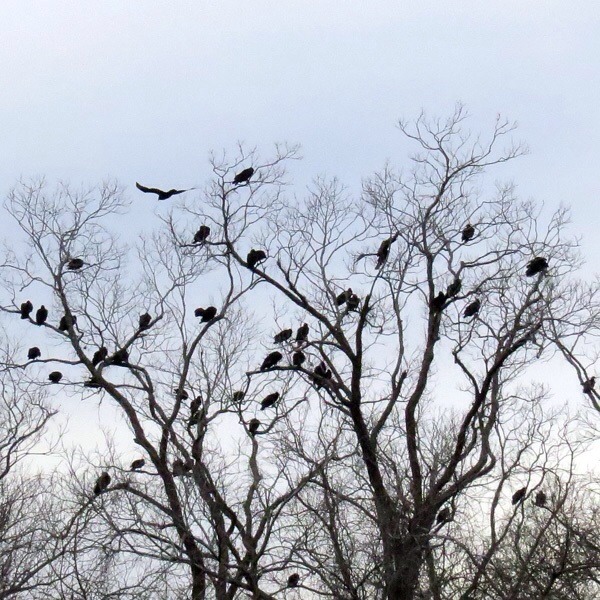
There are hundreds ot Turkey Vultures circling all day – right out of a Hitchcock film. In the morning, the trees are draped with them. Here are some getting ready for bedtime:

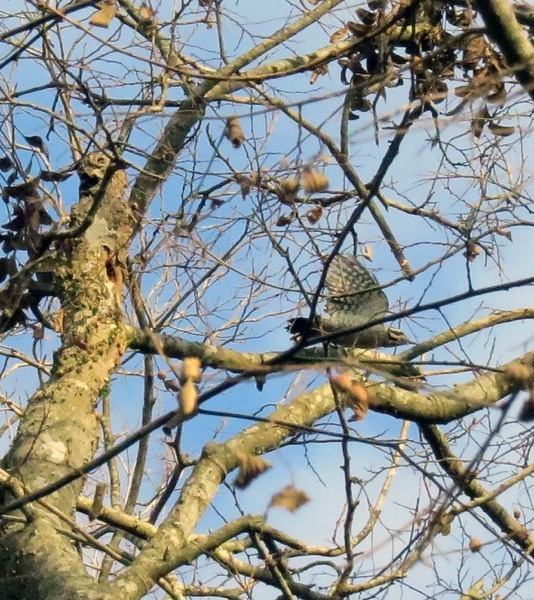
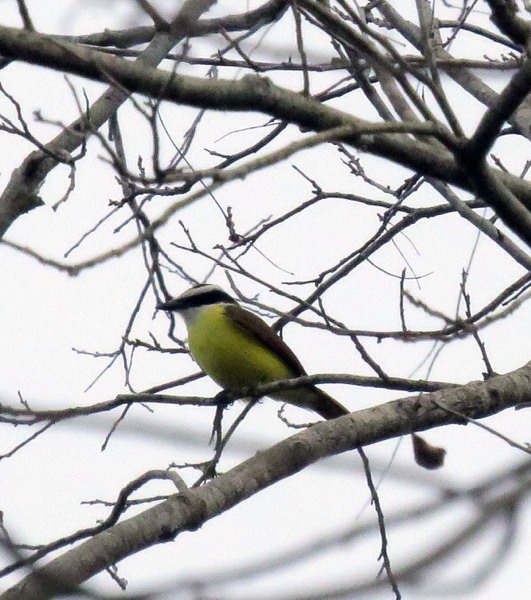
One of my favorite southern birds is the Great Kiskadee. They are noisy, colorful, and rather plentiful along the Rio Grande, and after a while, easy to take for granted. I hadn’t seen one in two years and didn’t expect them up in Goliad – so it was quite a pleasant surprise to hear their call and then see a pair. This one waited patiently for a long-range photo op.

The park ranger warned us this afternoon that it was going down to freezing tonight and that we might want to let our water hoses drip. There is a cold snap (for South Texas) coming but we are moving southward in the morning and should be ok. I stored my winter stuff in the truck today – Mary, who is wiser, is keeping hers close by for another few days.

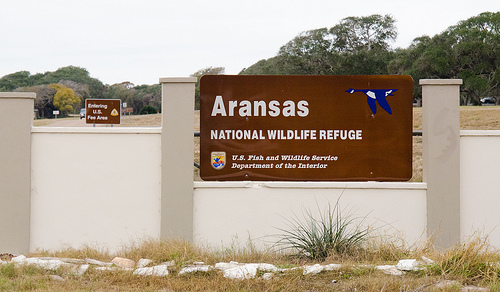
Aransas National Wildlife Area

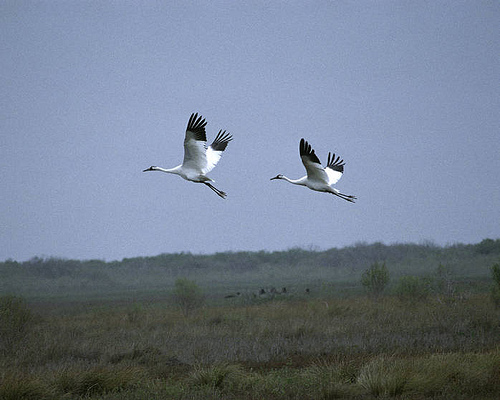
During our stays at Goose Island State Park outside Rockport, TX, we always try to make a visit to Aransas National Wildlife Area which is about a 35 mile drive. Aransas NWA is famous as the winter home of Whooping Cranes (although we have had much better luck near Goose Island State Park, on 8th avenue near the Big Tree where there are feeders in several pastures).  Aransas is  just a wonderful place to visit for birds and wildlife.

I remember our first visit: it was tension-filled because I had headed out with probably a half-tank of gas in the truck and you know how that goes – the second half seems to go a lot faster than the first. It is a Texas-flat drive. I don’t think we changed elevation more than ten feet the whole way – that to cross streams – and most of it was straight as an arrow.  Massive black dirt field lie in wait of spring planting — and way across them, you could see cars and trucks moving like mirages.  We cut that trip a bit short due to the gas situation — there’s nothing out there.

The roads in from Highway 35 are narrow farm roads and the signage is a little weak, at least the first time you drive it.   It’s a lot further in than an Easterner might expect – it seems to go on forever — like much of Texas driving.  As mentioned, there are very few gas stations or places to eat nearby, so plan accordingly. The Visitor Center (pay here for admission to the park–$5/car) is very nice with exhibits, a short film, gift shop and restrooms.  We found the volunteers really friendly and helpful –  like many federal parks and areas, the volunteer help makes the operations run.

Ringed by tidal marshes and broken by long, narrow sloughs, this 59,000-acres refuge sprawls mostly across the Blackjack peninsula.

Ringed by tidal marshes and broken by long, narrow sloughs, this 59,000-acres refuge sprawls mostly across the Blackjack peninsula.

Mild winters, plentiful water, and an abundant food supply attract more than 400 species of birds throughout the year. While the Whooping Crane is undoubtedly the highlight of the winter months, other water birds including Reddish Egret, White and White-faced Ibis, Mottled Duck, and Purple Gallinule also feed in the rich bay and the fresh-water lagoons further inland. In migration, the oak woods provide critical habitat for neotropical migrants traveling the Central Flyway. The sandy prairies and scrublands are hunting grounds for White-tailed Hawk, Crested Caracara, Aplomado Falcon, and other raptors. Rare treats like Buff-bellied Hummingbird, Masked Duck, Painted Redstart, and other surprise visitors from southern climes are always a possibility.

Whooping Cranes are one of the attractions but they are often far out and require a spotting scope.  Many birders take boat tours out of Rockport for better looks.

Whooping Cranes are one of the attractions but they are often far out and require a spotting scope. Many birders take boat tours out of Rockport for better looks.

Take the 16 mile driving loop, stop at overlooks and observation towers, plan several hours at least, and you will likely see deer, javelinas, raccoons, even alligators.

There is a alligator-viewing pool just outside the visitor center. There are several, just partially surfaced, here in this shot I took during a visit.

There is a alligator-viewing pool just outside the visitor center. There are several, just partially surfaced, here in this shot I took during a visit.

Unfortunately, the drought of the last several years has really affected the wildlife.  Changing salinity levels have dropped the population of blue crabs, a primary food source for Whoopers, and some special feed has had to be trucked in during difficult periods.   So you never know what you’ll see — but our visits in the last few years have been disappointing.

Most birders don’t make the NWA a destination per se — they are in the area for many of the other rich birding sites all along the coast and weave a trip here into their itinerary.  Check locally — last time we were there, their was a reliable Burrowing Owl not far from the turn of the main highway and also several Scissor-tailed Flycatchers on fences just to the north of the area.  Give it a shot — take your bike for some nice level riding with little traffic — just make sure you can out-pedal a javelina.

How to get there

From the south: Follow Hwy. 35N to the FM 774 exit. Turn right on FM 774 and go approx. 6 miles, winding through the farm fields. Turn right again on FM 2040. Go another 6 miles to the Refuge gate. Go to the Visitor Center to register.

From the north: Travel south on Hwy. 35 to Tivoli. Continue past Tivoli for approx. 1 mile to the FM 239 exit (on your left). Follow FM 239 to Austwell. Upon entering Austwell, FM 239 turns into FM 774 at the curve. Continue on FM 774. Follow 774 & take a right at the stop sign. Go down the end of the street. Take a right again. As you exit Austwell, drive ½ mile to the FM 2040 intersection. Go left on FM 2040 for about 6 miles to the Refuge gate. Go to the Visitor Center to register.

Salineño – Get it on your birder bucket list

I fell in love with birding about four years ago and one of the reasons was a trip we made to Salineño, Texas.  Driving there, we were stopped by a pleasant Border Patrol officer who was exiting the rutty dirt road that goes down to the site. A Vermont couple with a dog did not interest him — we essentially just exchanged greetings.  It was our first encounter with the sensitivity of the area where you can essentially wade the Rio Grande.  (And people have for decades, and still do.)
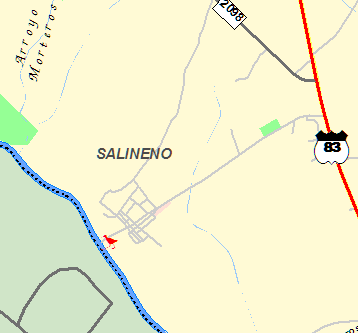
Salineño is just north of Roma on Route 83.

Salineño is just north of Roma on Route 83.

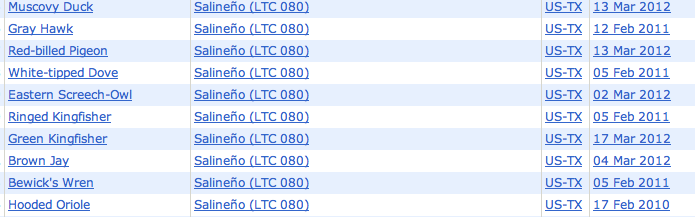
Entering a tract, which has been a famous birding spot since the 1970’s, we encountered a small group of birders sitting in lawn chairs watching the many bird feeding stations.  And what an array of great birds Mary and I saw: Green Jays everywhere, Great Kiskadees, and all three orioles (Altimira, Hooded, and Audubon’s.)  It was an immersion into a new world of color and activity, just amazing.  The Hooded Oriole was the first of ten life birds I’ve gotten there during a half-dozen visits.
Screen Shot 2013-08-09 at 3.17.50 PM

Salineño is a must-stop on any birding tour of the area.  The parking lot, right on the river, is a great spot for all sorts of birds.  We were there in 2012, arriving just as a large tour group came out of the woods, excited about some of their observations.  They had seen Red-billed Pigeons in the trees far up the river.  As they were just about to stow their gear and head to their next destination, their leader yelled, “Ducks – Muscovy’s” as a flight of four came right over us.  It was a lifer for me and I’m sure, many of the group members.  They piled happily into their cars to hit their next destination.
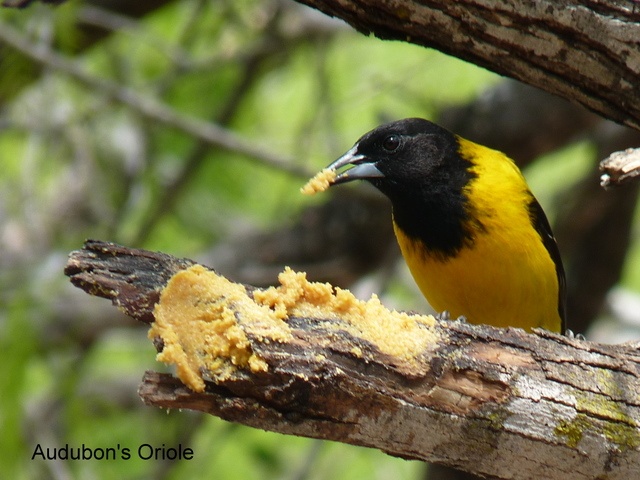
A predominantly Mexican bird, the Audubon's Oriole reaches the United States only in southern Texas.

A predominantly Mexican bird, the Audubon’s Oriole reaches the United States only in southern Texas.

For many years, the little tract of wooded land were we visited the feeders was owned and maintained by Pat and Gail DeWind who then sold it to the Valley Land Fund, a non-profit that protects over 10,000 acres of land up and down the Rio Grande Valley.  Volunteers, led by Cheryl Longton of Massachusetts, have maintained the feeders each winter, relying on donations from birders and others.  Last winter, the site was closed and the feeders moved just north to Fish and Wildlife land but it is expected that the original site will re-open this winter.
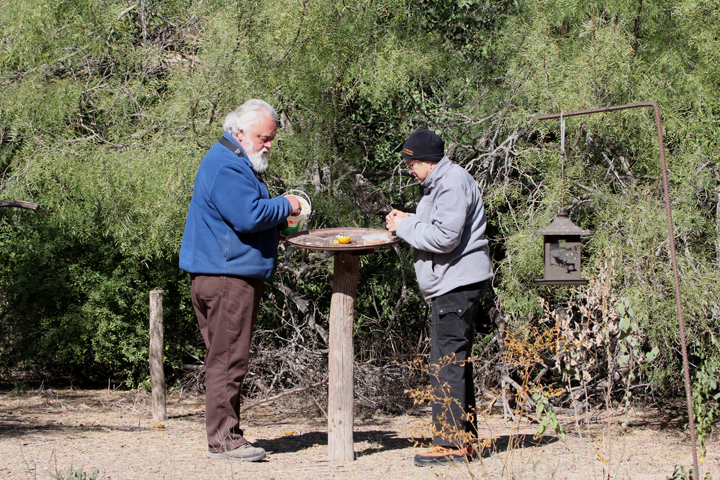
Merle and Lois, two of the long-time volunteers, fill a feeding station.
Merle and Lois, two of the long-time volunteers, fill a feeding station.

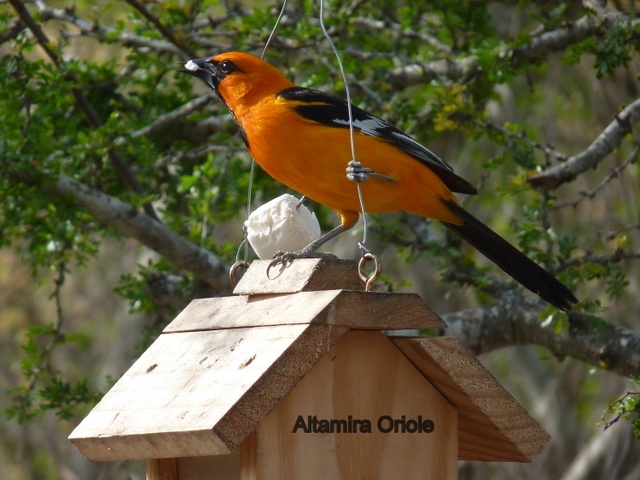
The Altamira Oriole is a bird of Mexico and Central America whose range just reaches into southern Texas. They are often seen at Salineño.

The Altamira Oriole is a bird of Mexico and Central America whose range just reaches into southern Texas. They are often seen at Salineño.

The woodland along the River at Salineño is an excellent spot for finding Valley birds such as Audubon’s Oriole, White-tipped Dove, Groove-billed Ani (summer is best), Long-billed Thrasher, Green Jay, and (now infrequently) Brown Jay. The parking lot is a great gathering spot for birders and a favorite spot to wait for fly-by kingfishers (all three species), Muscovy, or Hook-billed Kite. While standing at the River, you may see such waterbirds as Least or Caspian tern, Black Skimmer, various large waders, and Ring-billed Gull. During spring, Bank Swallows, Indigo Buntings, and Dickcissels stream across the River from Mexico. In winter, the River may be filled with both dabbling and diving ducks. Mergansers and (rarely) scoters occur as well. Check the boulders in winter for Black Phoebe and Spotted Sandpiper.

One of the target birds on our last trip was the Brown Jay.  One had been seen fairly reliably before we got into the area but on several tries at Salineño (you just missed it!) and up the river at another spot, we finally waited it out at the feeders and watched as a juvenile ate his heart out.  Birders from all over the country and Canada were snapping pictures.  As was I.
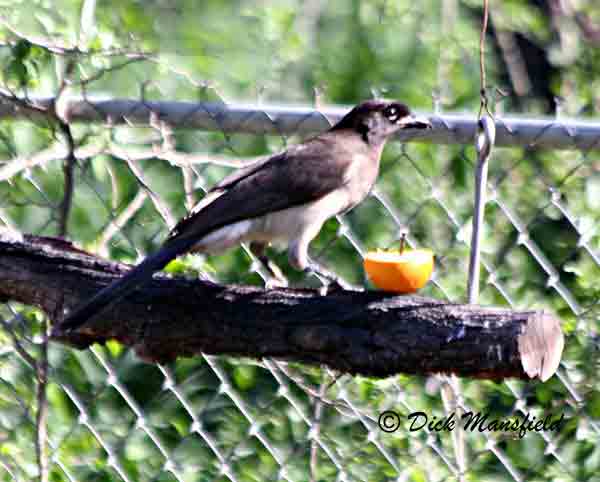
Brown Jays are resident of a short stretch of Rio Grande corridor from about Salineño to the woodlands below Falcon Dam

Brown Jays are resident of a short stretch of Rio Grande corridor from about Salineño to the woodlands below Falcon Dam

So, make Salineño a stop on a trip to the area.   Many birders also hit Chapeno, Falcon Dam, Falcon State Park, and work their way up to Zapata.  A list of potential birds is mouth-watering:  White-collared Seedeaters,  Pyrrhuloxia, Harris’ Hawk, Verdin, Scaled Quail, Golden-fronted and Ladder-backed Woodpeckers, Cactus Wren, Black-throated Sparrow, Long-billed and Curve-billed Thrasher, and Chihuahuan Raven.   Good Birding, indeed!

Sign up by RSS feed or via email to have future articles sent to you.
What Sparked My Interest in Birding

It wasn’t until I was turning 70 that I got seriously hooked on birding.  I had dabbled in it and enjoyed watching birds in our woods but never kept lists or owned any decent binoculars until late 2009 when I was planning our first Airstream trip to the Southwest.  I discovered eBird and also joined listserves in some of the southern states to learn about what was going on.  When we launched in January of 2010, I had a life list of 38.

The spark was kindled during our first stay at Goose Island State Park.  Here’s how I wrote about it at the time:

The drive to Goose Island State Park, in Rockport, Texas was easy with lots of straight Texas roads with 70 mph limits. We started to see lots of birds as we approached Aransas Wildlife Refuge and soon were searching for a site at the park – where we had made reservations. (Texas has an interesting process in their state parks — you can reserve a slot for a date or period but not a site — so you have to decide once you are there which available site you want.)

We found a nice isolated site surrounded by oaks and thickets and right next to a little bird sanctuary and the showers. We set up on the level site and I promptly got sick for two days — pretty severe stomach bug. Lots of rest, fluids, and good care from Mary and I made a nice recovery yesterday.

I felt up to participating in Saturday’s bird walk — having missed the two earlier ones — and was astounded at the variety as well as the knowledge of the volunteer guides. We saw about 45 species including willets, gulls, pelicans, ravens, vultures, ducks, and a white ibis. I don’t know birds around the sea very well so it was very informative and just spectacular birding.  (Note: This was the Spark!)


The camaraderie and expertise of the birding group, and the wonderful diversity of birds (mostly new to me) got me hooked on birding. (Jan 2010)

We really like this place — it’s a wonderful area. We decided to extend for another week rather than keep traveling. Seems nice to settle for a bit and enjoy the weather and the birding. Yesterday afternoon, we drove over to a field where two whooping cranes are living. There were a half-dozen other birders there — some armed with monstrous lenses for their cameras. The birds were just regal, standing on one leg, preening themselves, ignoring their watchers. It’s hard to believe that they fly down from upper Canada and that there are still only a little over 300 of them alive.

This is a nostalgic area for us. Last night out walking the dog, I was watching the sky full of stars and remembering night flying here, decades ago. I happened to remember a night cross-country where I was returning in a F-9 trainer with an instructor high over Houston and we just went inverted and watched the lights of the streets, parking lots, ball field for a while. I did my advanced flight training here, got my Navy wings here, and our daughter was born in this area. Our son got his USMC wings here as well.

So, we’ve got more whooping cranes to see at the wildlife center, a visit up to Beeville to find our old house and the hospital and the air station, and hope to meet up with my brother Barry and his wife Mica before they head further west. But the schedule is a vacation schedule — and all plans are flexible. It’s nice. Now I need to find those black-bottomed ducks.

So, when we departed Goose Island in mid-February, I had added 55 birds to my life list in two weeks and just ahead, at Falcon State Park, I encountered my first rare birds adding a Roadside Hawk and some Groove-billed Anis to my list.  That amazing first bird walk had launched me into passionate birding at age 70.  Thanks be.

Southwest Trip Wrap-up

Now that we’ve been home a few weeks and are seeing spring birds in Vermont, it’s interesting to think back about some of the neat birds we saw this winter.  I saw about 210 species with 25 new to me.  There were no extremely rare ones this year like in the past although the Brown Jay was one that hadn’t shown up for a few years.  Here are some of the ones that I particularly liked — some of my photos are not wonderful but give a taste of what we saw.  Great birding all in all.

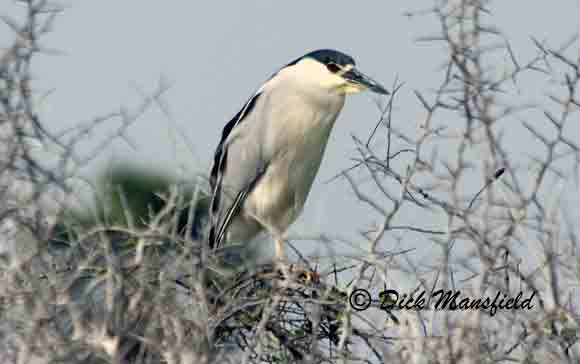
We saw large groups of Black-crowned Night Herons at Goose Island SP

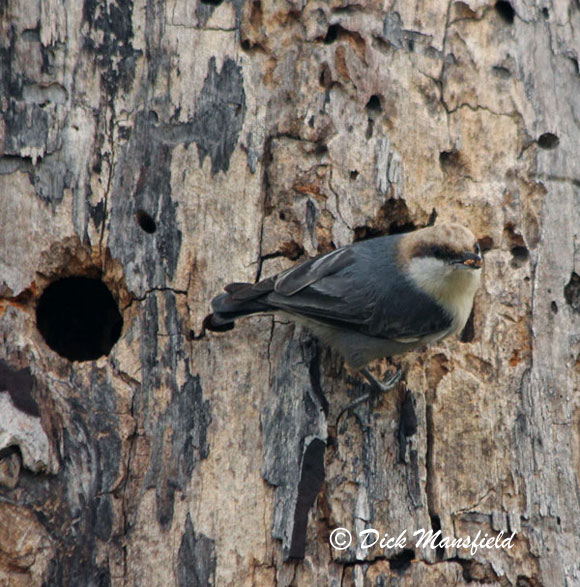
Brown-headed Nuthatches at Lake Fountainbleau SP in LA

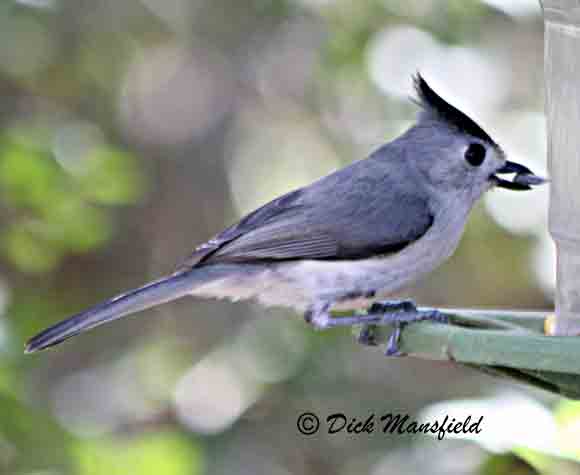
Black-capped Titmouse

Brown Jay at Salenino, TX

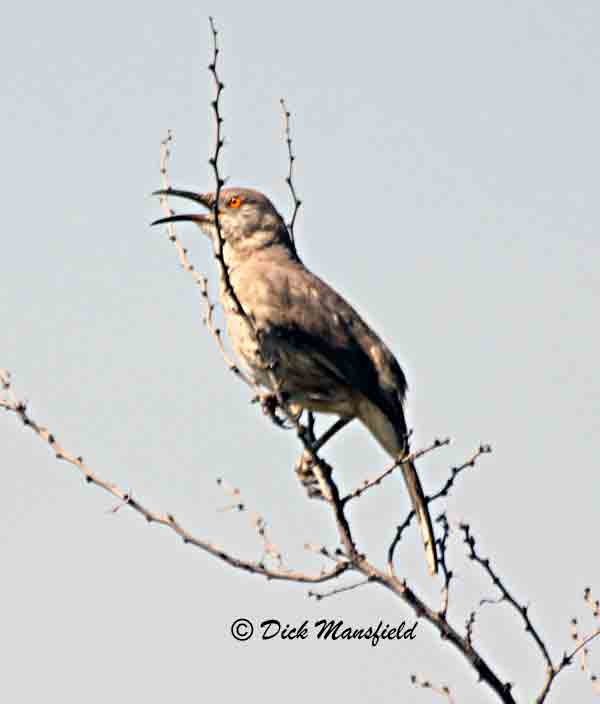
Curve-billed Thrasher singing at Falcon SP 
Golden-fronted Woodpecker

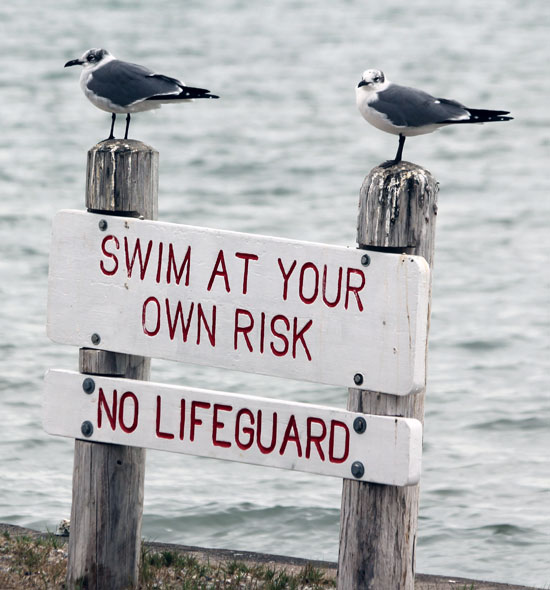
Laughing Gulls

Pine Warbler at Clarko SP, MS 
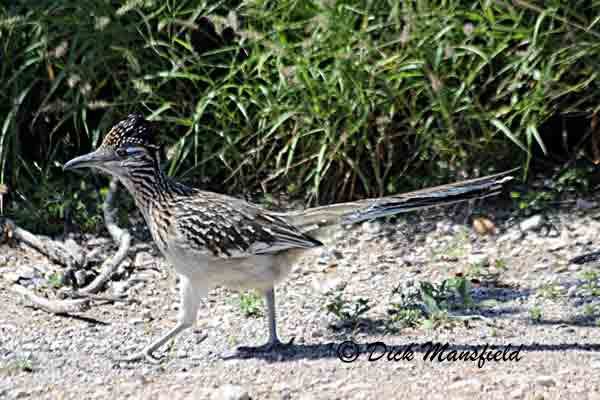
Roadrunners were less prevalent this year, perhaps because of the Texas drought.

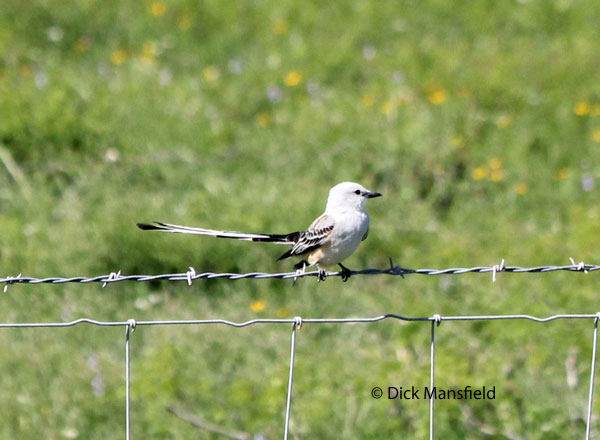
One of my favorites and a life bird — Scissor-tailed Flycatcher

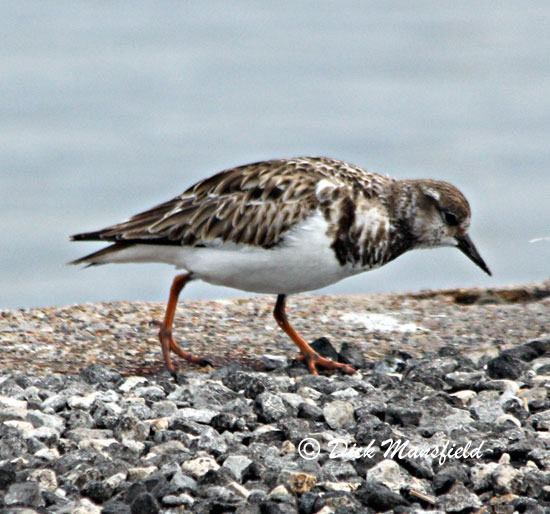
Semi-palmated Plover

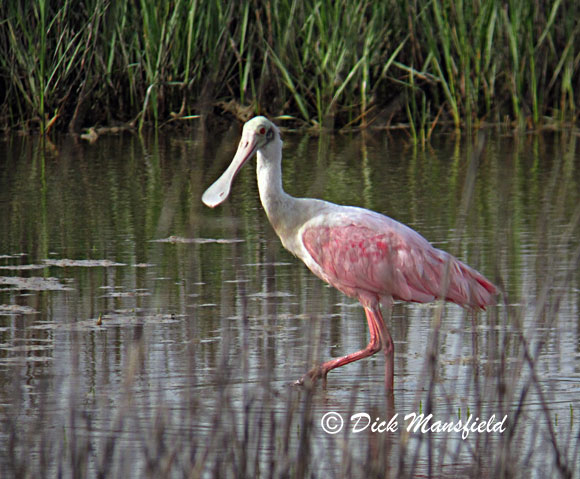
Roseate Spoonbill developing breeding plumage – Rockport, TX

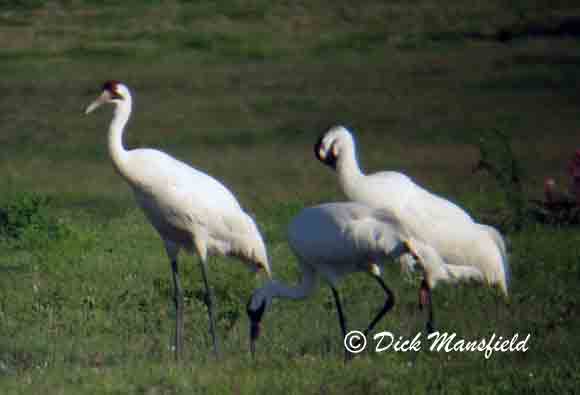
Whooping Cranes.

Willets courting.

A Great Day in Texas

Mary and I loaded up Penny and left early for some back road birding north of Rockport. We started tallying gulls and “telephone line” birds and soon were on a Farm-to-Market road heading toward the hamlet of Bayside. These “farm roads” in Texas are usually narrow with a speed limit of 70 and lots of white pickup trucks in a hurry. Not too conducive to birding although usually there is a wide shoulder (or ditch.)

We pulled off on a little narrow road alongside Copano Bay called Egery Flat aka Mosquito Alley and were immediately confronted with a small mudflat/pond with hundreds of shorebirds. As we tried to sort through Dowitchers, Dunlins, Willets some Black-legged Stilts, and lots of sandpipers, I was wishing that I had an expert along. Just ahead, we saw and photographed a Reddish Egret – a white morph in breeding plumage – which turned out to be a new bird for each of us. It is neat to watch them fish, stirring up the water with their feet and then grabbing stuff they’ve scared.

The American Golden Plovers were in his pasture

As the road turned to dirt, we saw several birds flush out of the grass and settle. I knew right away that they were one of the species we were after – and it turned out that they were American Golden Plovers, passing through on their way north. I got out my scope and we got some good looks, an so-so photos. As I watched, a steer (seen above) watched us and started plodding our way. Time to move on.

American Golden Plover

It was a pretty spring day with no one around on this straight back road so we let the dog go and walked for a while. The temperature was about 80 with a light breeze and blue skies with sparrows and meadowlarks rising from the fields. Of course, the mosquitoes found Mary.

We passed another flock of plovers and then, just as we were nearly done with the loop, Mary spotted more birds. We pulled over, looked at them through the binos, and took some photos. About then, a deputy sherriff pulled alongside asking “Everything ok?” I guess the red Vermont truck with kayak on top looked pretty unthreatening and he was off. (I learned later that the birds were migrating Upland Sandpipers, another new one for us.

Upland Sandpiper

One of the purposes of the outing was to check out a local eating place which friends had raved about. Crofutt’s Sandwich Shop & Bakery calls itself “An Oasis in a Junk Food Desert” and it is. Plain looking and frequented by local oil and ranch workers, it has been running for 33 years. We had the Shrimp Po-Boy and they were great. I had to eat mine next to the truck since Penny had an anxiety meltdown and started pulling the rubber stripping from the door .. again. Washed down with iced tea, with a couple of decadent cookies for later, it was quite a feast.

We returned in time for a short nap and then Penny and I drove to the vet for a last checkup. Her leg is nearly there and after a quick check, the doc said goodbye giving her a few treats for the road.

While our more ardent birder acquaintances go out for all day, we found that a few hours, some fresh air, some good food, and a nap is our preference.

We have managed to see 201 different species this trip so far with about 25 new ones for me. Now to follow some them as they migrate northward.

A Great Birding Outing

Yesterday, Mary and I loaded up Penny and left early for some back road birding north of Rockport. We started tallying gulls and “telephone line” birds and soon were on a Farm-to-Market road heading toward the hamlet of Bayside. These “farm roads” in Texas are usually narrow with a speed limit of 70 and lots of white pickup trucks in a hurry. Not too conducive to birding although usually there is a wide shoulder (or ditch.)
We pulled off on a little narrow road alongside Copano Bay called Egery Flat aka Mosquito Alley and were immediately confronted with a small mudflat/pond with hundreds of shorebirds. As we tried to sort through Dowitchers, Dunlins, Willets some Black-legged Stilts, and lots of sandpipers, I was wishing that I had an expert along. Just ahead, we saw and photographed a Reddish Egret – a white morph in breeding plumage – which turned out to be a new bird for each of us. It is neat to watch them fish, stirring up the water with their feet and then grabbing stuff they’ve scared.

The American Golden Plovers were in his pasture

As the road turned to dirt, we saw several birds flush out of the grass and settle. I knew right away that they were one of the species we were after – and it turned out that they were American Golden Plovers, passing through on their way north. I got out my scope and we got some good looks, an so-so photos. As I watched, a steer (seen above) watched us and started plodding our way. Time to move on.

American Golden Plover

It was a pretty spring day with no one around on this straight back road so we let the dog go and walked for a while. The temperature was about 80 with a light breeze and blue skies with sparrows and meadowlarks rising from the fields. Of course, the mosquitoes found Mary.
We passed another flock of plovers and then, just as we were nearly done with the loop, Mary spotted more birds. We pulled over, looked at them through the binos, and took some photos. About then, a deputy sherriff pulled alongside asking “Everything ok?” I guess the red Vermont truck with kayak on top looked pretty unthreatening and he was off. (I learned later that the birds were migrating Upland Sandpipers, another new one for us.

Upland Sandpiper

One of the purposes of the outing was to check out a local eating place which friends had raved about. Crofutt’s Sandwich Shop & Bakery calls itself “An Oasis in a Junk Food Desert” and it is. Plain looking and frequented by local oil and ranch workers, it has been running for 33 years. We had the Shrimp Po-Boy and they were great. I had to eat mine next to the truck since Penny had an anxiety meltdown and started pulling the rubber stripping from the door .. again. Washed down with iced tea, with a couple of decadent cookies for later, it was quite a feast.
We returned in time for a short nap and then Penny and I drove to the vet for a last checkup. Her leg is nearly there and after a quick check, the doc said goodbye giving her a few treats for the road.
While our more ardent birder acquaintances go out for all day, we found that a few hours, some fresh air, some good food, and a nap is our preference.
We have managed to see 201 different species this trip so far with about 25 new ones for me. Now to follow some them as they migrate northward.

– Posted using BlogPress from my iPad

A Big Day

Mary went on a bird walk this morning and came back with a long list of birds — several which I had not seen.  It was my day to watch the dog since she (the dog) gets anxious when separated for any lengthy period.
After lunch, we decided to go for a drive and look for birds so we left for Refugio, a small town about 35 miles away.  Birding at 70 mph on a narrow highway is a challenge but we were seeing hawks (Redtails, Kestrels, perhaps a Rough-legged) when I blasted by a Scissor-tail Flycatcher sitting on a fence.  This was one of the birds we were after.
No one was behind me so I slowed, turned around on the narrow highway, and of course the bird spooked as soon as we approached.  It flew, gracefully, up and then dropped down to a spot further up the fence.  We got some good looks.
We saw several more, slowing each time, and then birded a local park up in Refugio with no success.  Returning, we saw two flycatchers sitting close to one another and slowing the truck, got some photos.  They were very patient and chirping away at us and we left them undisturbed.  Fortunately, the road is little traveled even though those that do use it cruise at 70-80.  
Scissors-tailed Flycatcher, Refugio County, TX
It was a two mile detour to check out a spot on Highway 35 where folks have seen a burrowing owl.  I’ve been by there two or three times with no luck but we decided, in spite of the heavy traffic, to give it a try.  The spot is a large drainage culvert exactly two miles from an intersection so as we approached, I could see the culvert.  We pulled to the side and checked it with binos.  There was a small owl-looking lump on top (She comes up through a crack in the pipe.)  so once traffic cleared, we crawled ahead and shot a couple of photos of her looking at us.  We then left her undisturbed. 
Burrowing Owl alongside Highway 35, Aransas County, TX
It’s interesting — hundreds of trucks, RV’s, and cars go past that culvert each day, oblivious to the unusual bird watching them.  Of course, she’s tiny and blends into the scenery.  It was a great find — I never expected to catch her out of her haven.
Returning to Goose Island State Park, I took the Vizsla for a walk and decided to check the feeding station near our site.  Not much activity in the late afternoon but I sat down and right away, a Hooded Warbler — a handsome male — began using the bird bath.  Mary had seen the warbler earlier in the day and it was one I was looking for.  Of course, my camera was back at camp but I got a wonderful look at the bird — and my third life bird of the afternoon.  
We are here in Texas later than normal for us and we are starting to get some early migrants.  Hopefully, a few more will show up in the next week.  Then, some of them, we’ll get to see again in New England later on this Spring.  But not these three.

Adios, Falcon State Park

We leave windy, arid Falcon State Park in the morning after two weeks of nearly-constant wind and temperatures in the mid-to-high eighties. All in all, it has been a nice stay here and a chance to see some friends and make a few new ones. This is a unique state park: there is an active community here many of whom have been coming here for years and in many cases, decades. There is a rather active social calendar around the recreation center and while that’s not our cup of tea, we do drop in periodically to say hello and pick up a book.
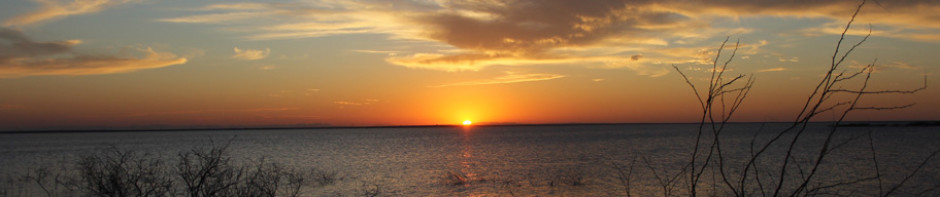
Sunset over Falcon Lake

We said goodbye this morning two our Oklahoma friends, Bud (87) and Charlotte (85) who we first met three years ago. Bud, a former trucker and mechanic, helped me with some big problems with the Airstream – and this time helped me (well, he did most of it) fix a faulty switch on a motor that raises the trailer tongue. Last night, we went over at dusk to talk and in the warm Texas evening, a number of couples came by to say goodbye. It was very poignant since with their age, you never know if they’ll be back. They are traveling home with some Vermont honey from our bees – and our hopes to see them again.
Being right on the Mexican border, there are some challenges. First of all, a Mexican phone company, TELCEL, grabs your signal much of the time and phones therefore are pretty unreliable. The radio stations are nearly all Spanish language and the few in English seem to be right-wing talk shows. It’s fifteen miles for decent wifi and 35 miles for decent groceries. Don’t even look for skim milk in a thirty mile radius; Chips and beer and fishing gear, yes.
And yet, this place grows on you. We are on the western edge of the Central Time Zone so it doesn’t get light until nearly 8 AM. Early morning walks with the dog are cool and filled with bird songs. Roadrunners and rabbits tease the Vizsla with their run, wait, run movements. Double-crested Cormorants fly over in large formations, heading for a day of fishing. Likewise, White Pelicans cruise out to Lake Falcon as we walk along. The breeze is almost always constant and picks up big time during the day.
Roadrunners drive our Vizsla nuts
Spring flowers have been popping everywhere and some of the ugliest plants have the prettiest flowers. Butterflies are everywhere but the wind makes it a challenge. Red Admirals come reliably to the orange halves we stick on trees.
Flower of a Thistle Plant
Prickly Pear Flowers

I had a chance to do some kayaking here although the wind kept the boat on the truck most days. The first morning I launched, a little Eared Grebe surface right in front of the kayak, dove and came back up alongside. I got pretty close to egrets, and Osprey, and other water birds. They seemed to not be afraid of the quiet boat — particularly with many bass boats roaring by.

We can’t get away from the drug war. Border Patrol vehicles cruise the park and and are common along the highways. A tethered observation ballon often flies to the north of here — sort of an ominous sight in a clear blue sky. But there have been no issues for several years here — even though Mexican drug activity goes on in Roma and Rio Grande City.
But as the Winter Texans like us leave, it’s hard to imagine living here. We’ve had a taste of the temperatures and the constant wind and one can see why siestas are popular. It’s deadly in mid-day. The decrepit homes, mongrel dogs, and trash get to you after a while.
But what a place for birds. I picked up nine new life birds and both Mary and I saw a wonderful array of Texas birds. Just on our little camp road we have Scaled Quail, Northern Bobwhites, Inca Doves, Northern Mockingbirds, Orange-crowned Warblers, Long-billed and Curved-bill Thrashers, Olive Sparrows, Chipping Sparrows, White-Crowned Sparrows, and the ubiquitous Turkey Vultures, Northern Cardinals, and Red-winged Blackbirds.
So, we are trading wind for mosquitoes and returning to another favorite place, Goose Island State Park where Penny has a vet appointment to check her progress and remove the last two stitches. It will be nice to kiss TELCEL goodbye. Never thought AT&T would look so good.