Category Archives: Texas birding

Adios, Falcon State Park

We leave windy, arid Falcon State Park in the morning after two weeks of nearly-constant wind and temperatures in the mid-to-high eighties. All in all, it has been a nice stay here and a chance to see some friends and make a few new ones. This is a unique state park: there is an active community here many of whom have been coming here for years and in many cases, decades. There is a rather active social calendar around the recreation center and while that’s not our cup of tea, we do drop in periodically to say hello and pick up a book.

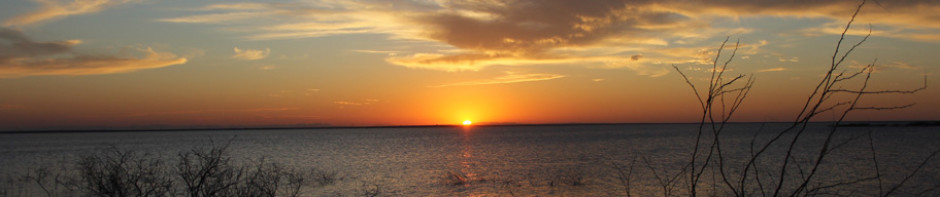
Sunset over Falcon Lake

We said goodbye this morning two our Oklahoma friends, Bud (87) and Charlotte (85) who we first met three years ago. Bud, a former trucker and mechanic, helped me with some big problems with the Airstream – and this time helped me (well, he did most of it) fix a faulty switch on a motor that raises the trailer tongue. Last night, we went over at dusk to talk and in the warm Texas evening, a number of couples came by to say goodbye. It was very poignant since with their age, you never know if they’ll be back. They are traveling home with some Vermont honey from our bees – and our hopes to see them again.

Being right on the Mexican border, there are some challenges. First of all, a Mexican phone company, TELCEL, grabs your signal much of the time and phones therefore are pretty unreliable. The radio stations are nearly all Spanish language and the few in English seem to be right-wing talk shows. It’s fifteen miles for decent wifi and 35 miles for decent groceries. Don’t even look for skim milk in a thirty mile radius; Chips and beer and fishing gear, yes.

And yet, this place grows on you. We are on the western edge of the Central Time Zone so it doesn’t get light until nearly 8 AM. Early morning walks with the dog are cool and filled with bird songs. Roadrunners and rabbits tease the Vizsla with their run, wait, run movements. Double-crested Cormorants fly over in large formations, heading for a day of fishing. Likewise, White Pelicans cruise out to Lake Falcon as we walk along. The breeze is almost always constant and picks up big time during the day.

Roadrunners drive our Vizsla nuts

Spring flowers have been popping everywhere and some of the ugliest plants have the prettiest flowers. Butterflies are everywhere but the wind makes it a challenge. Red Admirals come reliably to the orange halves we stick on trees.

Flower of a Thistle Plant

Prickly Pear Flowers

I had a chance to do some kayaking here although the wind kept the boat on the truck most days. The first morning I launched, a little Eared Grebe surface right in front of the kayak, dove and came back up alongside. I got pretty close to egrets, and Osprey, and other water birds. They seemed to not be afraid of the quiet boat — particularly with many bass boats roaring by.

We can’t get away from the drug war. Border Patrol vehicles cruise the park and and are common along the highways. A tethered observation ballon often flies to the north of here — sort of an ominous sight in a clear blue sky. But there have been no issues for several years here — even though Mexican drug activity goes on in Roma and Rio Grande City.

But as the Winter Texans like us leave, it’s hard to imagine living here. We’ve had a taste of the temperatures and the constant wind and one can see why siestas are popular. It’s deadly in mid-day. The decrepit homes, mongrel dogs, and trash get to you after a while.

But what a place for birds. I picked up nine new life birds and both Mary and I saw a wonderful array of Texas birds. Just on our little camp road we have Scaled Quail, Northern Bobwhites, Inca Doves, Northern Mockingbirds, Orange-crowned Warblers, Long-billed and Curved-bill Thrashers, Olive Sparrows, Chipping Sparrows, White-Crowned Sparrows, and the ubiquitous Turkey Vultures, Northern Cardinals, and Red-winged Blackbirds.

So, we are trading wind for mosquitoes and returning to another favorite place, Goose Island State Park where Penny has a vet appointment to check her progress and remove the last two stitches. It will be nice to kiss TELCEL goodbye. Never thought AT&T would look so good.

Birds of Falcon State Park

While the Texas drought has cut back the number of birds, there is still a wide variety here and down at Salineno. Here are some photos I’ve taken in the last week.
Altimira Oriole
Long-billed Thrasher across the street sounding like a Northern Mockingbird
Golden-fronted Woodpecker
Great Kiskadee
Green Jays are hard to beat for color and personality
Hooded Oriole

Birds of Falcon State Park

While the Texas drought has cut back the number of birds, there is still a wide variety here and down at Salineno. Here are some photos I’ve taken in the last week.

Altimira Oriole

Long-billed Thrasher across the street sounding like a Northern Mockingbird

Golden-fronted Woodpecker

Great Kiskadee

Green Jays are hard to beat for color and personality

Hooded Oriole

Finally — the Brown Jay

Since December, a Brown Jay has been regularly visiting the feeders at the Salenino, Texas bird sanctuary where Cheryl Longton and other volunteers continue a long tradition of taking care of the birds of the area.  The site is famous for the three orioles (Audobon’s, Altimira, and Hooded) as well as Green Jays and Greater Kiskadees.

So, as we planned our trip last winter, I watched the listserve and saw steady sightings of the Brown Jay, a Mexican bird that rarely strays north these days.   We were delayed at Goose Island for several weeks with our dog’s operation but the reports continued.

We arrived at Falcon State Park Thursday night and Friday morning, loaded up and made the short drive down to Salenino — to learn that the jay had not been seen there for three days.  The story of my birding life but not the end of the world — the orioles were there and it was a great to once again see the wonderful variety of birds there.

A large birding group from Austin came in and I learned from their tour leader that a Brown Jay had been seen just upriver at an old RV park at Chapena.  They were going up to check it out but we decided, since the dog’s foot was bothering her, to head back and try the following day.  (I read that night that all 14 of the group had seen the Jay at the RV park.)

So, Saturday morning, we drove the 15 minutes down to the park by the river.  It is pretty rundown and sort-of third world looking with stray dogs here and there, hand-lettered signs, a modest entrance fee, and no Brown Jay.  We did have a nice outing down by the Rio Grande and went back to Falcon figuring this quest was over … until I heard from a birding friend that the Jay had returned to Salenino.

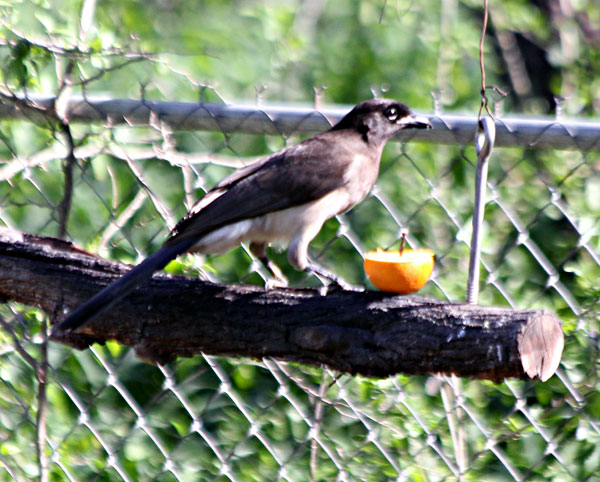
This morning, with modest expectations, we drove down to Salenino again and walking in, learned that the Brown Jay had come in about 8:30 but had left.  We sat around, watched Greater Kiskadees and Altimira Orioles along with all the other visitors when suddenly Cheryl said, “There he is, over by that feeder.”  Well, once it showed it was hard to miss — nearly the size of a crow and perched there, munching on an orange, to the accompaniment of camera shutters and birders oohing and aahing.  The Jay left after 10 minutes or so but likely was back later in the morning for some chicken leftovers put out for him.

We didn’t come to Falcon for this bird — we’ve been here three years in a row — however, it makes it nice to have a life bird so close (10 to 20 minutes away) and to finally get to see it.  Given the fact that Brown Jays, once fairly reliable here, have not been seen for a couple of years — and that this year there was only one steady one — make this feel like a solid lifer.

A Life Bird – Rufous Hummingbird

On a breezy Saturday morning, we took a birding walk in the shrubby woods here at Goose Island State Park starting off with a Red-shouldered Hawk perched in a tree right over our meeting spot. During the walk, We saw Yellow-rumped and Orange-crowned Warblers, seven or eight types of sparrows, four species of doves, and other winter birds. For me, the highlight was a young Rufous Hummingbird at one of the feeders.


Yesterday, I saw a Buff-bellied hummer (which I had on my life list) and today we also saw a hummer that some are trying to call a Costa’s – which would be quite a rarity. Some of us think it’s a young Ruby-throated but the bird walk leaders are taking our photos to a local hummer expert for an answer.

In any case, it’s wonderful to see hummers in early February. I love their flying, their colors, and their feistiness.

Shooting Birds – with a camera

One of the many photographic challenges, particularly when you have a Vizsla on leash in one hand, binoculars in the other, and a camera hanging from your neck, is to get a decent shot of flying birds. Here at Goose Island State Park, it’s sometimes easier since the vistas open up and many of the birds are larger and easier to find in the view finder. If there’s a stiff wind and you can catch them fighting it, they slow down for you.
So, with Penny “helping,” I have been shooting some of the birds we see on our outings, with varying success. It’s very much a work in progress and a $5k telephoto lens would help – but that’s not going to happen.

As a pilot, I like Brown Pelicans as much as any bird. Wonderful fliers, big targets, and they always look like they are having fun.

Not a good shot of a Northern Harrier but it does show the white body marking that, along with their low-flying hunting, makes them easy to ID.


An Osprey who got away while I grabbed for the camera


A couple of Roseate Spoonbills we saw yesterday. Their breeding plumage will start soon but they pretty neat right now.


The ubiquitous Turkey Vulture with its pronounced dihedral. They are everywhere in Texas.


White Ibis with the black wingtips – hard to miss.

So, tomorrow the sun should be out with better lighting possibilities. We’ll see how it goes – good thing it’s easy to trash digital prints. Practice does help.

Birds of Goose Island State Park

Goose Island State Park in Rockport, Texas is a great birding spot – even in a drought year like the present one. Between shorebirds and woods birds, there’s a great diversity of species and some years (although not this one) a rarity or two. Here are some captures of a few of the interesting feathered friends I’ve encountered in the last week.


A Buff-bellied Hummingbird


Laughing Gulls


Orange-crowned Warbler


Ruddy Turnstone


Spotted Towhee


Turkey Vultures


White-crowned Sparrow


Willet

Whooping Crane Winter Refuge Threatened

One of our favorite birding spots is the Gulf Coast region of Texas – we have visited there the last two winters. The long drought has not only parched crops and resulted in horrific wildfires, it as also threatened the winter habitat of the endangered Whooping Crane. It’s a classic western water rights fight with big oil on one side and environmentalists on the other.


From the species’ nadir of 16 adults in the early 1940s, the crane flock that annually migrates between Texas and Northwest Canada rebounded to a high of 270 in 2008. Then came the searing drought of last year, and the Guadalupe River that supplies vital freshwater flow to the cranes’ Aransas nesting grounds fell precipitously. With blue crabs and other marsh food in short supply because of high salinity levels, the crane population was weakened by malnutrition. Fifty-seven birds, nearly a quarter of the flock, died in 2008-09, 23 of them in Texas.

Due to Texas’ historic drought, the Guadalupe’s flow is down by more than 60 percent at Victoria, roughly 20 miles upstream from the Aransas National Wildlife Refuge, the cranes’ winter range. In September the refuge’s marshes were three times saltier than normal. The birds migrate from Canada each year to spend the winter feeding on crabs and berries along the Texas coast. The U.S. Fish and Wildlife Service counted 571 wild and captive whooping cranes in July 2010. The Aransas group makes up half that number and is the world’s last migrating flock that can sustain itself in the wild. The coastline from just east of the cranes’ refuge to the Louisiana border bristles with the world’s largest concentration of petrochemical and refining complexes, many of which rely on river water.

The Aransas Project, a conservation group, is pointing an accusing legal finger at the Texas Commission on Environmental Quality, which grants permits for commercial usage of river water. The group filed a federal lawsuit earlier this month charging that the agency is violating the federal Endangered Species Act by allowing the diversion of too much water from the Guadalupe and San Antonio rivers that flow into the crane refuge. It seeks an injunction to stop TCEQ from approving water rights permits until a court oversees a habitat conservation plan for the cranes.

An association including owners of five petrochemical plants near the refuge, including Dow, DuPont (DD) and Lyondell Basell (LYB), several power plants, and a nearby steel mill, have sided with TCEQ to defend the allocation system, while some coastal towns and businesses that rely on healthy bays and estuaries support the environmentalists. A TCEQ spokesman disputed the charge, saying the effect of lowered water flows on the crane habitat “is far from certain.”

This is not a simple conflict between birds and big oil. There are residents upstream who need drinking water, and there are fishermen downstream whose livelihoods depend on healthy estuaries. Ecotourism provides an additional economic incentive to maintain the estuaries. The endangered status of the Whooping Cranes may be the legal tool used to save the marshes, but if the suit succeeds, they are unlikely to be the only beneficiaries of a change in water rights.

It’s obvious that the birds and their wetlands food chain depend on fresh water to survive. It would be a tragedy if the effort to save the whooping crane flock dried up along with the life-sustaining flow of Lone Star waterways.

Texas Century Club

Last winter, while on a bird walk in Falcon State Park in Texas, I met a guy who was participating in the Texas Century Club, where birders try to identify 100 birds in 100 Texas counties.  He was well underway, having done it for several years, and had a long “tick list” of species he was looking for.  The park sits astraddle two counties, Starr and Zapata, and at one point on the walk, we saw a bird he needed for one county, but not the other — and we were just inside the wrong county.  Lots of comments about flushing it and herding it a few hundred yards to the north.

Later that day, I ran into him again at a farm pond where waterfowl congregate and we talked more about the club.  Like any competition, there are serious competitors and other who just do it when they are birding — he struck me as kind of in the middle.  It was an interesting look into a group about which I knew nothing.

Texas is big (254 counties) and most birders probably spend the majority of their time in less than 20 Texas counties. This is just under 8% of Texas counties! It also has lots of birds — one lister has 401 species seen in El Paso county alone. 

The Texas Century Club is a challenge established in 2003 by the Texas Ornithological Society to encourage its members to record 100 species of birds in 100 Texas counties.  The idea is to get birders to record the birds in more than the traditional hot spots. To “bird your own patch.”  To explore the road less traveled.  So far, one birder, Anthony Hewetson of Lubbock has logged 100 birds in 100 counties.

There are several levels of award; 5, 10, 25, 50 and 75 counties before you reach the ultimate goal of 100 species in 100 counties. The five county award level is open to all birders. The higher levels of awards are open only to Texas Ornithological Society Members.

Do other states have activities like this?  I know that in Vermont, we are competing amongst counties to see which of the 14 counties list the most species in 2011.  Who else has something going like this?

Rockport Beach Park

Rockport, Texas has many great birding areas and one always cited is the Beach Park.  It’s  long sandy beach with lots of grassy picnic areas.  It also is the protected nesting site of hundreds of Black Skimmers — that graceful bird known for flying low over the water, lower mandible skimming for small fish and other goodies. 

Black Skimmers on the go

I’ve not been to the park since dogs are not allowed and every time I’m in Rockport, I have Penny with me.  Today, I brought my bike and left the dog in the truck and pedaled in for a little birding.  Hundreds of Laughing Gulls filled the air with their raucous calls as I passed by and up ahead, I saw a gaggle of Black Skimmers circling and landing.  There’s a nice observation area near the roped-off nesting site and I took a bunch of photos of the birds whirling by.  It was quite a spectacle.

They’ll start nesting next month and I’m sure it is quite a sight to see the chicks and their parents up close.  Perhaps next year we’ll stick around a little later.

Laughing Gulls

I saw a Long-Billed Curlew, a Pied-Bill Grebe, a Willet, a bunch of American Avocets, Herring/Laughing/Ringed-Billed Gulls, and a number of other birds during the short bike ride.  It’s a place I will get back to another time.

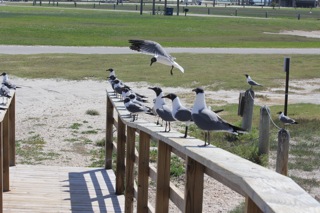
The Laughing Gulls, now in their plumage, just are characters.  Here’s a lineup from the walkway to the observation platform.  They laugh — and tend to make you chuckle as you see and hear them.