Category Archives: Texas birding

Yellow-faced Grassquit: Yes!

Yellow-faced Grassquit

A rare tropical bird, a Yellow-faced Grassquit, showed up at Goose Island State Park about a week after we left in January. For a month now, I have read posts of sightings of him – hundreds of birders have come to see him and he’s been very cooperative.

I thought that it would be a one-time chance to see him so we decided to return to the park for a week. It’s also a place we love and a good spot to celebrate my birthday. So we drove the short distance down from Goliad this morning.

While driving in to look at the few vacant sites, we drove by the spot where he’s been seen. Probably 25 birders were there, binoculars up and looking – and it was hard not to just stop the truck and trailer and join in.

We signed for a nice spot, got unhitched and set up and it was time to exercise the dog – which I did by bike. We rode past the spot but the few folks there had seen nothing since the morning. So, figuring we had all week, I had lunch and a little rest.

Mary suggested I go back and so I did. There were some women down from Houston and a guy who flew in for the weekend from Oregon. We waited and watched a few sparrows. The women decided to leave and I was about to when the Oregon guy – who is quite skilled as a birder – saw it fly into the brush and yelled “bird.” That got the gals hustling back and sure enough, the little rascal was just perched in the shade. You could see him but when the Oregonian got his scope, the bird was spectacular.

The Grassquit breeds from central Mexico to northern Ecuador and northwestern Venezuela, and also on the Greater Antilles and nearby islands (e.g. the Cayman Islands, and Jamaica). It is not a migratory bird but moves about outside the breeding season. It’s neat to think how far from home he is – and what an extremely rare sighting for the U.S.  Glad we came back here.

I’m sure I’ll get to see the guy a few times more and get some photos. The one above is from the web – but is just like the guy I saw this afternoon.
Rio Grande Turkeys

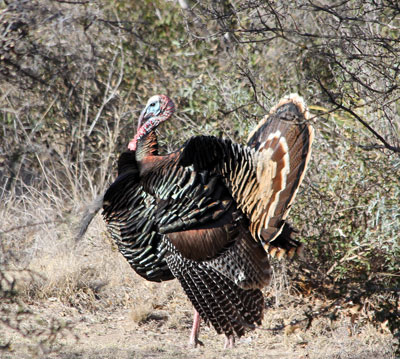
As I was sitting behind the Airstream reading on our last evening in South Llano River State Park, the dog stirred and became interested in something behind me.  It was a “parade” of about 25 Rio Grande turkeys strolling down the park road enroute to their roosting spots along the river.  They are pretty birds — a little smaller than our eastern turkeys but seemingly longer and taller.  It is pale and copper-colored having tail feathers and tail/rump coverts (short feathers located at the base of the tail) tipped with a yellowish buff.
South Llano River SP is home to one of the most significant Rio Grande turkey roosts in Central Texas.  About 800 turkeys roost every year at the park and their grounds are marked off until April.
 
The Rio Grande wild turkey is native to the semi-arid areas of the southern Great Plains states: Texas, Oklahoma, Kansas and Northeastern Mexico. It received its common name from the Rio Grande River, which is the water supply bordering the brushy scrub, arid country of some of its prime range in western Texas and northeastern Mexico. This race of turkeys generally occurs in areas having 16 to 32 inches of rainfall.
 
This subspecies was first described by George B. Sennett in 1879 who said it was intermediate in appearance between the eastern and western subspecies, hence its scientific name, Meleagris Gallapavo Intermedia.
Rio Grande Turkey strutting its stuff
Originally existing in the millions, this turkey had depleted to extremely low numbers by 1920. Formal programs involving trapping and transplanting were initiated in the 1930’s and today it exists over much of its ancestral range. Texas has the most Rio Grandes with a population estimated at over 600,000 birds.
One of the neat things camping at South Llano River is to hear the turkeys call to one another in the early evening — and then again in the morning.  And then to see them parade from their roosts, sometimes displaying as in the photo I took the other day.

Please visit our Airstreaming blog

My New Favorite Bird

As we have progressed through the South and Southwest with our Airstream, I have made favorites of several species of birds I’ve seen.  The last one was the Cactus Wren.  I never saw one (knowingly) last year and once I spotted one in Falcon State Park, I knew what size they were, where to look, and what to listen for.  And then, I ran into them all the time.  In fact, one was singing to us as we packed to leave our last campground.

Towhees have been birds I’ve been looking for.  I found one, then dozens, of Canyon Towhees at Davis Mountains State Park.  They are a bit bland but neat birds.

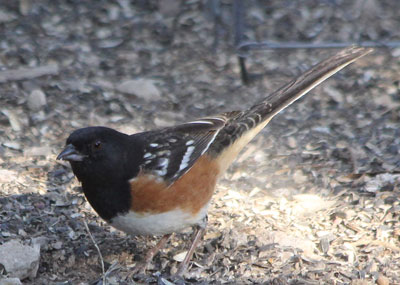
Spotted Towhee

But the Spotted Towhee has me enamored these days.  I saw my first one at a feeder here at South Llano River State Park and now see them each day.  They are beautiful and there agressive scratching the ground for food is fun to watch.  They hop and attack their food — feathers puff, dirt flies.  They’ve got a lot of spunk.

So, until I find a new favorite, the pretty Spotted Towhees are my pick of the week.

Water

One of the tricks that western birders seem to know is that if you can find water, you can usually find birds.  That’s been the case for me the last week or so.  At Big Bend, we stopped at an old ranch site where a dilapidated windmill, clanking away, delivered a little water in drips but attracted some interesting birds including a Green-tailed Towhee.

Here at Davis Mountain State Park, where I have seen a number of life birds including the Montezuma Quail, they have water at all feeding stations.  I put out a water drip at our campsite and regularly attract Canyon Towhees, Black-crested Titmice, White-winged Doves, Cactus Wrens, and a host of different types of sparrows.

Not far from here is a dry creek which has a little “seep” — a wet spot under some clumps of bushes.  It’s about a quarter-mile hike up the creek bed and as you get there, the birds all fly off but ten minutes later, you can see dozens of birds.  I was particularly looking for the Black-chinned Sparrow which I saw.  (It’s a little drab this time of year — mostly grey — but it’s Black-throated cousin — also there — is starting to show breeding plumage.)  Here’s my list from yesterday morning for about 30 minutes of watching and photographing:

Black-chinned Sparrow
Black-throated Sparrow
White-winged Dove
Black-crested Titmouse
Ruby-crowned Kinglet
Pyrrhuloxia
Cactus Wren
Chipping Sparrow
Western Scrub-Jay
Canyon Towhee
Phainopepla
Lark Sparrow
Vesper Sparrow
Northern Mockingbird
Rufous-crowned Sparrow

Here are a few photos I took at the “seep:”

A Black-chinned Sparrow in non-breeding plumage

I love the Black-crested Titmouse

A pair of Cactus Wrens

Life Birds on this trip

To date, I have added 35 birds to my list and missed a number of others.  All except one were in Texas.  I haven’t gone out of the way for any rarities but just logged stuff I’ve seen.  It’s an interesting way to recall the birding along the way — eBird does it electronically.

Altimira Oriole

Big Bend Adventures

As Big Bend State Park visitors know, it’s about 70 miles of desolation from Marathon down to the park headquarters, and then another 20 miles of desert to the Rio Grande Village campground. But what amazing vistas as you head south — just breathtaking. Photos don’t do the landscape justice. Geological features – incredible formations – give a real sense of the millions of years of history that precedes us.

Yesterday’s high was 96 degrees and we arrived, hot and dusty, and set up. There’s no air conditioning (no power or water) but we were doing fine — until I learned that I had set up on a site already reserved by someone else. So, it was stow things, hitch up once again, and move about 100 yards up the road to another site. I wasn’t a happy camper and Mary was overheated from the heat and dryness. Great start — Big Bend.

Once things cooled down, it was a lovely evening. It went down to 44 this morning and we ran the heater for a bit while having morning coffee. I found out that the little store here has WiFi (you can forget AT&T coverage for cell phones) so we could get email and post stuff. Still, with no electricity, battery usage for the computers needs to be monitored as well.

I took a little hike this morning on a short trail and saw a few birds, the Rio Grande, some cool rock formations, the Rio Grande, and Mexico. Above is an early morning shot of the campground and the scenery.

They warned us about wildlife here — particularly coyotes. Well, as we were leaving this morning to do some sightseeing in the truck, what should wander right in front of us, in the middle of the campground, by Mr. (or Ms.) Coyote. Took the picture through the windshield.


We drove up to the Chisos Basin which is just about impossible to describe. It’s high elevation for down here and has some spectacular mountains and vistas. I’ll get some shots next visit — we just took a “I’ve Been There” shot at the visitor center.

We have hung out reading this afternoon underneath the trailer’s awning. It’s about 88 degrees but there’s a nice breeze. I had Penny’s leash anchored by my chair leg. I left to fix a couple of seltzer drinks and from inside the trailer heard a bark, a yell from Mary, and a upsetting of the lawn chair. Mr. Coyote (or a sibling) had just crossed our road about 25 feet away and Penny was in attack mode. Fortunately, the leash got caught — or she got smart — and I grabbed her and all was well again — once Mary’s heart rate settled down.

This is a tough place from noon to five or so — you can see why siestas so popular in the Southwest. After May, things essentially close down here due to the extreme temperatures. However, we saw scenery today that just blows you away. Now, to keep the coyotes, mountain lions, and javelinas where they belong.

P.S. On guidebook we have, in talking how park animals have gotten too used to human foods, said that the crinkling of a potato chip bag opening can draw javelinas. I knew junk food was not good for you.

Heading Westward

Last year, we stayed here at Falcon State Park for some time and then, because of issues with trailer lights, decided to forego going out to Big Bend National Park. This year, figuring we are this far and may not get here again, we are pressing onward in a few days. We’ll go to Amisted National Wildlife Area (Del Rio), stay a couple of days at Seminole Canyon, and then hit Big Bend.

The stay at Falcon has been great. The weather has finally warmed into the 70’s and we have enjoyed the birding and the campers. This is quite unique – many folks come here for a month or more – and have done so for years. There is a very active recreation center with many social and education activities. Neither Mary nor I am big on sitting around talking about whatever, but we have gotten to know some of the regulars. We went to a Valentine’s ice cream social/ Yankee swap (they had some other name for it), and actually danced a little. The kids think we’re losing it.

A highlight of this stay is the puma I saw the other morning while walking the dog – the big cat was just sauntering across the road. I had binoculars but no camera with me.

The night sky here is amazing. There is no air traffic at all – which is too remindfull of the post-9/11 days. We get nothing but Mexican TV and radio but keep current with our iPhones. The campground is very quiet – all I can hear as I write is a coyote. Sounds like a young one trying out his voice. Penny gives a little growl just to let us know she’s on top of things.

So we’ve got some laundry and camper stuff (propane, parts, etc) to do before launching Wednesday morning. Got a couple of birds I’m looking for as well so Penny and I will be out looking for the Say’s Phoebe that’s supposedly here. Weather up ahead looks great so Wagon’s Ho!

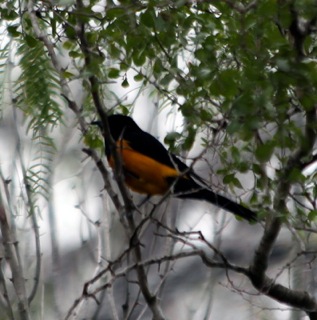
Black-vented Oriole

Black-vented Oriole
Mary and I took a drive down to Bentsen Rio Grande State Park to do a little birding today. It’s about an hour and half drive – no big deal for Texas – and the park has a great reputation for special birds. However, Hurricane Alex hit the Rio Grande River hard (as we have seen here at Falcon) and the high water decimated Bentsen. Many areas are still not open and the habitat is slowly recovering.

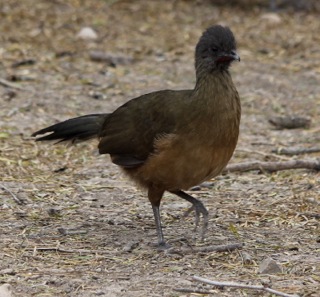
Plain Chachalaca

We took a cold walk spotting the standard warblers and gnat-catchers, Green Jays, and woodpeckers and were a bit discouraged — but still enjoying some nice looks at birds.  Mary headed back up to to the center to warm up and I went on a bit to a river outlook, hoping to see an Anhinga.  Which I did — three of them in fact.  They were too far away to photograph but they were a new bird on my life list — one that I’ve just missed at other places.

There has been a rather rare bird – a Black-vented Oriole – hanging around the RV park next door for several weeks.  It’s been chased by many birders but I hadn’t heard much about it in the last few days and hadn’t planned to try to see it.  (Our time was limited with the dog waiting in the car.)  As I came back, I saw a guy with a big lens sitting on a bench, looking into the woods so I asked him what he was seeing.  “The oriole is up there,” he reported — and soon had a neighbor on the bench.  We watched the bird move through the foliage, never really coming into the open, but giving us some nice looks anyways.  I shot some pictures, more for the record than for high quality, and was thrilled to nail this lovely bird who normally is in Mexico or Central America.  It’s survived a number of below-freezing nights recently and looked no worse of wear.

At the same time, a noisy gang of Plain Chachalacas strode up to the feeders. These turkey-sized birds are hard to miss but this was my first time seeing them — so they became lifelist bird 3 for the day.

I returned to find Mary and she reported that she had seen the Clay-colored Thrush up by the feeders.  I knew that bird was often seen at Bentsen but probably walked right by it.  So I back-tracked, waited just a few minutes, and Bingo — one showed up at the feeder.  Bird 4 for the day.

Clay-colored Thrush

We don’t go crazy chasing birds but it’s fun to see new stuff and add them to the list.  I’ve got a few sparrows and hawks I’d like to see here at Falcon before we leave next week but I won’t lose any sleep if I don’t.  Just watching the Caracaras and Ospreys fly in the high winds of the last few days has been a treat – as was seeing a couple of special birds today. 

Avian Eye Candy

Yesterday morning, Mary and I drove down to Salineno, a small refuge on the Rio Grande about 20 minutes from here. Cheryl, the host, has many feeders and attracts a wonderful variety of South Texas birds. When we went there last year for the first time, it was visual overkill — just so many different birds that we never see up north. It reminded me of my first time snorkeling — there is almost too much color and movement for your senses to process.

Today was no exception. When we first got there, a “sharpie” had just passed by scattering the birds so it took a few minutes for the orioles and jays to start returning. We sat in lawn chairs watching Green Jays, three types of Orioles (Altimira, Hooded, and Audubon), Greater Kiskadees, and a host of other species flock to the peanut butter and loose bird food. Here are a few of the shots I took. Enjoy — we certainly did.

Altimira Oriole

Long-billed Thrasher eats while Green Jay waits impatiently

Golden-fronted Woodpecker

Audubon Oriole at feeder

Green Jay with a mouthful of crunchy peanut butter

Greater Kiskadee

Visit our Airstreaming Blog

Nature Encounters at Falcon


The first afternoon at Falcon State Park, I was reading in the shade (it was 85 degrees) with Penny lying next to me. Suddenly, she exploded into barking and lunging on her leash, startling me. I looked at across the road and a mama wild pig and six piglets were trotting through the underbrush, driving our Vizsla nuts.

We’ve seen feral pigs down here before and seen the amazing damage they cause with their rooting and trampling. They are a major nuisance in much of Texas and some, with their nasty tusks, are pretty mean-looking critters.

The first night here, the coyotes started yowling just after dark — that eerie sound that make you glad you’re not sleeping out in the open.

This park is looped with nature trails that provide a wide variety of flora and fauna. You never quite know what you are going to meet around the corner. We’ve seen a number of rabbits that drive her crazy — forcing me to put a harness on her instead of just a collar.

Yesterday, after spotting several deer, we came upon a roadrunner who, in “beep-beep” fashion, kept running up ahead to where the trail turned, waiting and running again. Penny was going nuts and I was trying to hold her, and the camera — this going on for a bit. I dropped the leash and stepped on it while taking the photo, but must have missed it for Penny was off like a flash, as was the roadrunner. I’m sure it flew for she came back shortly, panting, and we continued our walk.

Last night, we took a walk late on the roads and it was black. I had a small flashlight but remembered, about half way around the loop, of the pictures of puma-like cat that has been spotted around here recently. I thought, if I see two glowing eyes up ahead, I’m out of here. The walk turned out to be uneventful although the night sky was spectacular.

Today, we rounded a bend on the trail and came upon an armadillo. Penny saw one in Louisiana last year but this one was right in front of her, waddling away. She lunged as I shot the picture but never got loose.
Tonight, she is “hunting” inside the Airstream — fixated at an opening under the stove where I suspect a mouse is residing. It may have ridden from Vermont or joined up here in Texas. If it reads the forecast for the weather ahead (nothing like the north or northeast but still below freezing), it is looking for a warm abode.

The other “nature” factor here is the small thorns that are everywhere you walk. I usually ride the bike so that Penny can run on the greenery beside the road. I noticed that she stopped running and was limping and checked her pads, finding many of the little thorns. They hurt just brushing them off. I’ve been wearing sandals and they wedge into the space beneath my feet, and smart. It’s just part of the exercising in the Southwest.

Visit my birding blog