Electrical System Issues

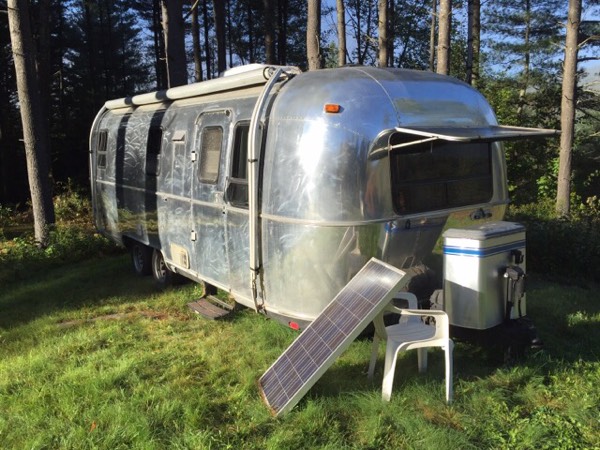
We seldom spend much time “boondocking” with the Airstream and one reason is that we just have one battery. Over the years, we have taken some steps to improve our sustainability: we carry an 80w solar panel and have a small Honda generator, which we use mainly in the Northeast where trees and cloud cover often make solar problematic. Since the propane furnace is such an energy hog, I installed a catalytic heater which Penny certainly enjoys, since it is at her end of the trailer. I have also switched out most of our lights to LEDs and fixed a battery-draining function in our new refrigerator.

One of the reasons I have not moved ahead is that our battery area, on the tongue of the unit, only has room for a Type 27 battery. We’ve used Costco deep cell batteries which are reasonable but we only have room for one without major work to the frame and added tongue weight. So I have been looking at putting one or more batteries inside the Airstream so it requires pricey AGM units and a new controller — to replace the single-stage one that is now nearly old enough to vote.

So, the project began with exploration: removing the couch to get a better look at the electrical system.
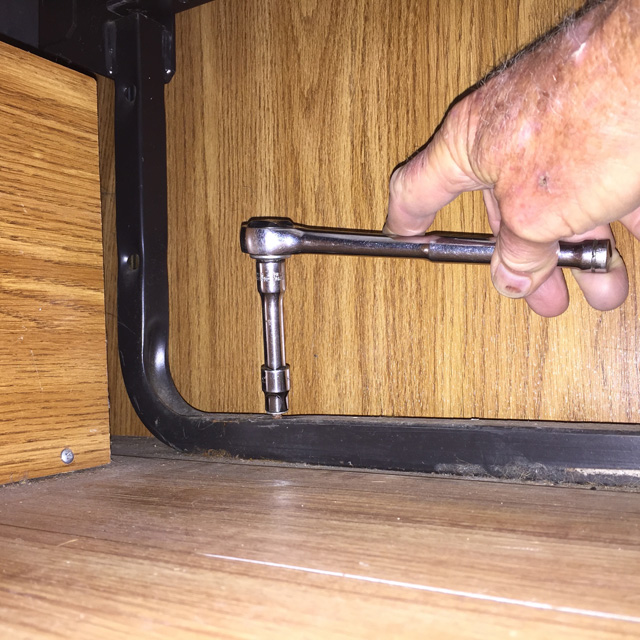
It helps to have long arms when crawling under the couch to remove screws.
It helps to have long arms when crawling under the couch to remove screws.

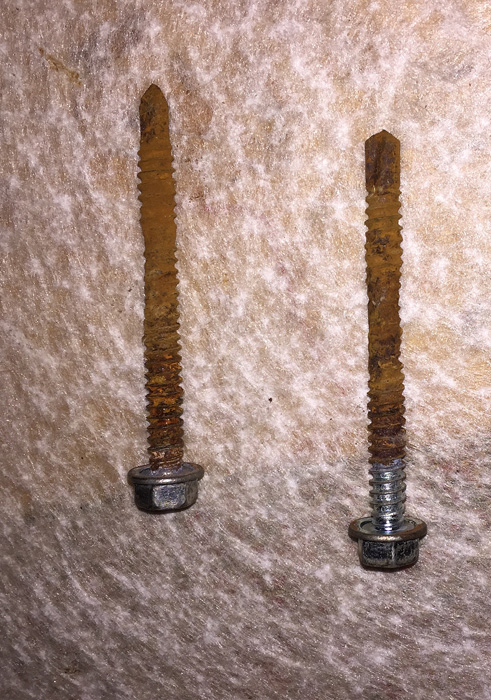
These came out hard - it's time for stainless steel replacements.

These came out hard – it’s time for stainless steel replacements.

Once the couch was pulled out, the jumble of wires, insulation, and mouse droppings made cleanup task number one. Task two was to open it up more and try to figure out which wires were the ones I might need to move.
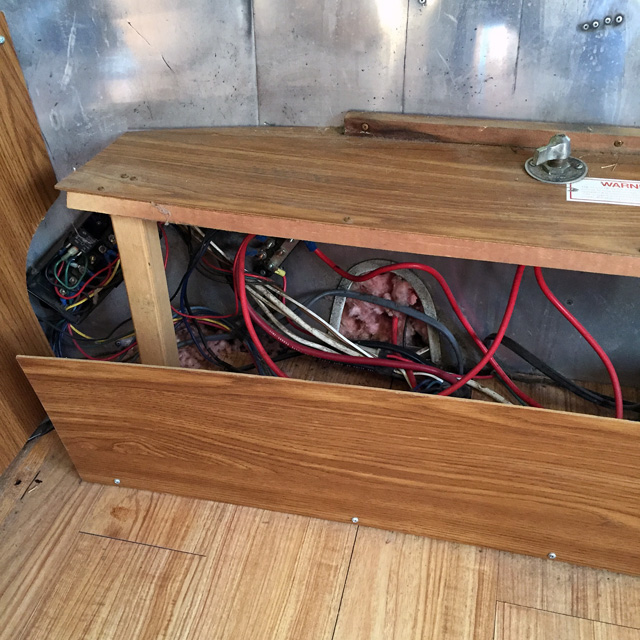
Lots of wires there - wonder where they all go?

Lots of wires there – wonder where they all go?
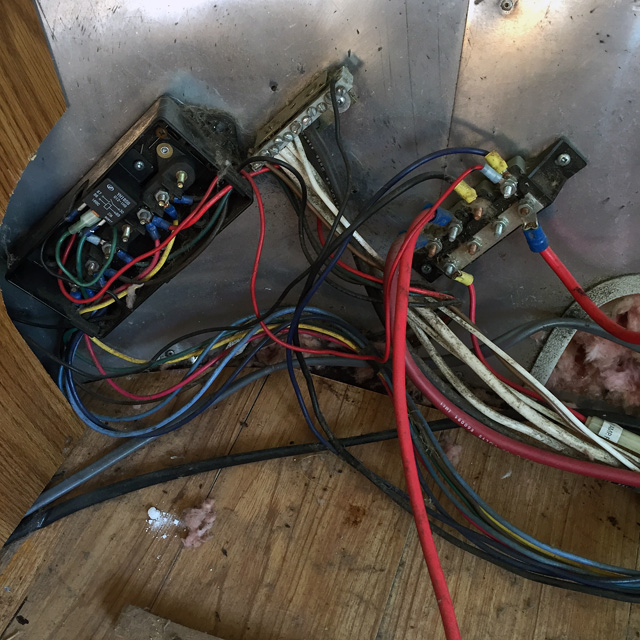
A closer look allowed me to identify the major wires to the battery.

A closer look allowed me to identify the major wires to the battery.

One of the issues to deal with if I’m planning to install new sealed (expensive) batteries is to upgrade the converter to a multi-stage unit which will charge but later on, float to keep from cooking the batteries.
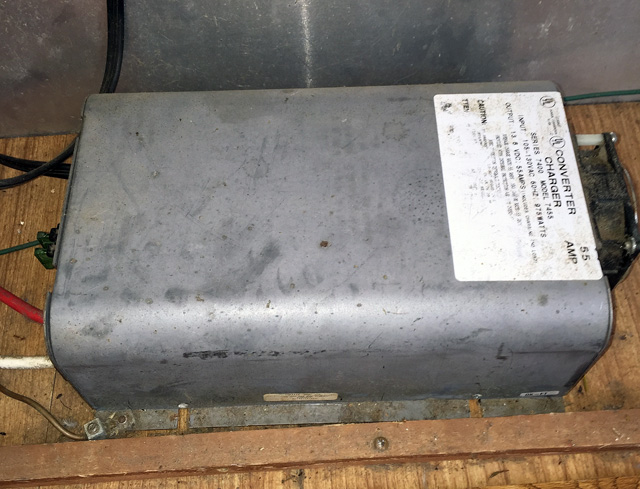
This converter which takes 110 v and changes it to 12 v has had a good run. Should be easy to replace.

This converter which takes 110 v and changes it to 12 v has had a good run. Should be easy to replace.

The next steps: first go down to Vintage Trailer Supply and talk to them about a new converter — and probably buy a 60 amp unit.  I also need to get some replacement battery connectors because I’ll remove the existing ones in order to snake the two battery lines into the Airstream. I’ll also pull in the lines for the solar controller and the tongue jack.

I plan to replace the converter and temporarily install my battery inside and test out the charging system through the new converter and then the solar setup.

Then I will finish my research on AGM batteries and take a deep breath and order a couple. They are costly but should be good for some time and also provide the staying power we need while camping away from hookups. Stay tuned.
A Jaunt to Chickering Bog

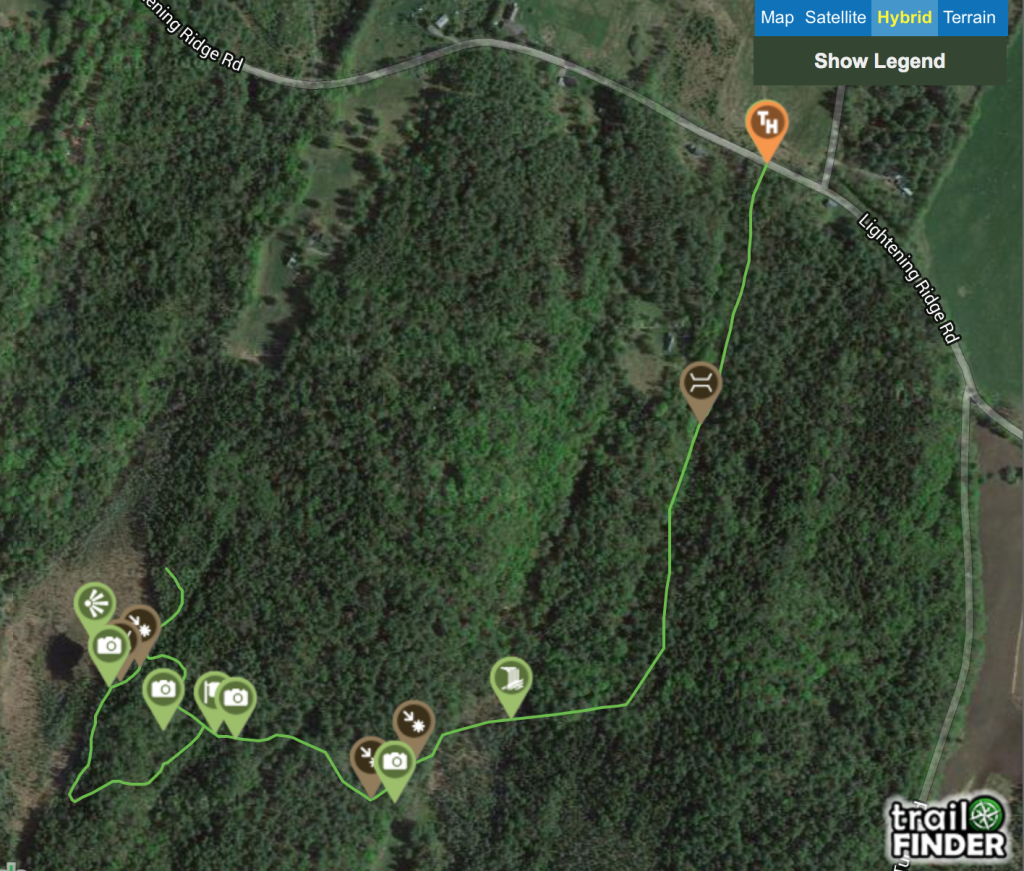
After a hospital lab visit and some errands yesterday morning, I decided to visit a local area where I have never birded: Chickering Bog Natural Area located on the border of Calais and East Montpelier. It’s not too hard to find: see the directions at the end of this article.

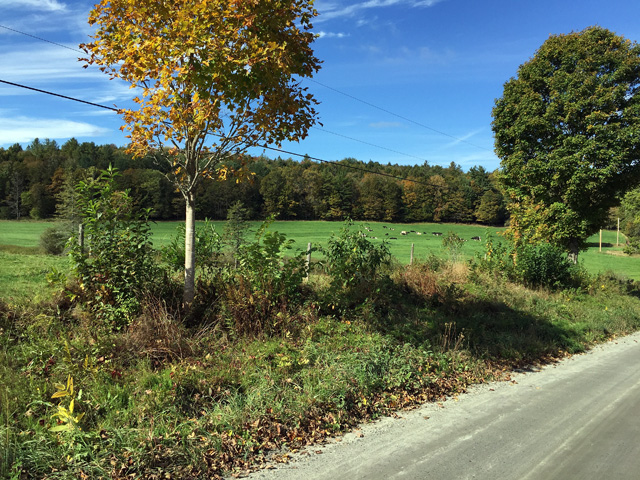
The scenery along Lightning Ridge Road is lovely.

The scenery along Lightning Ridge Road is lovely.

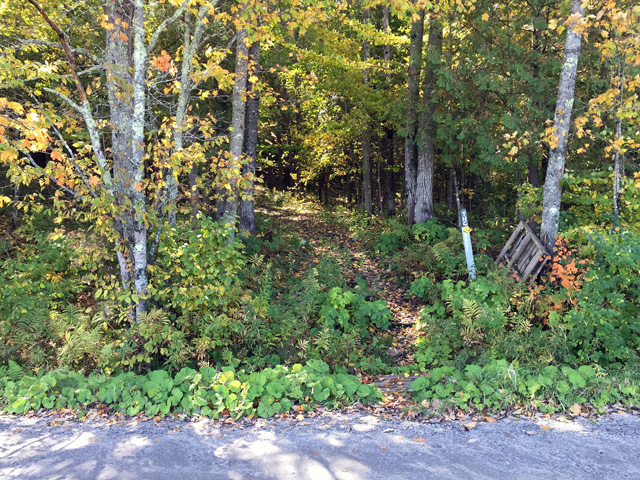
You have to look carefully for the entrance trail – I have missed it in the past.

You have to look carefully for the entrance trail – I have missed it in the past.

The trail is on private land at the start and also follows a snowmobile track. It's easy walking with some debris from falling trees.

The trail is on private land at the start and also follows a snowmobile track. It’s easy walking with some debris from falling trees.

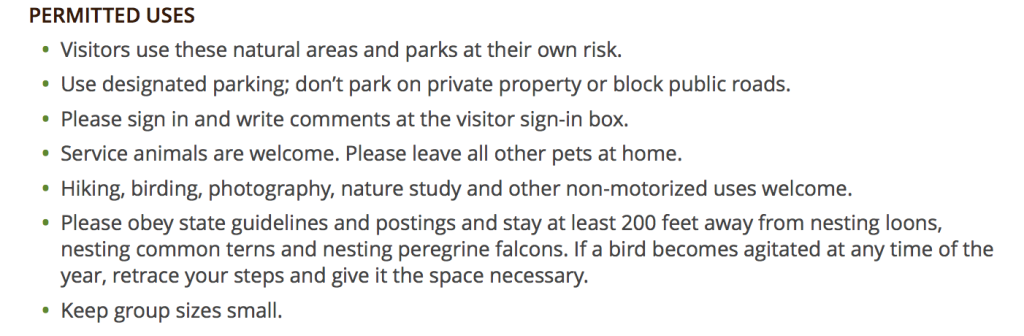
A friend reading this post wrote me to let me know that pets are not permitted on Conservancy sites — she had read the guidelines (which I had not) so Penny was a scofflaw. I must say that I don’t buy the policy at all – a least they could require leashes. In any case,so that you don’t make the same mistake, here are the guidelines:

Screen Shot 2015-10-08 at 7.08.34 PM

Penny loved the woods and cavorted, as best as an eleven-year-old Vizsla can, as we moved up the trail. Bird activity was light with an inquisitive Downy Woodpecker following us chirping away. We flushed two Ruffed Grouse which always gets the bird dog excited.

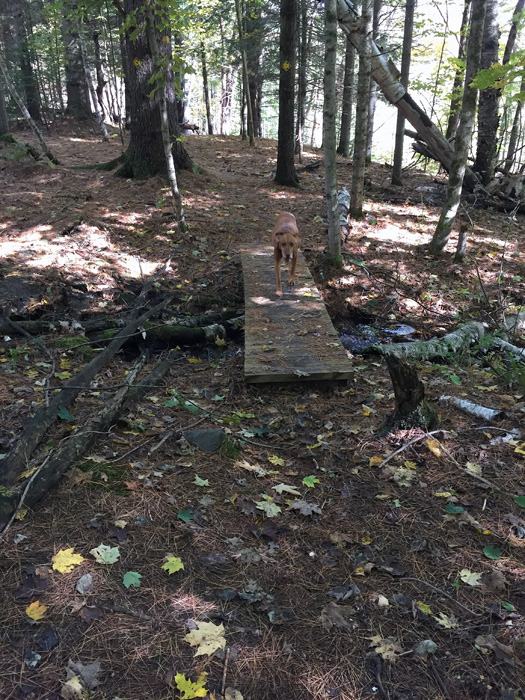
The trail's wet spots are well-covered with planking. Here Penny is crossing a tiny brook.

The trail’s wet spots are well-covered with planking. Here Penny is crossing a tiny brook.

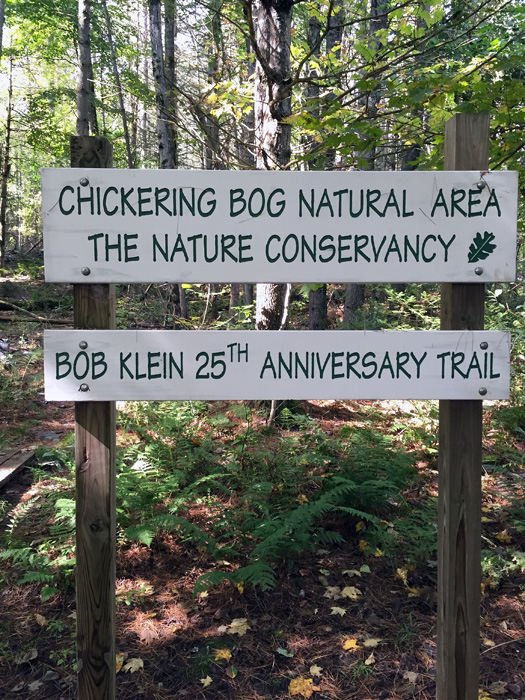
After fifteen or twenty minutes, we entered the Natural Area which is managed by The Nature Conservancy.

Sign

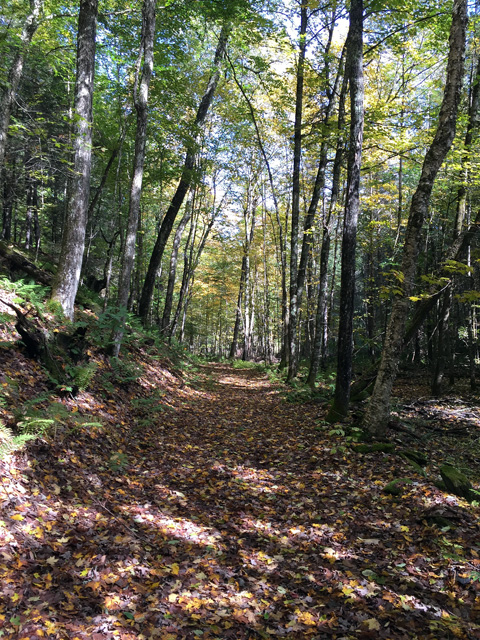
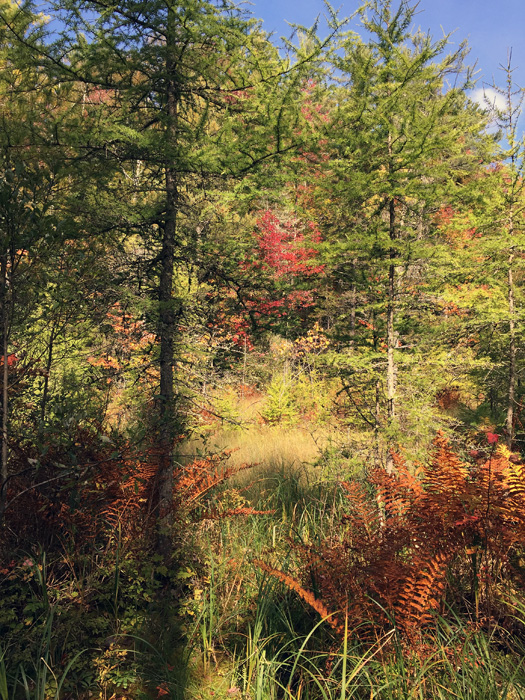
The foliage is starting to turn and there were some pretty spots along the route.

TrailfoliageW

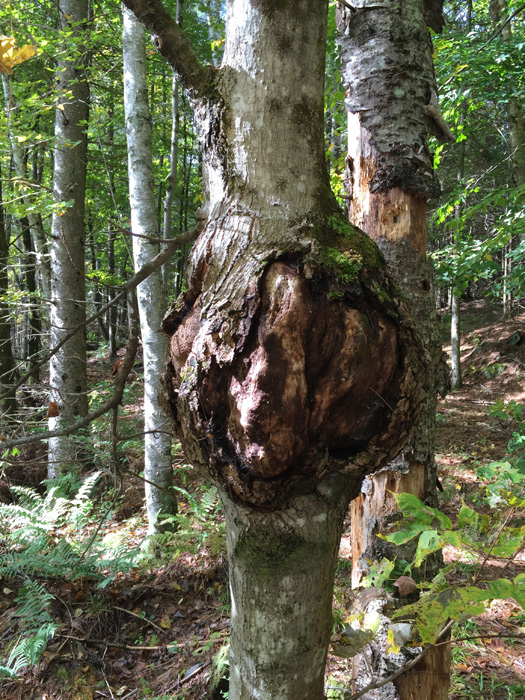
This tree alongside the trail has a problem. I always wonder what caused the blemish to form.

This tree alongside the trail has a problem. I always wonder what caused the blemish to form.

After a little over a half hour (it’s about a mile), we arrived at the bog and went out on the boardwalk looking for wildlife.

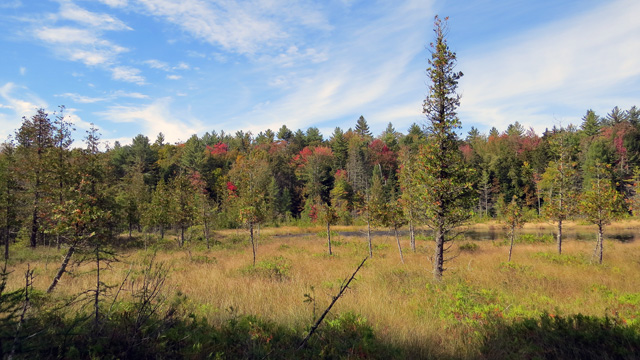
The bog was beautiful with fall colors starting, no bugs, no noise, no people - just a guy and a dog.

The bog was beautiful with fall colors starting, no bugs, no noise, no people – just a guy and a dog.

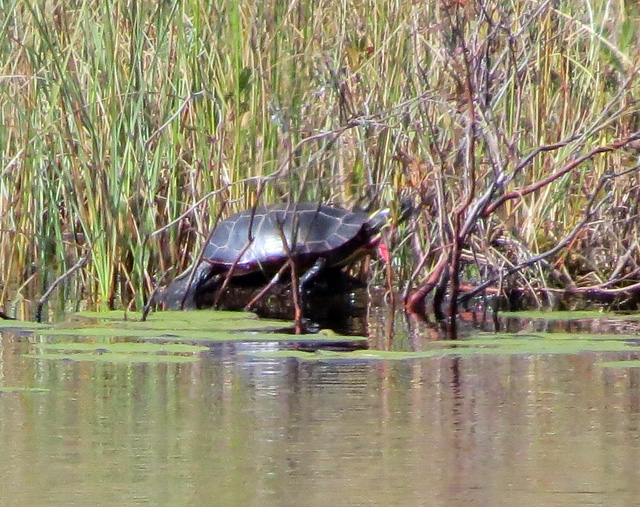
The only wildlife that I saw at the bog was this big turtle on the far edge of the open water.

The only wildlife that I saw at the bog was this big turtle on the far edge of the open water.

From The Nature Conservancy page:

Chickering Bog began to form when glaciers receded from Vermont over 10,000 years ago and left behind a bedrock basin that filled with water. The pond that was formed slowly filled in with vegetation. As these plants died, they accumulated and only partially decomposed, forming a layer of peat that has continued to thicken over the years, reaching an impressive 30 feet deep in the northern part of Chickering Bog. It is the peat that gives the area its semi-solid, “quaking” quality. A small patch of open water is all that remains of the original pond.

Chickering Bog is actually misnamed; this so-called bog is really a fen. The difference between the two wetland types has to do with the water source and the acidity of the site. Bogs tend to be acidic and poor in dissolved minerals; fens are more alkaline and rich in dissolved minerals. Water enters bogs solely through rainwater, while fens like Chickering Bog are also fed by calcium-rich groundwater and springs.

Screen Shot 2015-10-01 at 8.24.47 PMTo get there from Montpelier, take Route 2 east 6.5 miles to East Montpelier. Then take Route 14 north about 3.2 miles to North Montpelier where you will see North Montpelier Pond on your right. Continue on Route 14 for 1.1 miles until you see Lightening Ridge Road on the left, which is marked by a sign for the Calais Elementary School. Turn left and go 1.6 miles to George Road on the right. Park on Lightening Ridge Road on the right a little past George Road. The Conservancy trail begins to the left of the private driveway. You have to look hard, but there is a green post with the initials “TNC.” A snowmobile trail starts here and goes up the hill to the entrance of the natural area and the trail to Chickering Bog. Look carefully for the sign that marks the Conservancy’s Chickering Bog trail after crossing a wetland on the snowmobile trail.

West River Railroad

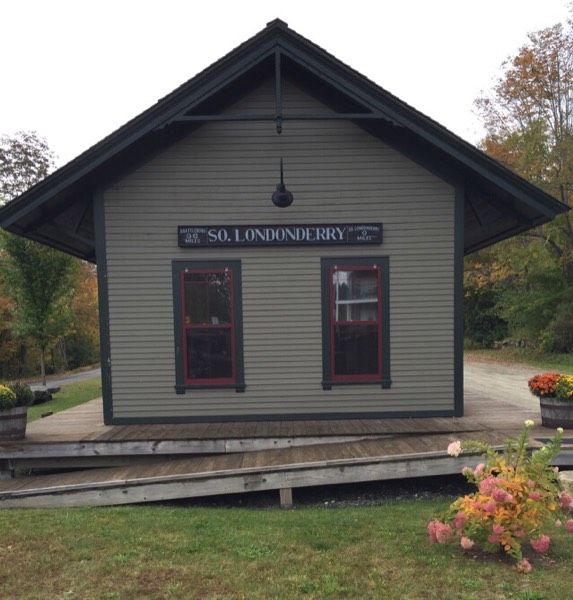
When I see remnants of the West River Railroad like I did while camping this week, I think of my dad. About 80 years ago, he was a poor kid from Lynn, MA who signed up for the Civilian Conservation Corps and travelled by train to Brattleboro. There he boarded a small self-propelled train that chugged up the West River Railway to South Londonderry.

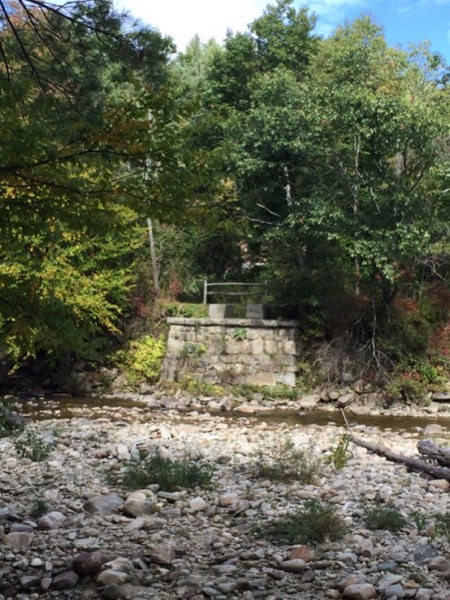
This bridge abutment marks the crossing point for the old West River Railroad

Dad was stationed at the CCC camp in Weston and excelled in athletics, particularly local road races. His group built the highway, by pick and shovel and wheelbarrow, now Route 100, up over the mountain to Ludlow. The best thing he did was to meet my mom, a South Londonderry girl, at a local dance and as they say, the rest is history.

The railroad was thirty-six miles long (There is a famous old book on it called “Thirty-six Miles of Trouble) and ran from Brattleboro to South Londonderry.

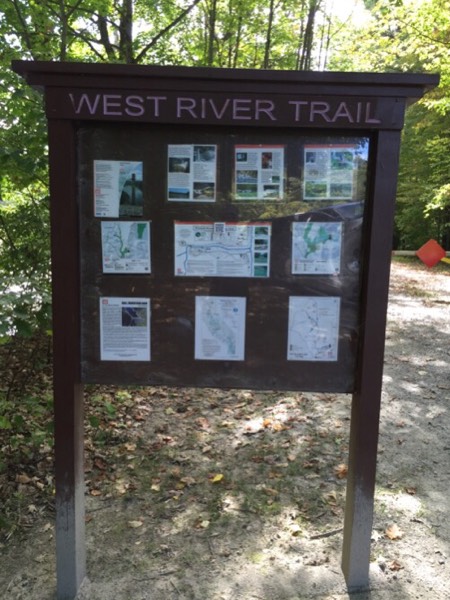
A rail trail along the old track bed now allows recreational users to enjoy the wonderful scenery.

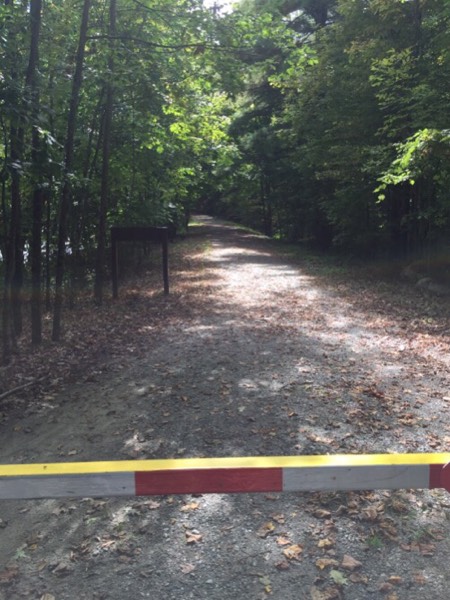
While camping at Winhall Brook Campground, Penny and I did some exploring of the West River trail. From the north section of the park the trail goes a little less than three miles to South Londonderry. From the south section, you head south for a mile or so and run into the obstacles created by the construction of the Ball Mountain flood control dam.

The trail heading south from the campground. Firm and level, great for biking or walking.

We ran into bad weather and cut our camping stay short so I never checked out the hike up to an overlook to see the dam. However, there is a lot of information online on the trail which, with some breaks, continues down to Brattleboro.

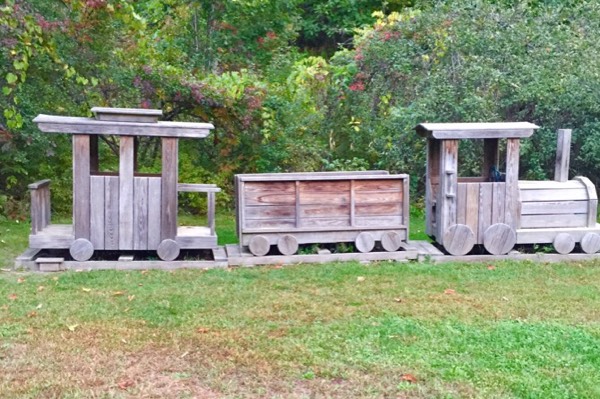
Even the campground playgrounds have a railroad theme

My grandfather was a railroad engineer living in South Londonderry who was killed in a train accident in Connecticut when Mom was young. He rode the West River Railroad to work for years.

The West River Railway is part of our family DNA. It is great to see the local efforts made to restore the rail bed for horses, cyclists, hikers, skiers and snowmobilers. All aboard!

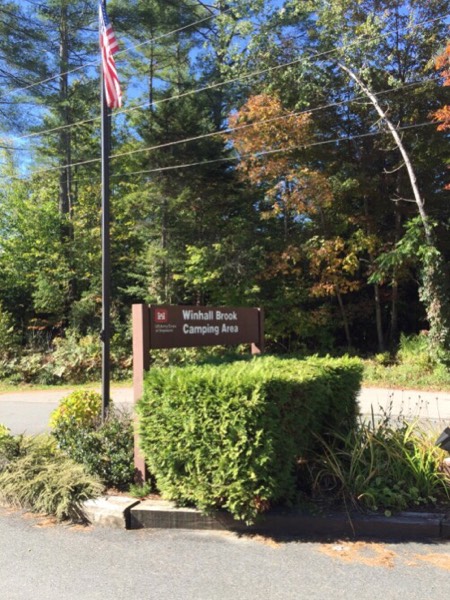
Winhall Brook Campground

On our first night at Winhall Brook Campground, a crisp fall temperature taxed our puny electric heater so we cranked up the radiant heater in the early morning to take off the chill. Penny loves it; she curls up right in front of the heater, toasting herself.

After a morning walk ( Broadwing Hawk and Winter Wren best birds), I sat in the sun outside the welcome center checking emails and blogs.

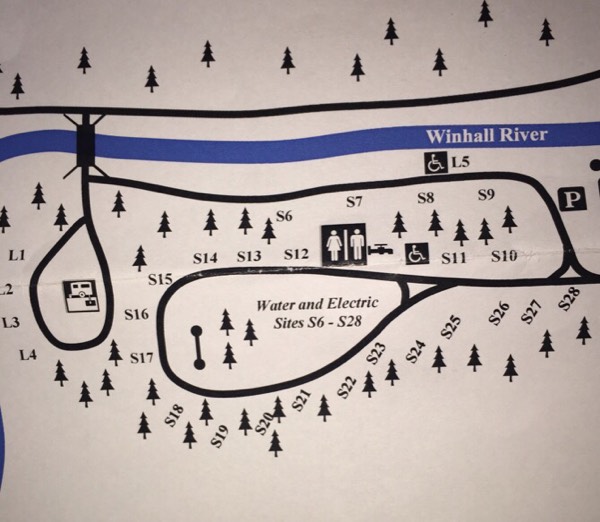
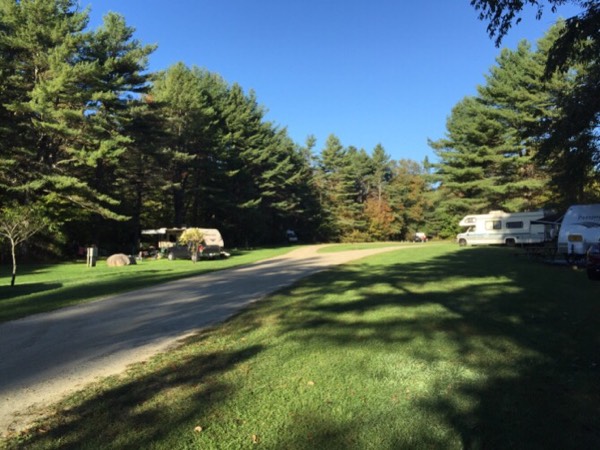
This is the water/electric loop. We are at S19 which is nice. The units are closer together than many of the no-hookup sites.

There was a lot of turnover in the loop today with three big rigs showing up. Foliage season is starting to attract many visitors. The colors are improving each day.

We took a mid-day drive a few miles up to the local cemetery where my Dad and Mom, and both my Pearson grandparents are buried. It is a beautiful site with a view of Glebe Mountain and a number of maples starting to show brilliant orange and red. Mary and I weeded and cleaned up around the gravestone – it was a good visit. Many of my aunts and uncles are buried there as well.

After fueling the truck in Londonderry, we bought a Vermont Apple pie and some local ice cream for supper.

1443536548.jpg

This place has been in business for 20 years and while a tourist attraction, makes a mean apple pie.

Last night, we had a delightful young couple from North Carolina over for dinner. It was simple: salad, spaghetti with meat sauce, bread, apple pie and ice cream. We never socialize but this was fun: they are tent-camping for three weeks around the Northeast and in the midst of car problems so this was a nice break for them.

I checked out the north loop this morning (Red-eyed Vireo, Gray Catbirds) which was empty. There are some excellent lean-to sites along the brook and the West River. I wasn’t impressed by any of the RV sites although some looked fine. There are no hookups on the North loop but a clean restroom, nice playground, and an attractive pavilion.

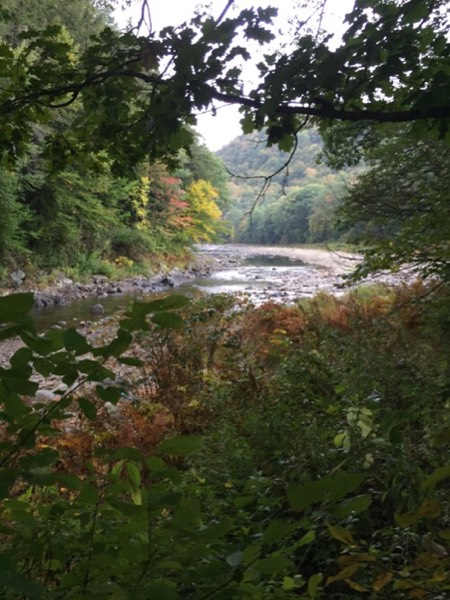
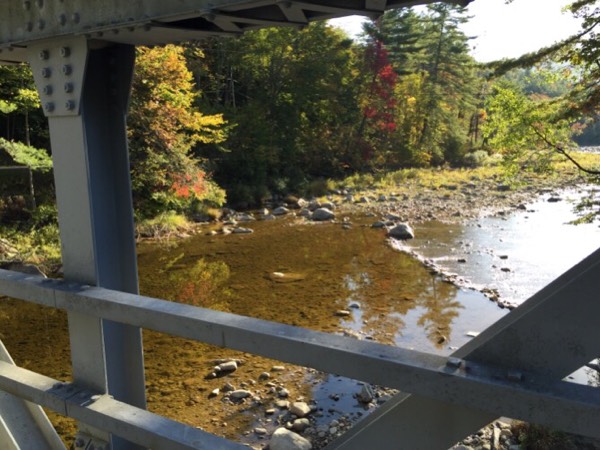
The West River looking south. Winhall Brook enters from the right. Water levels are low.

We have showers in the forecast today and serious weather system hitting later on. At first, we planned to  just hunker down and read – and be glad that we are not tent-camping in the wet. Been there, done that.

Taking a closer look at the forecast once we found 4G coverage, we decided to hook up and headed home early rather than slog home tomorrow in heavy rain. We’ll definitely be back.

An Early Fall Road Trip

After several weeks of repairing a rotted area of the front entry to our house, with the wonderful help and guidance of my brother Barry, I decided that a change of scenery might be nice. I had been wanting to check out a campground in southern Vermont so when Mary said that she was all for a getaway, and I checked availability, we were reserved for three nights at Winhall Brook Campground in South Londonderry.

This is our first experience with Corps of Engineers sites so it was great, if unusual for federal areas, to find that they had a section with water and electric hookups, which given the nighttime temperatures in the forties, were important to us.

The Airstream had been sitting down under the pines for a month so I moved it up to the house, removed some road dust outside and cobwebs inside, and then began the process of restocking it for the trip.

The trip down Sunday was easy – a beautiful Vermont day with light traffic. We picked up Route 100, Vermont’s ski highway which runs through the heart of the state, and saw dozens of motorcyclists and many a cyclist out for a Sunday ride. The meandering road and scenery is fun, even while hauling a trailer.

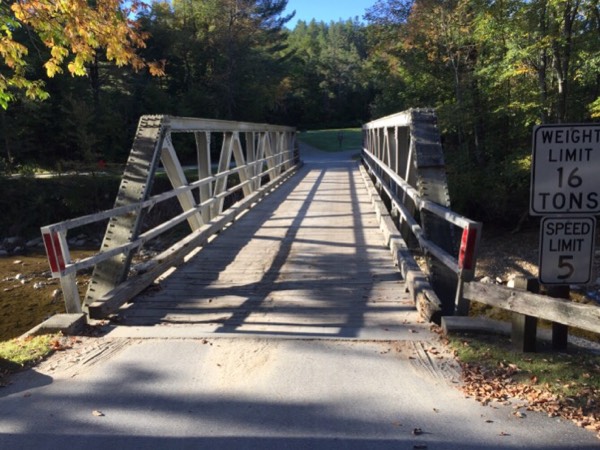
No one was at the campground’s welcome center so we headed out to our site, having pre-registered. I was concerned about the narrow bridge we’d have to cross (limited to vehicle 42′ or shorter – our truck and trailer is 45′) but it we had no problems. It was tight and I tucked in my mirrors.

We met the host, found our level spot in amongst the trees, and set up with ease. The power is strong, the water tastes, great, and the neighbors our quiet.

There is no cell coverage but the office has a good wifi signal. After a good night, we have warmed up the trailer and Penny and I are heading out for a chilly bird walk.

Put this campground on your “to-do” list. Did I mention that with the interagency pass that it’s only $13 per night? Best deal we’ve seen in years – for one of the best campgrounds we’ve visited. What’s not to like?

Paddling Lake Attitash

After four days of rain showers with some thunderstorms, we finally are getting a day or two of muggy but cloudy weather. Yesterday morning, I asked our grandson Mac if he wanted to paddle for a bit and when Mary graciously offered to watch the dog, we were off to the local lake.

Lake Attitash’s chief feature for us is that it is only a few miles away. It is shallow, small (360 acres) and extensively developed; roads and cottages, two or three rows deep in places, virtually ring the entire lake, as well as a summer boys’ camp, and at least two boat docks. There are literally hundreds of boats of all types and sizes but most just are active in the evening and on weekends. It was rather quiet today but the south wind gave us a steady chop to deal with.

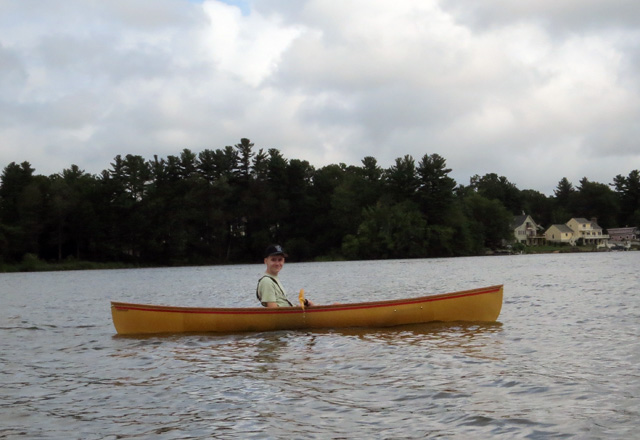
Mac used my boat and I squeezed into Mary's ten-footer.

We just had launched when we saw a Bald Eagle cruising past. The waves were hitting us from the stern quarter so I was more focused on paddling than grabbing for the camera. Ten minutes later, a Great Blue Heron lifted off from the bushes right in front of us, followed by an active Belted Kingfisher who delighted us by diving rather close by the boats.

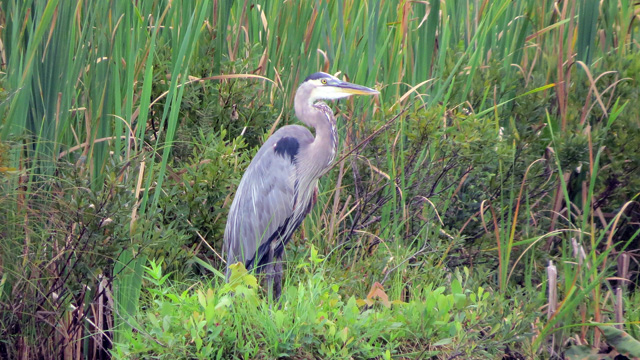
There is a long inlet that is very shallow and full of water lilies, water hyacinths, and many aquatic weeds. It is protected from the wind and often has a lot of waterfowl. We spotted our Great Blue Heron, or his brother, fishing in the shallows.

This may have been the GBH that we flushed earlier.

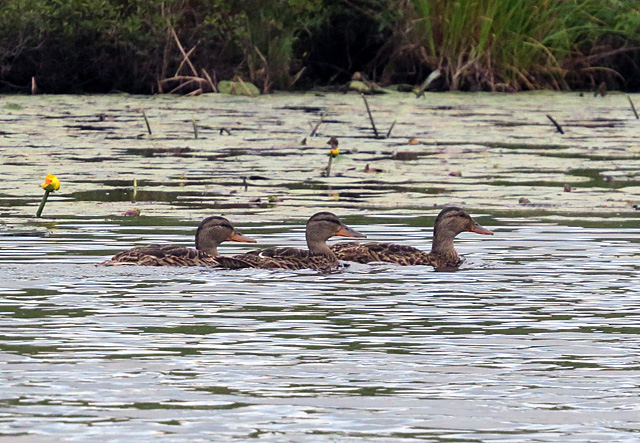
Further ahead, I spotted this trio of young Mallards cruising just so they kept ahead of us.

These ducks were wary but never flushed as we kept our distance.

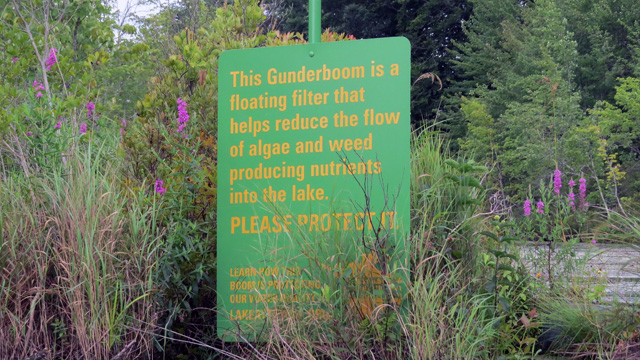
The inlet has a protective boom to supposedly keep nutrients and algae out of the lake. It once may have been a good idea but as Mac says, "Doesn’t look like they maintain it." Sticks and branches pushed sections to allow water to just move over the top – and looking at the lake, it appears to be a lost cause. This lake is eutrophication with a capitol E.

The Gunderboom may have seen better days.

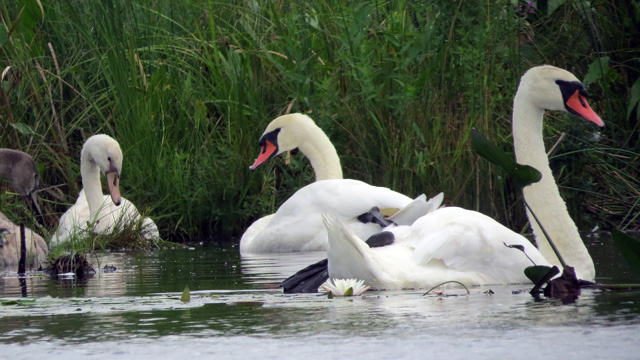
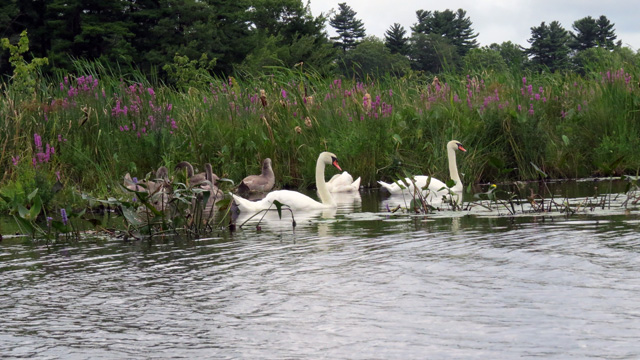
Heading back down the inlet, we saw a Mute Swan family again – having seen the adults earlier. The cygnets are nearly full-grown but still grey and fuzzy-looking.

MSwans1W


MSwans2W

Heading back into the wind, the paddling was a little slower but the boats tracked better. We ended the outing with a flyover by an Osprey. It was a fun outing with my fourteen-year-old grandson who is a pretty good paddler/birder. Good birding.


Our Hornbeck Boats – What’s Not To Like?

I was on the shoreline at Falcon Lake State Park in Texas, hoisting my kayak up on to the truck, when a gust of wind caused the boat to twist and head toward the ground, with me fighting it to a soft landing. I got it up and in place the next try but thought, “This getting harder every year – lifting a 50-60 pound kayak eight feet up to a rack on the F-150. It was easier when it was the Saab and I was ten years younger.”

I woke up the next morning with chest tighteness but attributed it to the wrenching that my torso got from the kayak. However, I do have some heart issues (Afib) and when our daughter, who was 2000 miles away and very concerned heard about it she texted, emailed, and I think left a message that she felt I should get it checked out.

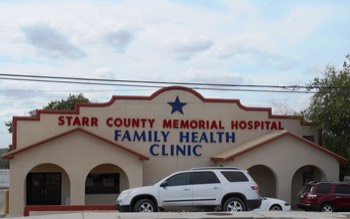
So the next morning, I drove the 40+ miles to the Starr County Regional Hospital, which is a tiny rural hospital, and went to the ER. Since I was feeling OK, I was sent next door to the clinic for testing.

It was interesting: I was one of the only Anglos there – most go to the larger facilities down on the Valley. My Hispanic PA was good – as was the whole staff. I got an EKG, blood work, and a thorough exam and they felt everything was fine. As it has turned out to be.

But this episode was the stimulus to get serious about replacing the Eddyline boats with something more manageable. I put them on Craigslist a month after we returned and had a buyer at once.

I had heard about some light-weight canoes made over in New York State several years ago and met a guy in Texas with two Hornbeck boats strapped on his car. He raved about them.

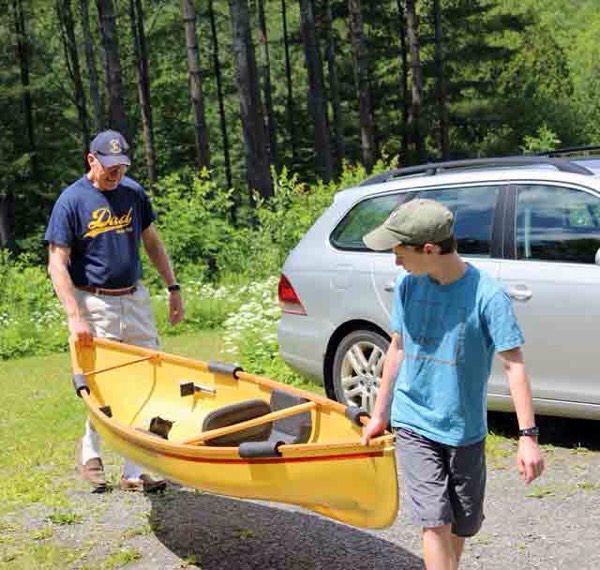
So, several months ago on a Saturday, Mary and I and the dog headed over to Olmsteadville, New York and after trying out several boats on their small pond, bought two Classics, one ten-footer for Mary and a twelve-footer for me. We loved the lightness (16 pounds and 18 pounds), the ease of paddling, and the stability.

The boats are easy for one person to handle but if you have a helper, go for it.

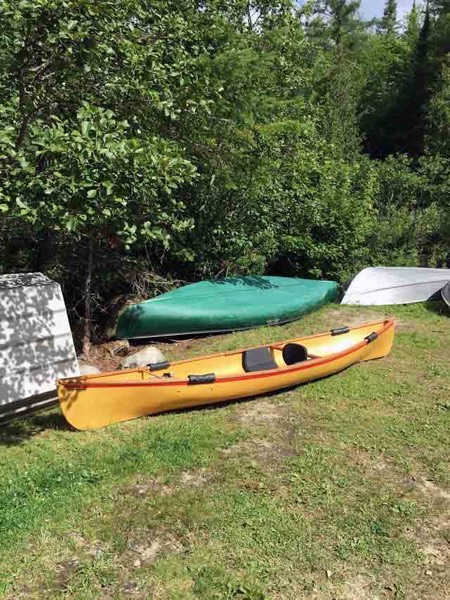
Waiting, along with some slower cousins, for a paddler.

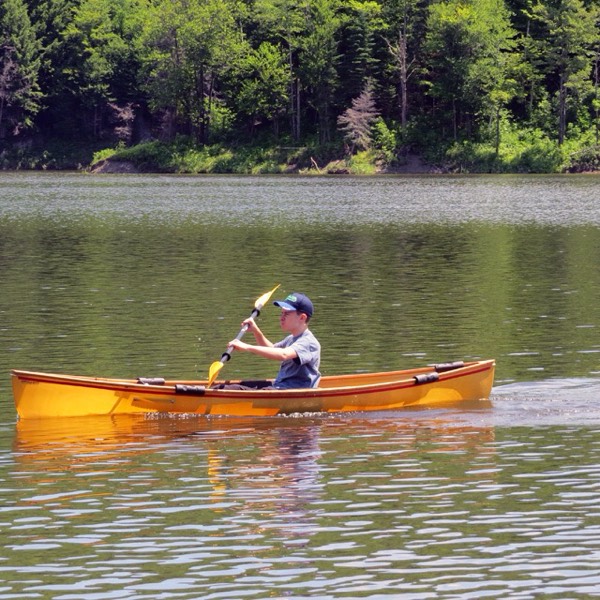
The boats are great for grandchildren to paddle — immediate fun.

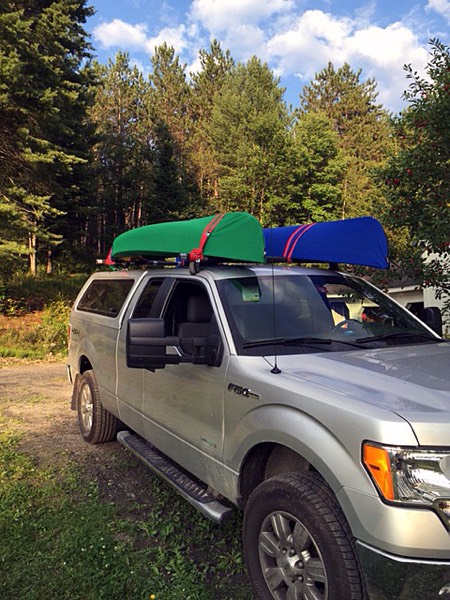
I bought some custom boat covers to protect the Kevlar from sun damage and road rash from Sue Audette aka The Bag Lady who sold me a cover for my racing canoe years ago.

I love my Hornbeck for its ease of loading and its stability for birding and photography. I suspect that we’ll use them a lot more than our kayaks since they are great for a wide variety of ages, sizes, and abilities. I’m debating whether to take one with us this winter – we’ll be near water about a month out of the three. Stay tuned.

2016 Trip Planning

I was watching the clock on my computer, waiting to try to reserve a site for our February visit to San Diego, as the February sites opened up at 8:00 AM August 1st (11:00 EDT). I knew that the South Carlsbad State Park was closing for repairs in mid-February so had planned a week’s stay just ahead of that closure date. What I did not know was that much of the park was already closed and that very few sites were open.

As 11:00 clicked on, I counted to ten and loaded a page I had pretty much ready-to-go but could not find any sites in the area we had stayed before. There were only about 30 sites available and as I selected one and hit return, it would be gone. I lost about five along the beachside this way and soon only a couple on the opposite side of the road were available. I got one and locked it in and took a deep breath.  I had heard of folks fighting for Florida sites as soon as they became available but had not run into this before — too much tension but ten minutes later all were booked and I felt fortunate to get one.

This site is closed during our February visit but we'll be rather close and happy to have a campsite.

This site is closed during our February visit but we’ll be rather close and happy to have a campsite.

It turns out that California has a restriction that you can not reserve a campsite more that seven months away. New Mexico has a six-month restriction. Most other states we visit do not.

I have locked in a couple of weeks at Patagonia Lake State Park in Arizona prior to our California visit and then about ten days at Anza-Borrego Desert State Park after we leave Carlsbad.

Anza-Borrego Desert State Park is great for birding, hiking, and desert flora and fauna. Photo courtesy of Roger Smith.

Anza-Borrego Desert State Park is great for birding, hiking, and desert flora and fauna. Photo courtesy of Roger Smith.


We wanted to get back to Arizona for birding and see the kids in San Diego so that formed the backbone of our first half. Then we need to ride out Texas school spring break which ties up their parks and hopefully visit our Ohio gang on the way home. The trip is pretty much planned (Mapquest routes, spreadsheets, some reservations) leaving in early January and returning in mid-April but very well may change. It’s nice to have a game plan and to have locked in those crucial California dates. Stay tuned.
Geocaching Revisited – or – My Vizsla is in Spain

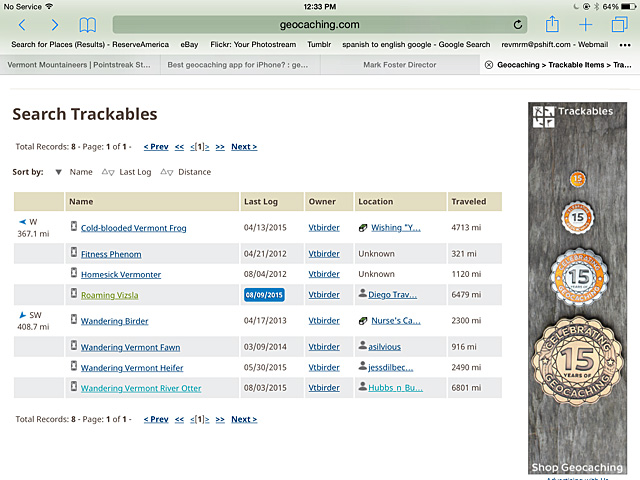
As I have noted in previous posts, I am an “on again, off again” geocacher who goes months between activities, then gets a spurt of activity for a bit, and then goes on to other things. I have about six trackables in circulation (see below) and every time one gets moved, I get an email.

Two of my trackables have logged over 5,000 miles.

Two of my trackables have logged over 5,000 miles.

Enroute to Bovina, I got an email telling me that my Roaming Vizsla trackable was heading to Spain. Here’s the goal that I set:

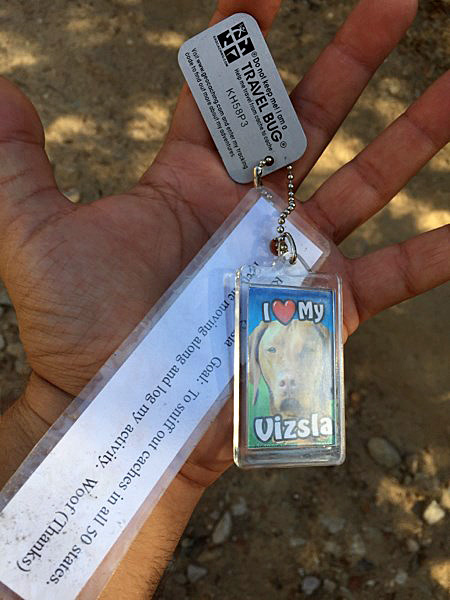
To sniff out caches in all 50 states (plus overseas if I get a long ride).  Keep me moving along and log my activity.

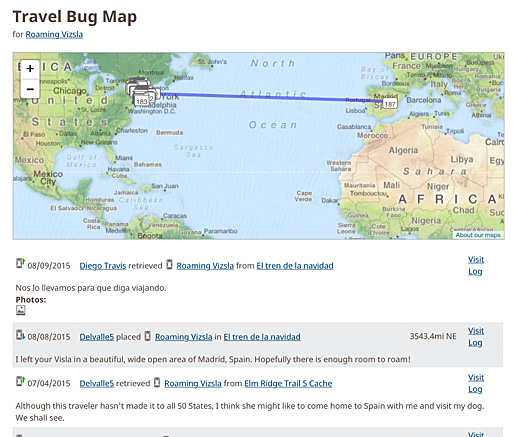
So Pablo, who found the Vizsla tag in a cache in New York state wrote these comments in the electronic log:

Although this traveler hasn’t made it to all 50 States, I think she might like to come home to Spain with me and visit my dog. We shall see.

I left your Visla in a beautiful, wide open area of Madrid, Spain. Hopefully there is enough room to roam!

Here is the tag and the goal picked up by a Spanish geocacher in Madrid yesterday. He said: Nos lo llevamos para que diga viajando. (We took him traveling.)

Here is the tag and the goal picked up by a Spanish geocacher in Madrid yesterday. He said: Nos lo llevamos para que diga viajando. (We took him traveling.)

I looked at the map to see the travel and as you can see, the trackable made a number of stops in the Northeast before leaving for Spain.

I looked at the map to see the travel and as you can see, the trackable made a number of stops in the Northeast before leaving for Spain.

That night at supper, I mentioned the email from Spain and explained a little about geocaching. I had forgotten how enthused our y0ung friend Julie can get but she was all over it – having heard a little about geocaching but always up for an adventure with her kids. I remarked that I didn’t know if there were any caches nearby but after supper, got my iPhone out and saw that there was one across the street and another a few hundred yards down the road at their church. That started things rolling.

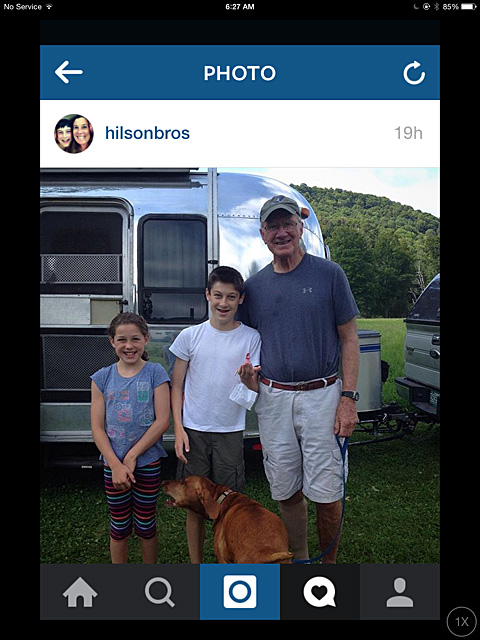
Julie bought the app at once and while it was too dark to go out and search, she went home and did some reading and studying and first thing the next morning, both she and her two older kids were ready to roll. They found a two-part cache at the fire station and then had breakfast and with me, found the cache at the church. By now, they had enlisted two more friends who were psyched.
The two geocachers with me as they pause before their next venture. Photo by J. Hilson

The two geocachers with me as they pause before their next venture. Photo by J. Hilson

So, as we were leaving with the Airstream, Julie and her baby in a running stroller along with four kids on bikes were heading down the road on a half-mile to trek to a local cemetery to try to find the next cache. I think we’ve got another family of avid geocachers in the making. Meanwhile, it’s got my interest kindled again and I suspect I’ll crank up my searching in the next month. I’m at 88 caches found and would like to hit 100 before we head out for the Southwest. Check it out — it’s fun for all ages.

A Mid-summer’s Trip

Our excursion with the Airstream to the Catskills to see some dear friends didn’t start well. Not only did I drain the truck battery by leaving the ignition on all day (a last-minute run to put up windows before a rain squall, and then forgetfulness) but then, after getting the battery going, I ran into problems again with the tongue jack. I had the Airstream about halfway up to slide over the hitch ball when the whole system died — and all the banging, twisting tricks I had used in the past did nothing.

I used a socket wrench to manually lift the rig — not a tough project but time-consuming and sweat-producing, and got the trailer elevated enough to install the weight-distribution bars, and then lowered things and we were ready to go in the morning. I put a trickle charger on the truck battery and did not look forward to a trip of manual jacking to unhitch and hitch.

I fired off an email to the manufacturer, running through the history I’ve had of intermittent operation and asking for advice, figuring hopefully I would hear back next week.

Friday morning was a beautiful day to travel. Vermont’s scenery was lush and green and the alto-cumulus clouds and unlimited visibility promised great weather ahead. We go down through Rutland, over to New York state and pick up the Northway south of Lake George. It was easy cruising until we came to a dead halt in a tough traffic jam at the intersection of NY 149 and Route 9 – where there is a dismal strip of high-end outlet stores. I had forgotten that it was a Friday in mid-summer and half the world would be there looking for “bargains.” We sat, crawled, stewed, and finally chilled with air-conditioning for a half-hour or more but finally we were on our way south to Albany.
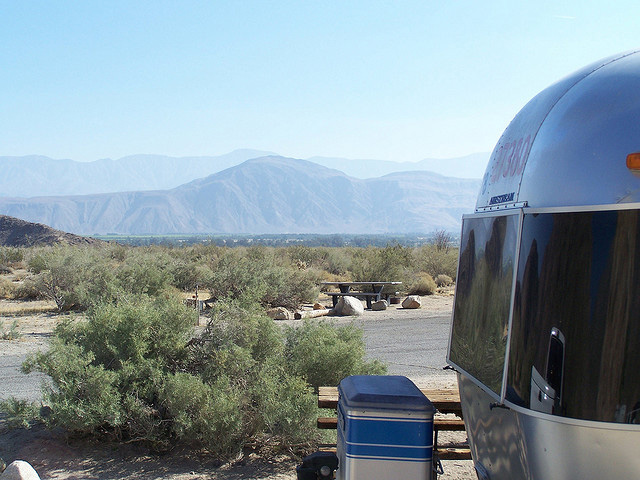
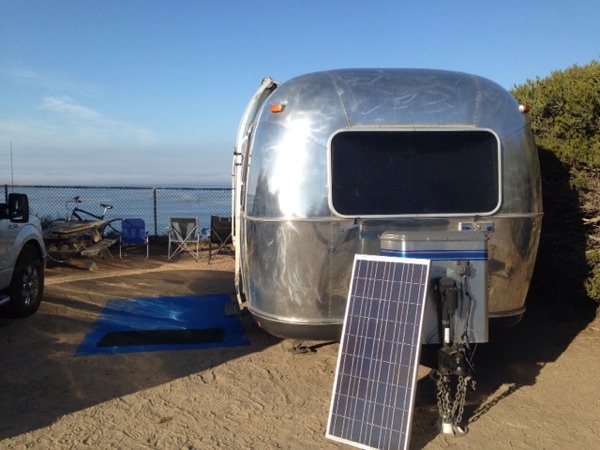
Our friends live in a small community called Bovina Center. It is about 1.5 hours from Albany and three hours or so from New York city, so there are lots of “city people” buying up old homes and farms — but the area is still very agricultural and lovely. The roads are winding, many of them red dirt, and some of the hills are a test for the Ford F-150’s ecoboost engine.

Our friend Jim grew up in Bovina and has a brother, cousins, and a host of family and friends scattered throughout the town. He and his wife, Peg, moved back after retirement and they now have  most of their immediate family within a stone’s throw. Their daughter and family are next door, a son lives another door down, and their other son and his spouse live a short drive away.

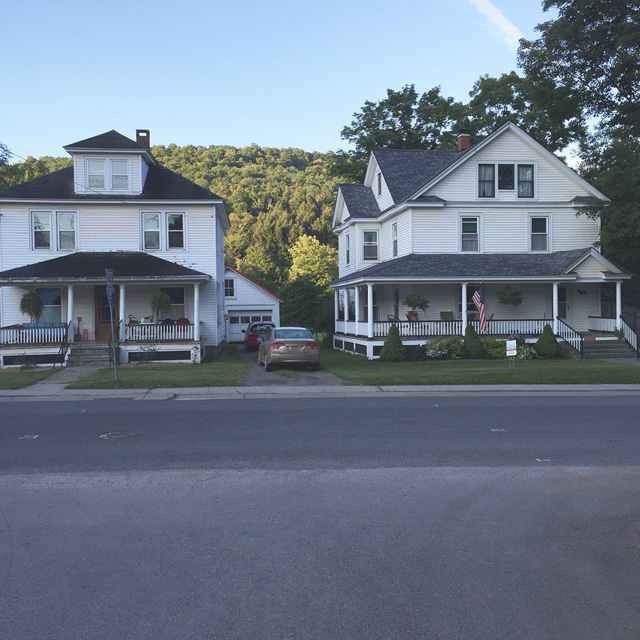
The front porch of the house on the right is an informal community gathering spot.

The front porch of the house on the right is an informal community gathering spot. 

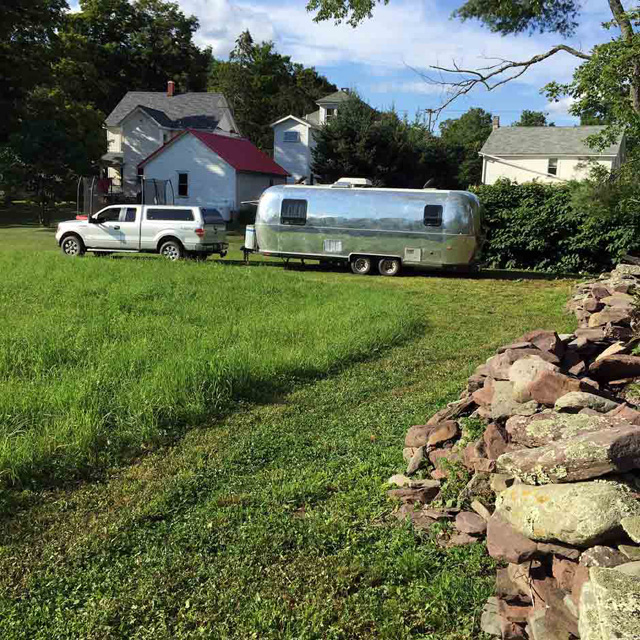
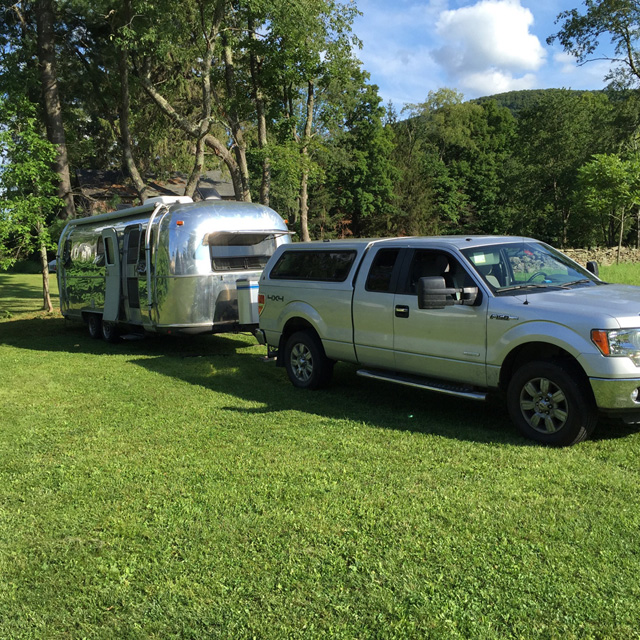
There’s a neat spot out behind their houses to park the Airstream. They run an electrical line out and it’s quiet, shady during the day, and a perfect place to stay.

We are close enough to be part of their activities and meals without being too intrusive. We first were here last year and loved it - and were invited (our invited ourselves) back.

We are close enough to be part of their activities and meals without being too intrusive. We first were here last year and loved it – and were invited (our invited ourselves) back.

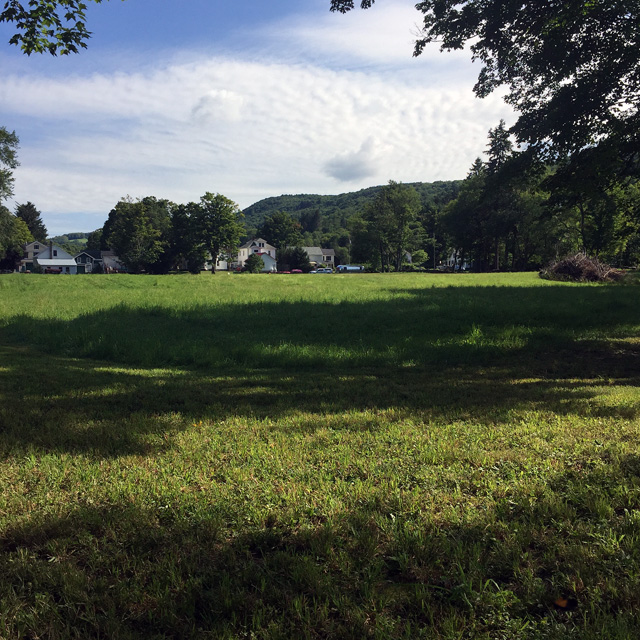
BovinaSite1WI’m sitting in the shade out by a tributary of the Delaware River as I write this. I can see a Belted Kingfisher on a branch near me, shaking out his feathers after a dive, and here’s the view back toward the trailer.

Not a bad place to sit and write.

Not a bad place to sit and write.

Now, back the Airstream jack issues. When we stopped for lunch enroute, I saw an email back from Randy, the technician from the manufacturer. He told me that based on my description, he thought we had an electrical grounding or connectivity problem and outlined a number of things to do to try to correct things. When we got to Bovina, I decided to work on it before manually operating the jack. I tightened up the jack’s bolt connections, checked the fuse again, and then looked at the leads to the fuse. The connections had some green corrosion on them. I fished through Mary’s purse for an emory board and smoothed off both leads, replaced the fuse whose ends I also polished, and sure enough there was power to the lift. I used it to get set up, wrote a quick email of thanks to Randy, and went on to enjoying the weekend.

The next morning, while taking Penny for a walk, I took some photos of downtown Bovina.

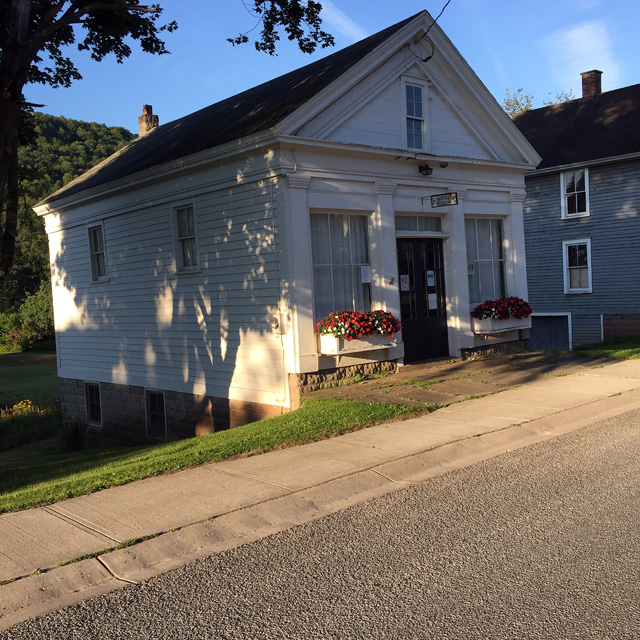
The Bovina Historical Society

The Bovina Historical Society

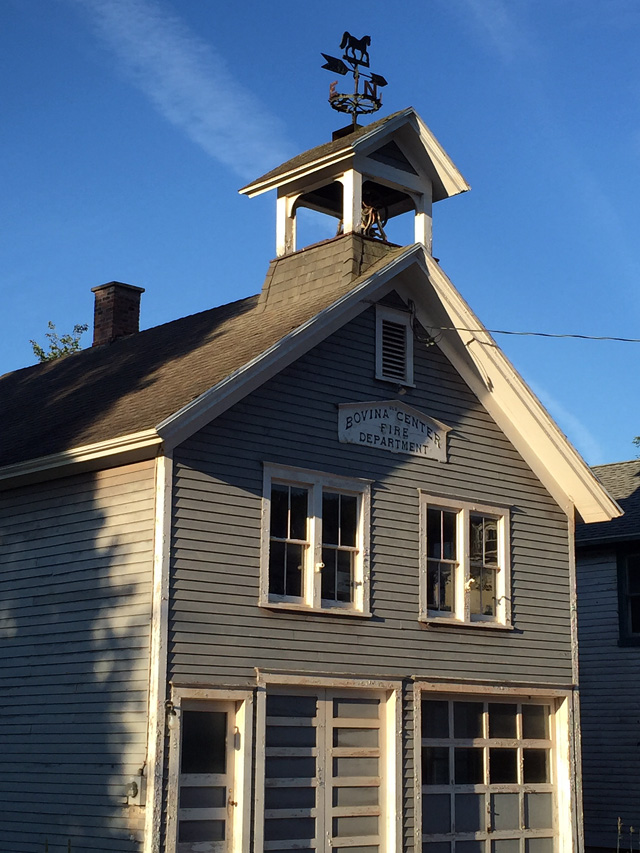
The old Bovina First Station with antique equipment inside.

The old Bovina First Station with antique equipment inside.

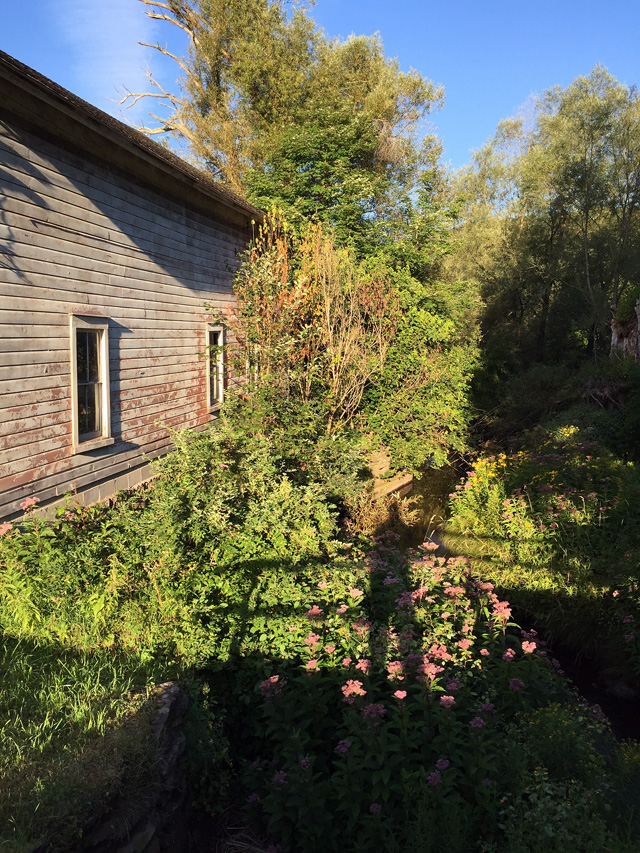
An old mill stream with the  photographer's shadow in the middle.

An old mill stream with the photographer’s shadow in the middle.

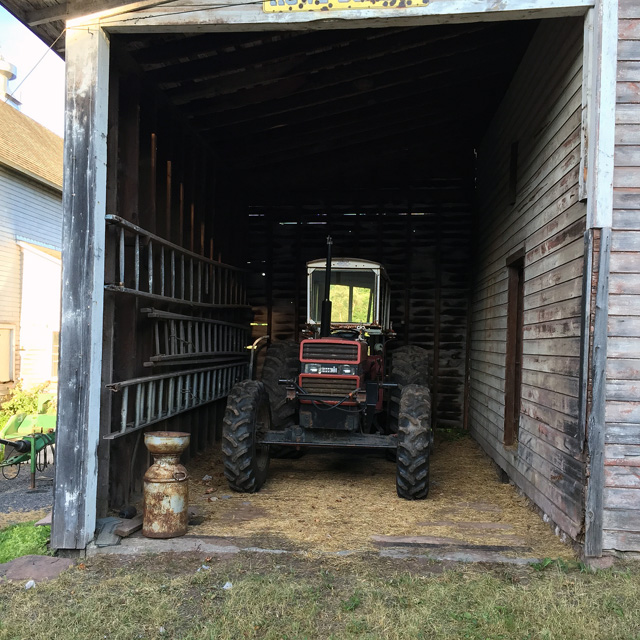
An old tractor with a rusted milk can and strainer.

An old tractor with a rusted milk can and strainer.

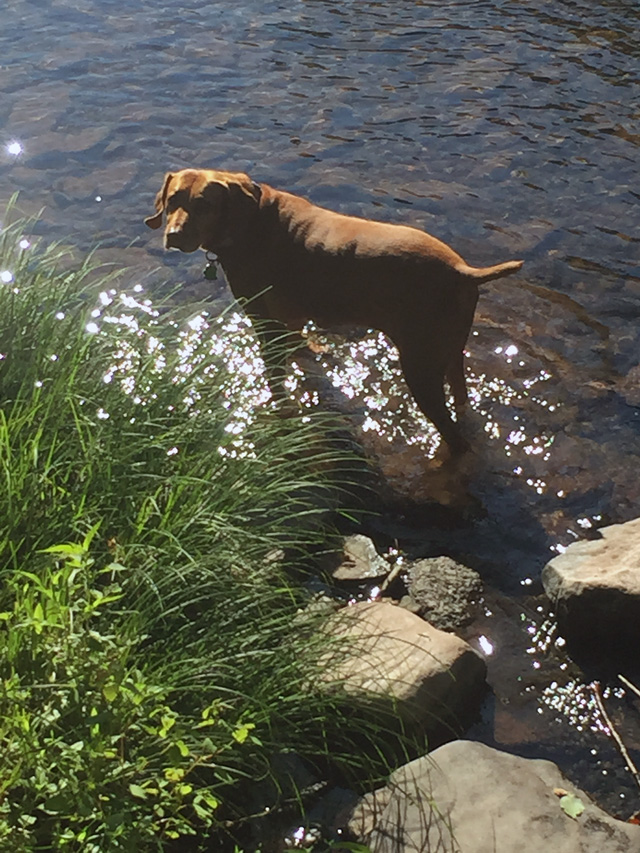
Penny enjoying the river

Penny enjoying the river

This is one of those trips that you want to do, but if you put off too long, the summer is over and schedules are crazy again. We’ve done some birding (not bad for mid-summer), some local sightseeing, attended a benefit concert, and gone to the local church (whose congregation and services we love.) This is a special time of year at a special place and a good Airstream trip to see good friends. I hope that your summer goes well.