I Brake For Birds

One of my favorite bloggers, Larry of The Brownstone Birding Blog, recently wrote a clever post called Cold Weather Car Brrrrrrding!  This time of year, he notes, “birding by car can be a good option when you’re dealing with wicked windy winter weather.” Amen, brother.
BrakeforBirds

I use my truck quite frequently, particularly in lousy weather, to scout for birds on the back roads of central Vermont. Not only is the weather lousy right now, it is also deer season and most outdoor people take a two week vacation from tromping through the woods. Even with blaze orange gear, it’s not too safe to venture into the woods, especially with a reddish-brown dog running beside you.

Yesterday morning, I headed out for a short jaunt – this time in the car which needed snow tires mounted – and after the studded snow tires were in place – I did a little road birding. I took a look at our local reservoir which was pretty, but bird-free.
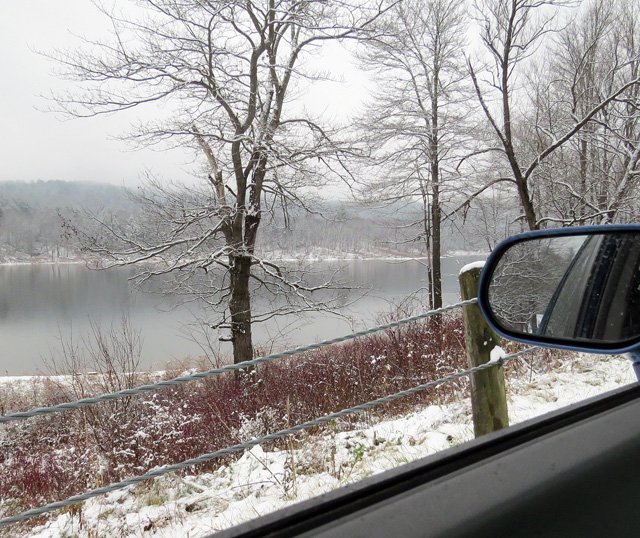
New snow and no birds -- it looks like most of our migration is over.

New snow and no birds — it looks like most of our migration is over.

Larry pointed out some of the benefits of birding by vehicle in inclement weather:

  • you can stay warm
  • you can listen to sports, NPR, or music on the radio
  •  it’s a good location from which to drink your coffee
  •  your car makes an excellent blind so that you don’t scare off good birds and makes it easier to take pictures of them
  • you can cover a lot of ground by driving directly to some hot spots without spending a lot of time walking around

I would add that I can keep my iPhone plugged in and record birds into BirdLog without frozen fingers and also that I can keep Penny, our dog, happy in the back seat.

Birding with someone to watch while you drive can be helpful but that infrequently works for me on local outings. However, more than once Mary has spoken sharply to me as I try it ID a hawk on a pole while driving toward it, sometimes literally.

Vermont has a strong new “no handheld device” law to try to help with distractions while driving. We’ve all encountered distracted drivers and they can be dangerous.  Unless you are on a back road, keep your attention on the road while birding by vehicle. That life bird you just freaked out over can turn out to be a lifer – your life.

Good birding. Safe driving.
Trash Talk

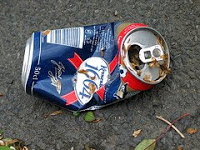
The other morning, as I dragged our two large containers down our driveway, I marveled again at how our recycling bin is full while the one for trash is less than half full. Over the years, as more and more materials can be recycled, the ratio of recycling to trash has grown. I say this not to pat ourselves on the back — it’s as much a Vermont thing as a Mansfield thing. It seems that roadside trash, always rather limited, is also improving over the last few years.

149291467_895e4f69a1_mThen my thoughts turned to the terrible situations we will soon encounter as we travel with the #Airstream to the Southwest. Every year we get discouraged about the trash along roadways and the lack of recycling. So I decided to recycle a post I wrote several years ago, since nothing has changed for the good.  Here it is from February 2012:

One of the big disappointments about Texas birding is the amount of trash you encounter along roadways – about anywhere. Many times I’ve spotted a Crested Caracara up ahead to find it’s only one more Walmart plastic bag tangled on a fence post. Of course, with no recycling, no returnable deposit, and a “toss it out the window” mentality, what can you expect?

Recycling is about non-existent throughout the South. It hurts to crush plastic milk cartons and toss them with the cardboard, cans, and other recyclables. State parks are pretty lame, with only aluminum cans collected. Since we drink no soda or beer from cans, well you get the picture.

The other day I drove over to a large wildlife management area for some birding. It is used for grazing as well and some of the residents didn’t seem too impressed by the Vermont plates and kayak on the red truck.

It was a foggy morning and on the way on the access road, I saw a life bird – a White-tailed Kite perched in a dead tree. I took a photo through my scope which was pretty fuzzy but ok for documentation. 

Once I left the truck and began birding alongside the Guadeloupe River, I was shocked by the debris. Some was from recent high water but much was crap left by hunters and fishermen. Beer cans galore, fishing line in trees, it was really depressing. But some great birds helped make up for it. Red-bellied woodpeckers made a racket while dozens of yellow-rumps did their flycatchers act.

The highlight was a big bird that flew off and perched in a tree up ahead. Thankful that I didn’t have the dog with me, I got right underneath a Great Horned Owl who watched me through the branches but stayed perched as I photographed it and then quietly moved on. 

It was a good birding outing but I could not help but contrast it with my trips to rather pristine New England WMA’s. Sure, you’ll always run into idiots who litter, but in Texas, it seems to be genetically imprinted. Mary and I are far from alone at our disgust for the situation – many from Canada and the upper mid-West share our opinion – as I’m sure do many Texans.

We have found a few parks and municipalities where there is more recycling so often we rattle along with several weeks worth of recycling in the truck, looking for a home.

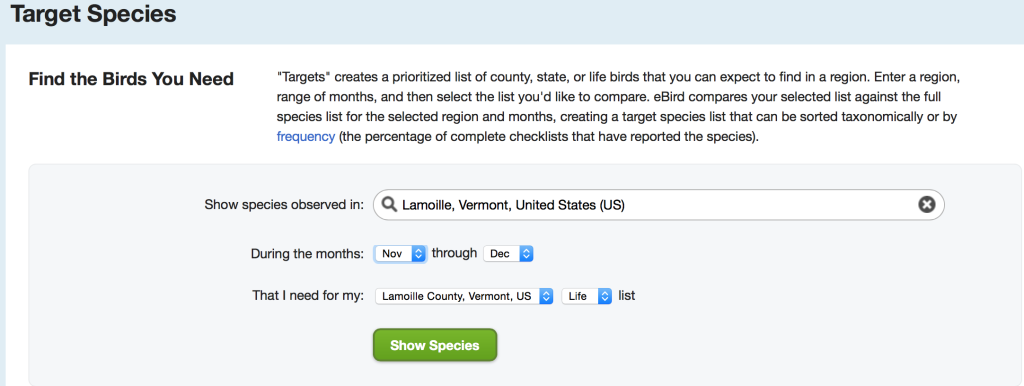
eBird Targets–Exploring the Possibilities

Cornell’s eBird just announced the launch of eBird Targets–a new tool that creates a prioritized list of county, state, or life birds that you can expect to find in a region. You enter a region, range of months, and then select the list you’d like to compare. eBird compares your selected list against the full species list for the selected region and months, creating a target species list that can be sorted taxonomically or by frequency (the percentage of checklists that have reported the species). Each time you submit a checklist to eBird, a geo-referenced tag is created that allows you to keep track of your lists on the My eBird pages. From the simple life list to very focused region-based year lists, eBird Targets allows birders to play the games they find most interesting while creating more and better data for science.

I decided to run a list to see what I might find in my target county for this year, Lamoille. I am sort of stuck on 130 species and recent visits have drawn blanks and the combination of other commitments, weather, and the departure of many of my “missing” birds, make 135 to 140 a reasonable expectation.  So let’s see what eBird says — what I want are the birds that will be there during the next six weeks that I don’t have on the year’s list.

So first, I run this query:

Screen Shot 2014-11-14 at 3.24.11 PM

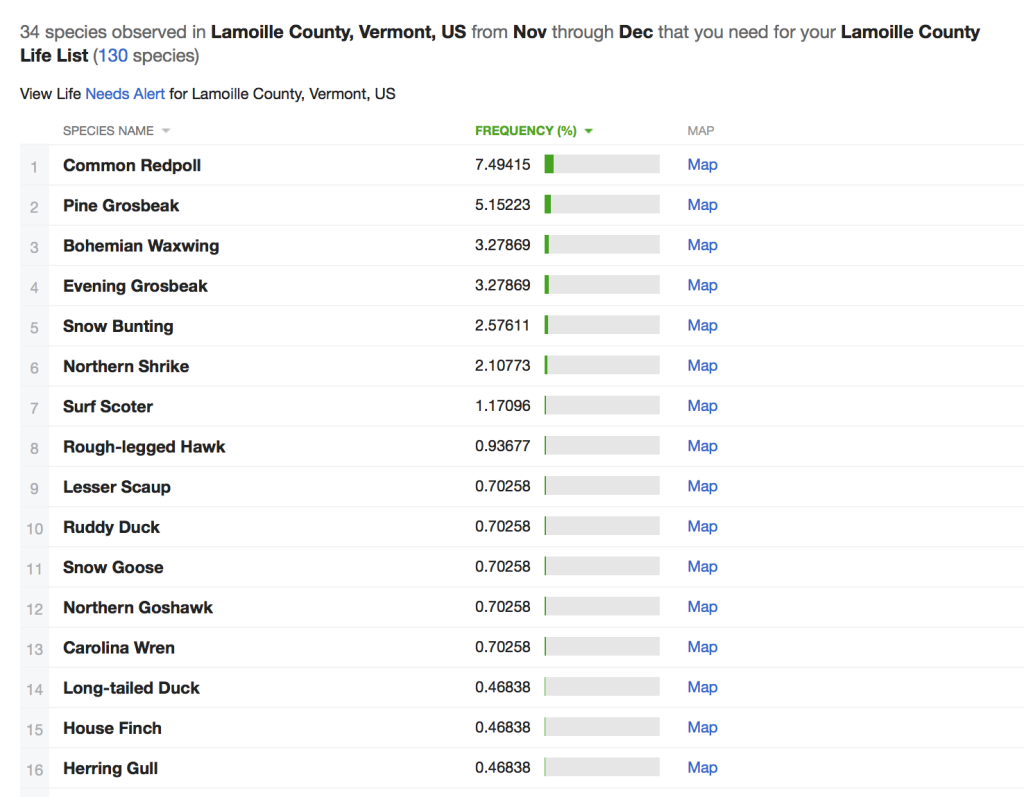
Now this is for a life list for the county, which in my case is the same as the year list.  The report shows 34 species and ranks them by frequency — so if I can get five I’ll be happy.

Screen Shot 2014-11-14 at 3.26.45 PM

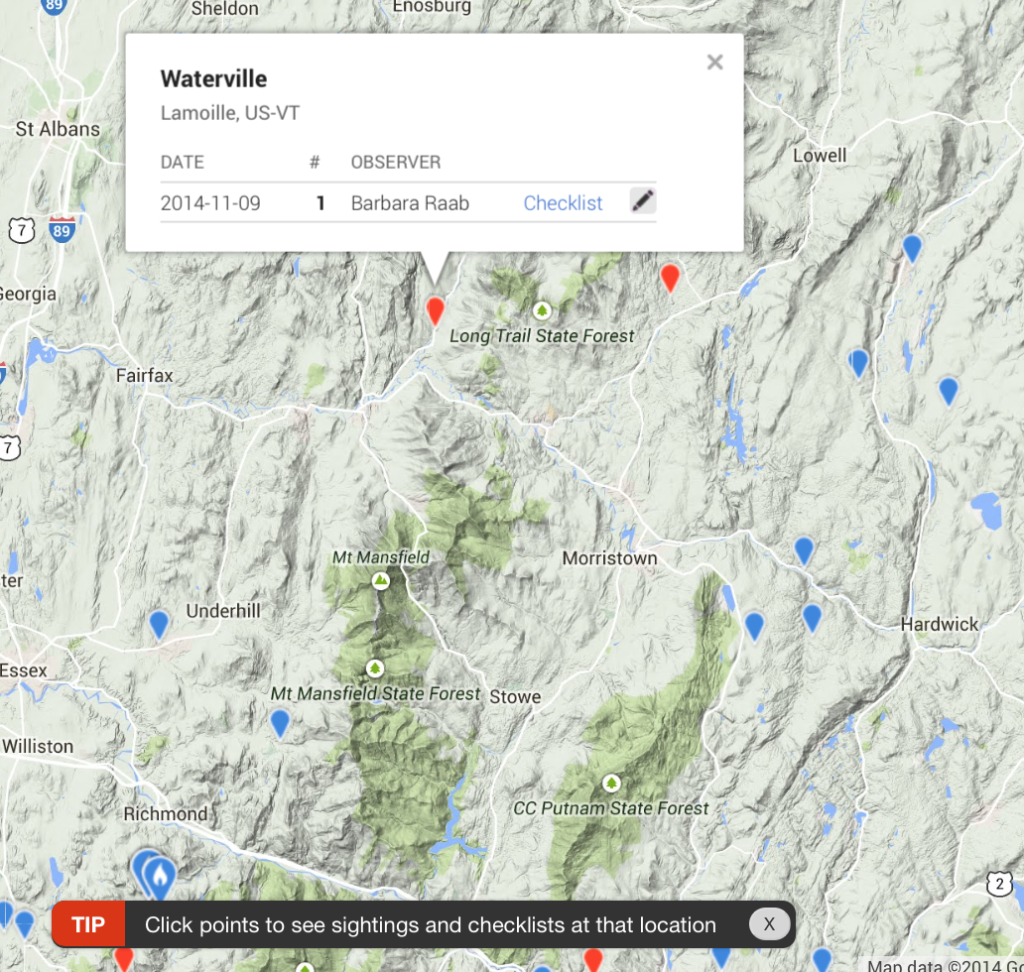
The other neat aspect of this program is that it provides a map of where a given species was reported in the past, highlighting recent sightings.  Here is one for Evening Grosbeak.

Screen Shot 2014-11-14 at 3.31.00 PM

I’m sure that I’ll be using this a lot as we start traveling to states in the Southwest. Combined with alerts from eBird, email listings, and various iPhone apps that cull eBird data, we have a lot of tools available.

The eBird team ends with this suggestion:

Please give the new eBird Targets output a try, and use it to find everything from your next life bird to your next year bird in your home county. Have fun, and submit lots of complete eBird checklists along the way!

Six Weeks To Liftoff

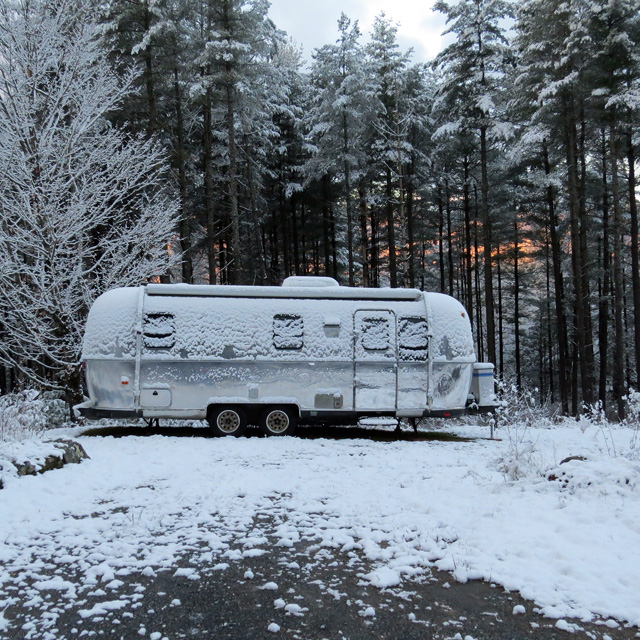
Awaking this morning to a couple of inches of snow, I am happy that not only is the #Airstream winterized and moved to the launch site beside the house, but that we have our winter travel plans well underway. Here’s the “Snowstream” this morning as Penny and I took our morning dog walk.

Chilling out, waiting for departure to warmer climes.

Chilling out, waiting for departure to warmer climes.

Tomorrow is opening day of deer hunting so the hunters will love this early layer of white. If it would stay, I’d like it too but this time of year, with the ground still waterlogged, it’s very frustrating to try to snowshoe or xc ski — even if we get another six inches.

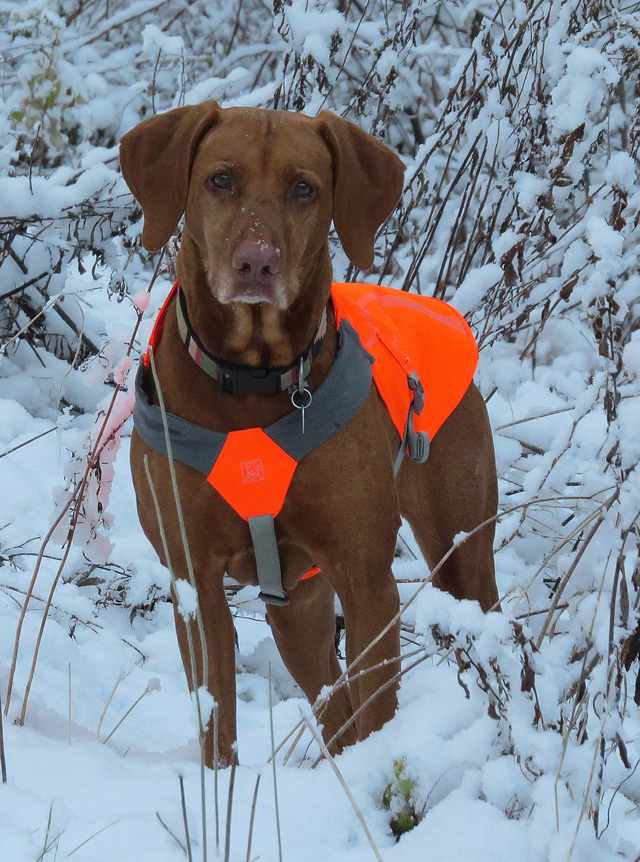
I bought a nice new vest for the Vizsla yesterday since we still walk in our woods every day and there are idiots, not many, who are a little trigger-happy. No one leaves horses or cows out until after the season ends.

Penny looks pretty spiffy in her new vest but of course, she doesn't like it.

Penny looks pretty spiffy in her new vest but of course, she doesn’t like it.

So, we’ll continue to plan — keep the wood fires going — enjoy the holidays — and before that long, head south where all we have to worry about is wind storms, thunderstorms, and alligators.

Looking Forward to Arizona Birds

As we go through the barren "stick season" in Vermont and see only a few hardy local birds, it is fun to think about what might be waiting for us out west. Here are a few of the photos I took of birds we encountered in Arizona. They are fun to look at anytime but especially on a cold windy damp night like this evening.

Last year, the first bird I saw at Gilbert Ray County Park, which is just outside Tuscon, was the Phainopela – which was a life bird. They are desert flycatchers and with their flashes of white on their wings, are fun to watch. They also are pretty songsters.

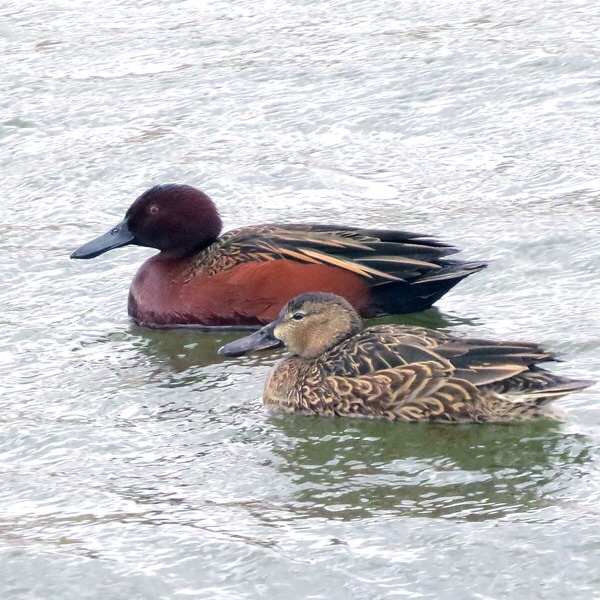
A few days later on the first morning at Patagonia Lake State Park, I saw these two Cinnamon Teal cruising along not far from shore. They were a handsome couple.

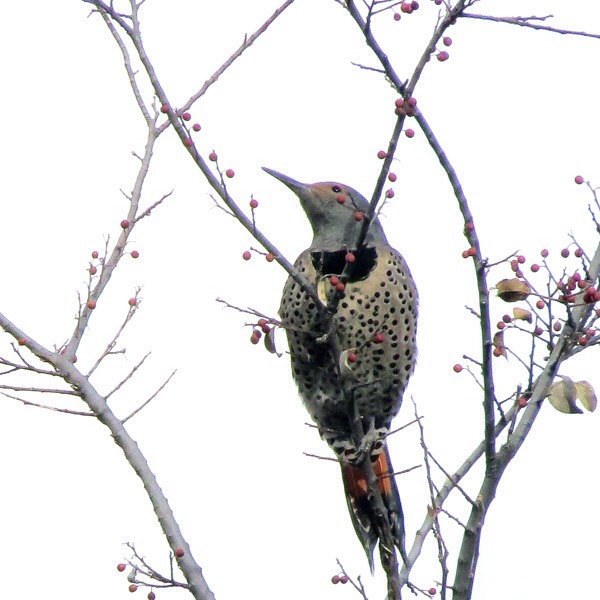
This Red-shafted Northern Flicker was one of many I saw. I also saw their cousin, the Gilded Flicker.

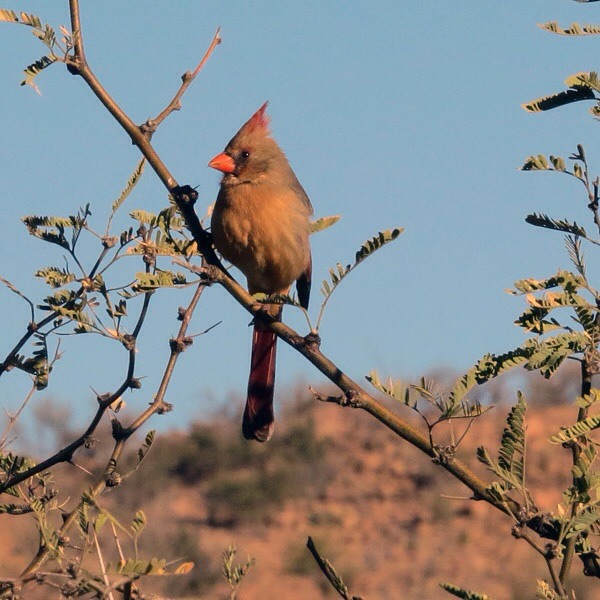
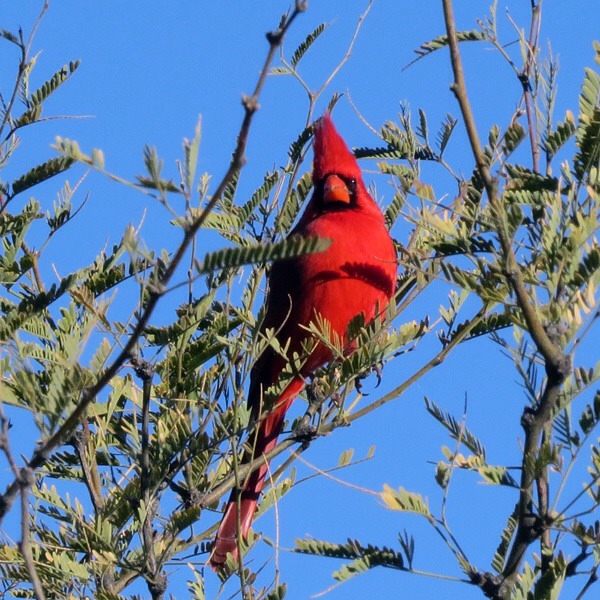
Northern Cardinals are vivid out here – as they are in the New England snow. It is a lot easier photographing without frozen fingers.

We plan to spend a longer time in Arizona this trip and hit some spots we have never visited. I’m getting psyched.

Florida no, Texas si

One of the nice things about traveling with your home tied to your truck is that it’s pretty easy to change destinations and itineraries. And we have – we’ve decided to forgo the carefully-planned trip to Florida and head to the Southwest once again.

In putting the Florida plan together last month, I kept running into full parks or places with just one or two spots left for a few days here, a week there. It looked like every place I reserved would be completely filled and I had visions of lines to check-in, to use the dump stations, and perhaps even the showers. Many people had commented on the congestion and traffic in general and the other day, an experienced birder friend just rolled her eyes when I mentioned Florida over Texas. That sort of sealed it for me.

The other factor is that as I studied the bird books, I noted that with few exceptions, I’d already seen most of the birds in Florida – with about a half dozen exceptions. While I like seeing birds again I also like to add new ones and there are many out west that I’ve missed in our past trips.

<a href="https://www.vtbirder.com/florida-no-texas-si/634557370163637d93d2z/" rel="attachment wp-att-2928"><img class="size-full wp-image-2928" src="https://www.vtbirder.com/wp-content/uploads/2014/11/634557370163637d93d2_z.jpg" alt="One of the birds I missed last year was the Tropical Parula. photo by Nate Swick" width="640" height="359" /> One of the birds I missed last year was the Tropical Parula. (Mary got it but I’ve got over that!) photo by Nate Swick

So I cancelled the many reservations I had made – took a modest financial hit for doing so – and started plotting how best to get to Texas in January and Arizona after that. It feels right and I’m already reading the Texbirds reports just to get the birding juices flowing.

We plan to leave right around the first of the year if the weather allows and will likely aim for the Rio Grande Valley for the first major stop. We want spend time in the Patagonia, AZ area again and log some time at our favorite stop, Goose Island State Park.

<a href="https://www.vtbirder.com/florida-no-texas-si/15576261305de03d4d598z/" rel="attachment wp-att-2929"><img class="size-full wp-image-2929" src="https://www.vtbirder.com/wp-content/uploads/2014/11/15576261305de03d4d598z.jpg" alt="Another rarity that I will be looking for is the Hook-billed Kite. photo by Peter W. Wendelken" width="640" height="422" /> Another rarity that I will be looking for is the Hook-billed Kite. photo by <a href="https://www.flickr.com/photos/neotropicalbirdsmayanruins/">Peter W. Wendelken

Yesterday, while the weather was rather balmy for November, I moved the Airstream from the back lawn to a spot that is suitable for loading and a straight shot down the driveway. It was much better to do it now than in late December. Stay tuned for trip reports in the coming year.

Winterizing the Airstream

With temperatures forecast for 22 degrees F last night, I felt pretty smug having a wood fire going in the house and having the Airstream winterized and ready for what we know is up ahead. The fact that I worked on the project a week or so ago when it was rather balmy makes it even nicer. At the risk of much more info than most people want, let me briefly run through the process that I use on the Safari.  Every rig is a bit different but essentially, it’s a matter of getting water out of the lines and tanks and replacing it with anti-freeze.

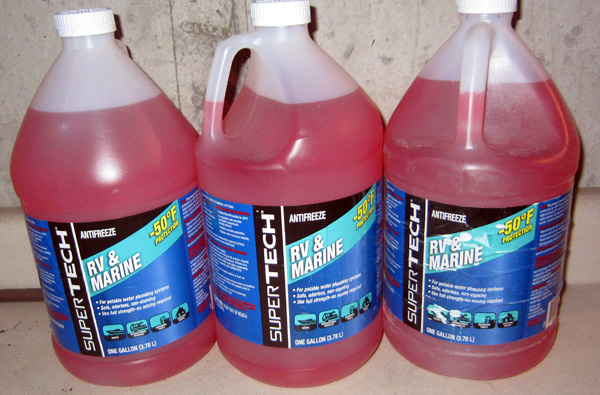
This propylene glycol antifreeze is about $5 a gallon. It takes about two gallons for the Airstream.

This propylene glycol antifreeze is about $5 a gallon. It takes about two gallons for the Airstream.

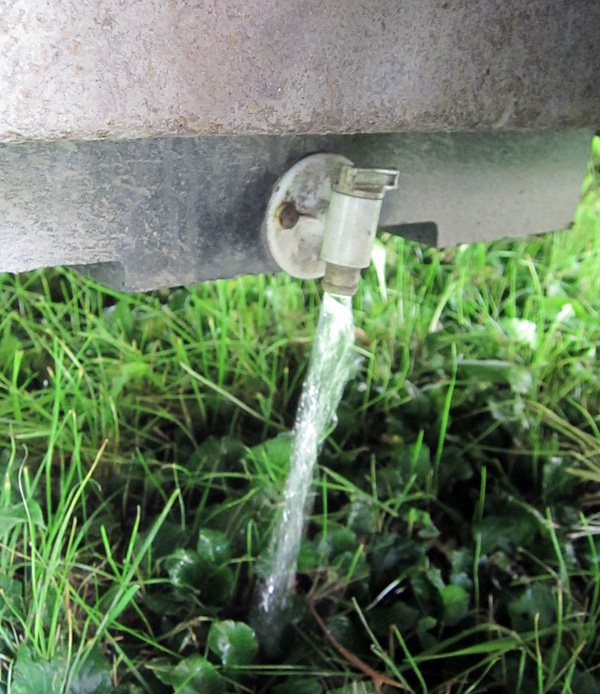
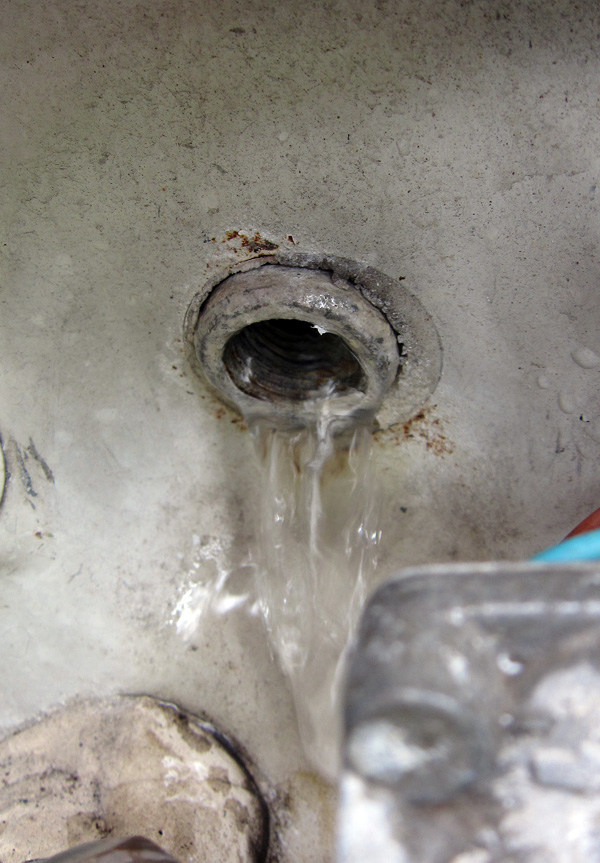
The first step is to drain the water out of the system.  Some folks use compressed air on the lines to help with this but I just open the drains.  There is the fresh water tank drain, a plug for the hot water tank, and some drains underneath for low points in the lines.  Of course, you should have your black and grey water tanks empty or just containing some anti-freeze.

Believe me, it's much easier to drain the water tank when it is 50 degrees out than 30 and blowing snow pellets.

Believe me, it’s much easier to drain the water tank when it is 50 degrees out than 30 and blowing snow pellets.

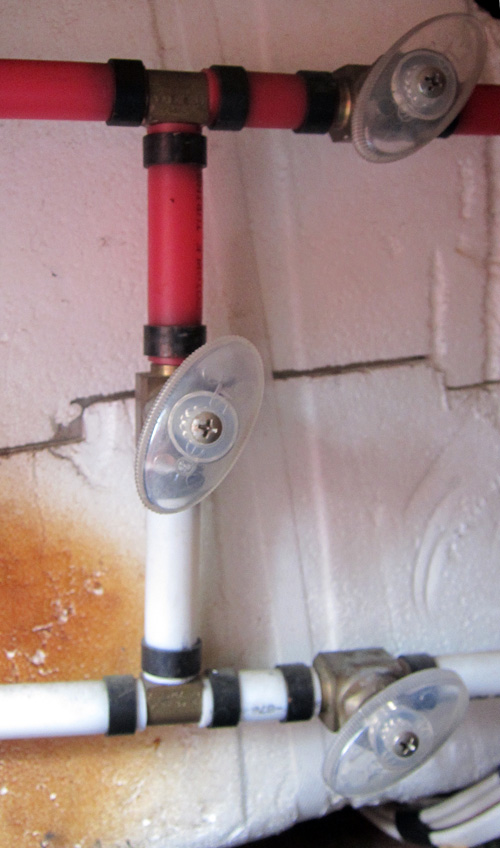
One of the key steps in the process is to bypass the hot water tank so that you keep it empty and do not introduce costly anti-freeze into it. There are three valves and while I have it in my written instructions, I just close the open ones and open the closed one, and reverse that process when getting the system back in operation in warm weather.

The valves on the horizontal pipes are closed in winter and the one on the vertical is opened, bypassing hot water tank.

The valves on the horizontal pipes are closed in winter and the one on the vertical is opened, bypassing hot water tank.

The hot water tank plug is easy to lose -- I usually put it back in loosely after draining.

The hot water tank plug is easy to lose — I usually put it back in loosely after draining.

Now, you pump in the anti-freeze.  The previous owner installed a short length of plastic tubing that I can insert in the gallon jug, and after changing a valve near the water pump, draw pink fluid into the system. It’s just a matter of opening a faucet, turning on the water pump, and waiting for the water in the line to discharge and for pink fluid to start flowing. You do this for hot and cold on the sink, lavatory, and shower. Make sure to winterize the flexible spray hose in the sink. (That’s the voice of experience.)  Do the same for the toilet, dump some anti-freeze down all the traps, and you should be pretty well done.

This year, I caught the flush water in a pan and tossed it out the door, keeping it out of the grey tank. It took a little less than two gallons and I think it’s all set.  We’ll see in January in Georgia when we defrost and light off the system again.

PhoneSkoping

I have pretty much transitioned to using my iPhone 5 for digiscoping using an attachment called a PhoneSkope. As I mentioned in a previous post, I always have my iPhone in my pocket and it’s a handy way to shoot through the scope. The quality gets better with each iteration of the phone, and an iPhone 6 may be on the not too distant horizon.

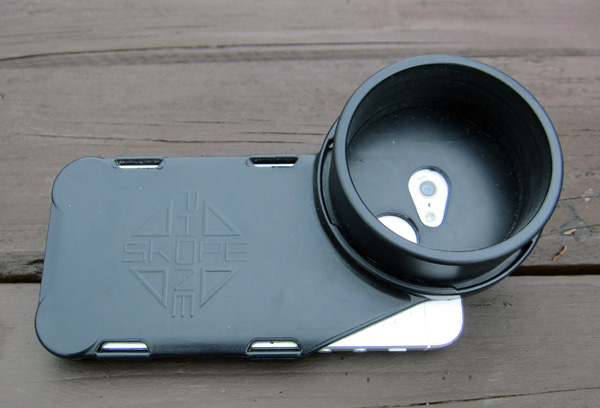
Each PhoneSkope is tailored for your camera and your scope. The cost is about $80 for case and adapter.

Each PhoneSkope is tailored for your camera and your scope. The cost is about $80 for case and adapter.

The setup is simple. You just put your phone or tablet into the case and attach it to the optic adapter by twisting and locking it in place. You then slide the optic adapter onto the end of your scope eye piece. It’s about a one-minute deal – I keep the case and adapter on the phone while I’m birding. (You can still use all functions of the phone.)

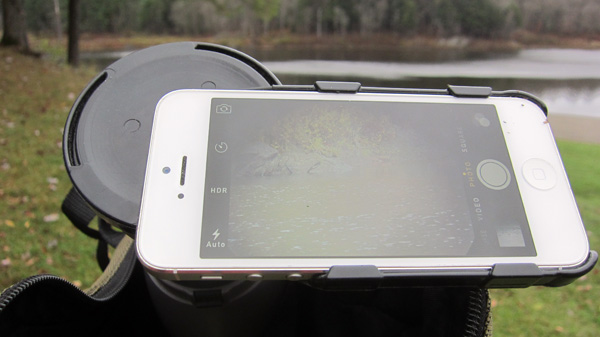
Here's what you see - and you can either photo or video, and change the scope setting to get in closer.

Here’s what you see – and you can either photo or video, and change the scope setting to get in closer.

There are lots of blog posts on using the iPhone (and other smart phones) so my suggestion is just to get out and shoot. It’s easy and even if there is some vignetting, you can reduce that through a finger swipe on the screen. The images are pretty good sized and  can be perfect for web work.

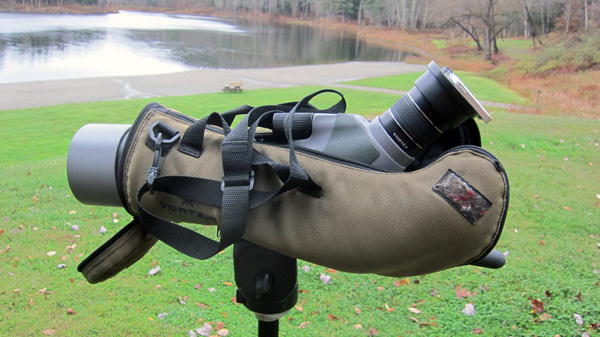
Here's what I lug around although I usually take the phone off the rig and zero in on the bird with the scope.

Here’s what I lug around although I usually take the phone off the rig and zero in on the bird with the scope.

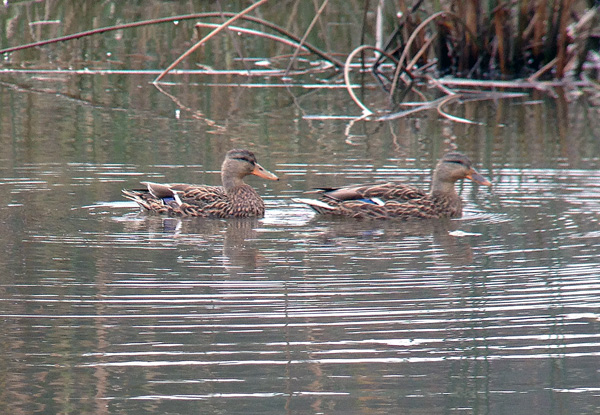
Here are a couple of Mallards I got with the iPhone the other day -- nothing special but a nice easy shot as they cruised along.

Here are a couple of Mallards I got with the iPhone the other day — nothing special but a nice easy shot as they cruised along.

I know there are other adapters that folks use and like. PhoneSkope has worked well for me and I see that they have created them for the new iPhones and other tablets. Consider giving it a try – you’re likely carrying a pretty good camera in your pocket.

Won’t Get Fooled Again

Yesterday morning, after seeing some Black Scoters on a local reservoir, I drove up to Lamoille County to try my luck there. I saw six male Hoodies on a small pond beside the road which seemed to bode well for the birding up ahead. Well, not exactly.

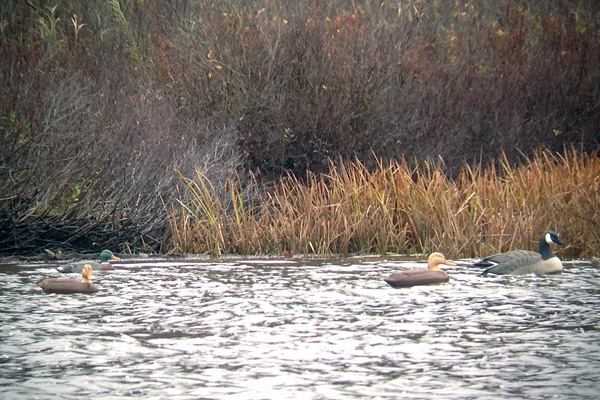
I pulled into the boat launch area at the south end of Lake Elmore, my usual first stop, and saw that the stiff wind had the water pretty roiled up. Scanning from the truck, I saw a line of Canada Geese hunkering down in the tall grass on the far side. I thought I saw some ducks also so I hopped out into the breeze and set up my scope and started quickly scanning through the six or eight geese, looking for something different like a Snow Goose. Here’s what I saw:

Decoys2W

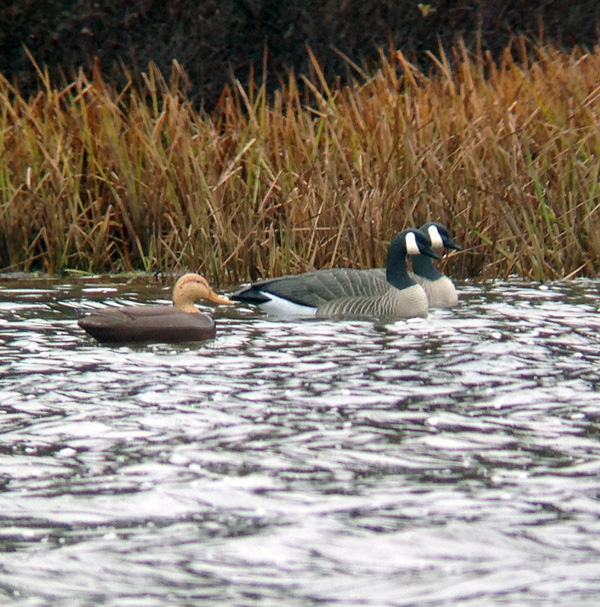
I then looked at the ducks thinking, “That’s a female Mallard – no it’s not.” Then I saw the male Mallard and realized that these weren’t ducks, they were decoys.

Without the bobbing and the shaking scope, these are obvious as decoys.

Without the bobbing and the shaking scope, these are obvious as decoys.

I swung the scope up lake and scanned everything else and then heard a couple of “wank, wank” calls from the decoy area. Figuring that a hunter was trying to yank my chain, I looked once more and saw a small camoflauged shelter in the reeds. I gave a wave and headed out, a bit chagrined but a little wiser.

I don’t monitor hunting seasons (obviously) and since we have limited waterfowl activity midstate, you don’t hear a lot of shooting or seeing hunting activity. I mainly worry about deer season.

We had a good morning although nothing unusual – it was just good to be out with the dog between rain showers. I stopped on the way home and grabbed a few shots of the decoys to illustrate this post. It is funny how obvious they are once you know they are decoys – but at first glance with a shaky scope…. That’s why they work for hunters.

The lesson of the day – if the birds are staying put in your scope they are probably not just being cooperative, they are probably tethered.

DIY Repairs

Owning an older Airstream is always an adventure, whether you are trying to find a leak in the roof, a mouse in a cabinet, or solution to a problem you yourself caused.  This is a short story of owner-caused damage and DIY repair.

You learn pretty fast that you need to know how to fix things when you travel with an RV of any type. I’ve repaired dents, replaced punky floor segments, and done many along-the-highway fixit jobs. This time, it was my back yard.

I was setting up the ‘stream on the back lawn for a few months and needed some planks to keep the wheels from sinking in and to level things out. As I drove on to a long plank, the tire caused the wood to swing up and bashed the rod to the grey water tank – tore the whole thing off. (I don’t have pictures because I was too mad a myself to think about getting a camera.)

The foot-long rod with its handle lie there, looking pretty lonesome, and the guide for it was pulled out by the rivets. I could, however, get a hold on the rest of the rod and pull it out.  I had visions of traveling with a Vise-Grip this winter.  First thing I did was to try to epoxy the old rod onto the remaining section.  Two days later, a test pull ended that experiment.

Some good friends of mine, Shawn and Helen, had recommended a local RV dealer who I had never visited. It’s a small mom & pop operation called M’s RV Sales & Service.

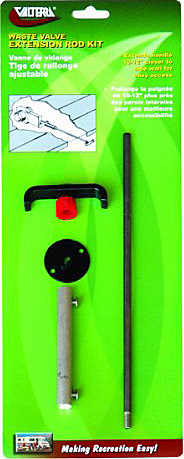
ValterraWI know that no outfit likes to work on grey or black water tanks and was dreading the visit but decided to go down and talk to them about options. What a breath of fresh air! As soon as I showed Marcel and Joanne the broken rod they not only made me feel better by saying, “We see lots of those,” but also came up with an easy solution — a rod extension kit.  Marcel gave me some ideas on how to proceed, how to deal with the rivet that was still on the other end of the rod, and sent me off with a “We like to work with owners that do their own work — give us a call if you get stuck.”

The fix went rather easy after the coaching – I was pleasantly surprised. I also was pleased to find a small dealer who will be a great “go to” person if I need one down the road. I might be calling him for repair advice from Florida this winter. Hopefully not.

I you are in the Central Vermont area, M’s is just south of Montpelier on Route 12. Good people, great service.