Observing the hard side of nature – a bear story

     Sometimes we are given a rare opportunity to experience an event no one could ever imagine.  By being aware of one little sound in the forest, I was able to witness something that otherwise would have gone unnoticed.  It has affected me in a profound way.  It is a story I will tell as long as I live.   This story is not an easy one to tell, or to read, but it is real.  It is primal.  And I cherish the life that was sacrificed so that others can thrive.  Be prepared to be moved if you decide to read on.

     I heard the snap of a branch in the woods. My immediate reaction was to dismiss it, assuming it was a dead limb from a snag.  I decided to give it full my attention.  When I looked up, I was surprised to see a black bear running full speed down the steep slope along the east side of my house.   It turned and with amazing agility despite it bulk, slalomed its way through several saplings, and followed along the edge of the woods past the south side of my house.   What was it running from?  I had to know so I hurried around the north side of my house feeling confident it made enough of a barrier between us. Besides, the bear was about 100 feet away and my front door was within five quick strides! I felt safe. Peering around the west side of the house, I caught another look at it.    I was thrilled to have this incredibly long view: black furry portly belly, lumbering stride, tan face, small ears, and stubby tail.  It seemed to be an average-sized adult and I thought it might be a female.

IT’S ABOUT TIME!” I thought to myself.   I have been waiting several years for my first bear sighting since I moved here.  I had heard enough bearanoid stories from the previous home owner, neighbors, and folks around town.  One fall I found a large bear calling card (scat) in my driveway full of seeds, apple, and corn. On the forested hillside above my house, beech trees with claw marks and “nests” are undeniable signs of their presence.  It was just a matter of time before I’d actually see one in motion.

The bear was still running hard and just in front of it, I could to see the tell-tale spots of a young fawn.  It was frantically fleeing and I knew it was soon to be a goner.  I’ve heard that bears will sometimes take a fawn, but I never thought I’d witness such a thing.  Next I realized they were heading toward the road and they were both in danger.

photo by vladeb

photo by vladeb

My house is surrounded by forest and has a sense of wildness, but is also close to a main road. Although the highway is on the edge of several well-traveled game trails, it does not penetrate or fragment the forest. Over the years I have seen many nature stories unfold here.  There was the winter of the short-tailed weasel that would frenetically slink its way through the old stone wall in search of a meal.  Another winter I had a long glimpse of an even rarer weasel, the fisher.  It parked itself under a suet feeder and cleaned up the greasy crumbs left by the birds.  This summer’s entertainment included a 30-inch long garter snake. It  magically slithered up a stone wall, turned at the top and came back down while its back half still continued up… like opposing escalators at Macy’s Department Store.    I have also enjoyed over 80 species of birds that I’ve heard or seen here.

One dark November morning I was drawn to the window by raucous shrieks of blue jays.  Like today’s event, I witnessed another gruesome act of nature.  A merlin (falcon) was using the yard as a B&B during her migration.  The jays were unusually loud and sounded disturbed. One of their kind was pinned below the merlin.  After a few minutes of wrestling, the merlin prevailed and flew off with her meal.

It seems natural to want to intervene, to be the fixer of “problems,” and help the weak or unfortunate.  The thought does pass through my mind even when I see a blue jay (egg-stealer, baby-bird-raider) in trouble.  Here I was again, feeling like I should race to the road, stop traffic to spare the bear and the fawn.  How ridiculous, but it’s human nature to react with emotion and want to do something.

I flashed-back in my brain to a day I hiked with my friend Deb and we came upon a similar scene.  A snake had caught a frog by just one back leg and couldn’t get its mouth around it to swallow.  The frog tried to crawl away.  We didn’t interfere, but a young girl and her father came along the trail.  She pleaded, “Daddy, the poor frog! Do something!”  The father used a stick to lift the snake, then  jiggled it until the snake lost its hold on the frog.  The frog was free and the snake was hungry.  Poor snake, I thought.

Of course, all I could do was watch the animals sprint away.  I hoped somehow the fawn would escape and I lost sight of them.  I almost believed it could happen, but I knew that was very unlikely.  My heart broke when I heard the cry of the fawn, sounding like a baby lamb.  Overwhelmed with empathy, I felt the terror of that moment and it nearly undid me.  Such a tiny, innocent creature…Nature isn’t fair.

Watching Nature on ETV teaches this lesson, but it is drastically different.  There is an emotional distance or displacement that happens when I’m passively sitting in front of a box, in my living room, knowing the event is from the past.  When it is too much to bear, it can be muted, changed, and turned off.   It makes it seem less real.

But this was real and I felt totally engrossed; I grabbed my binoculars.  I called friends, Keeping Track, the neighbors.  They asked if I was documenting it.  No, I was living it.  I found the bear on the west side of the house, in the woods about 100 feet away.  My front door was 15 feet away.  I felt safe.  The bear was partially blocked by a fallen pine tree but I could see her panting and settling down.  Was she eating?  It was very quiet and I watched for several minutes.

I went back inside for a moment and when I returned, I could not find her.  Where did she go?  Did something spook her?  I knew it would be incredibly stupid (perhaps fatally stupid) to approach the woods, and so I scanned from the lawn.  I found her several hundred feet away from where I believed the fawn lay.  She was looking in my direction, nose held high.  She was aware of me.  Perhaps she thought, “She’s 100 feet away.  I am safe.”  She slowly ambled back to the fawn, keeping her distance from the edge of the forest, curving around my house like she was tethered on a long lead.  Occasionally she would stop, turn towards me, lift her snout again.  She must have smelled me. She settled back behind the pine tree.   We were both safe.

After 25 minutes, she picked up her prey and started up the game trail. It’s one of the trails I call “the highway,” one of the most obvious, muddiest, most used.   It’s the trail I often walk on.  It’s the trail that arcs around the west and south side of my house, up the steep hill, and eventually to a large wetland and the Vermont State Forest.  She uses it too, I thought.

She walked, head held high, holding her prize, then broke into a run. I was amazed by her agility and strength.   That is when I convinced myself she was a mother, taking the fawn to her own family. I imagined her own cubs waiting for her in the forest, growing bigger, going on.

After a safe period of time, I took my camera to the sight of the kill. I expected tracks and sign to be obvious; I expected to find carnage.  I had the right spot, but all I found were some broken hawkweed stems.  I followed the game trail, but there were no tracks, only a few broken ferns, laid flat in the direction she traveled and an occasional tuft of downy fawn fur.  I searched the east side of the house where I first heard the commotion and saw her.  All I found were some dry pine needles in raised clumps, the spacing matched what I thought were reasonable strides for a charging bear (6 tracks in about 9 measured feet).  I could see the faint trail of the pine needle clumps leading down the hill.  I searched for hairs, tracks, anything….Nothing!  Nothing to grasp on to, to tell about the tiny fawn’s little life and big sacrifice.  It all seemed so unreal to me, I somehow needed to convince myself it really happened.

Filter out your busy thoughts. Choose to pay attention.  Listen to nature.   The woods might seem quiet, but there are life stories happening out there! The sound of the branch snapping sounded different than a branch falling from the snag.  I chose to pay attention to it.  It opened the book, for this story to be told.

Alison is an experienced Vermont birder who first wrote this article in 2010.

{ 1 comment }

Bobolinks and Snipes

The fog was just lifting this morning when the dog and I launched out on a wet birding adventure at the Sparrow Farm trail.  I was looking for Bobolinks since I had yet to see one in the county this year — and no sooner had we left the truck when I heard and saw several in the large unmowed hayfield before us.  They were fun to follow with the binoculars and were very actively flying, courting, and calling.  Taking photos of them was a challenge: they were up and then back down in the grass before I could focus on them.  They were pretty heavy for the wet stalks and sort of drooped down out of sight.  Here’s one just to prove I was there.

I logged six into eBird but think that probably a dozen were there.  It was encouraging to see, given their challenges due to the lack of grassland.

I logged six into eBird but think that probably a dozen were there. It was encouraging to see, given their challenges due to the lack of grassland.

I also heard Wilson’s Snipes winnowing – something I had heard before there.  Today, they were flying, high in the sky like remote controlled model planes, winnowing as they zoomed and dove.  I tried some flight shots — what a joke?   They were fast and quite a ways up there.  Here are a couple of lame photos.

You'll probably have to take my word that this is a high-flying snipe.  It is an amazing flier,

You’ll probably have to take my word that this is a high-flying snipe. It is an amazing flier,


I tried to get this one coming in for a landing.  In retrospect, I probably should have tried the video option since they were calling the whole time.

I tried to get this one coming in for a landing. In retrospect, I probably should have tried the video option since they were calling the whole time.

We had a nice walk through the marshy area into the woods and picked up, by ear and site, about 28 other species.  As we finished, the high pitched call of Cedar Waxwings alerted me to a couple just behind me on a low tree.  Here’s one of them.

It's hard to beat Cedar Waxwings for looks - they are cool characters.

It’s hard to beat Cedar Waxwings for looks – they are cool characters.

And then, in a birding bonus, a young woodchuck posed for us.  The dog was on her leash and never saw it — fortunately for my arm muscles.


"I know I'm just a rodent but I am pretty cute."

“I know I’m just a rodent but I am pretty cute.”

If you enjoyed this post, please consider leaving a comment and subscribing by RSS feed or via email to have future articles delivered to you.

{ 0 comments }

Bonus Birding

Most of us, when we stop to think about it, have encountered things while birding that we likely would not have seen otherwise.  Birders on the VTBird listserve recently had a short exchange on this subject which was very interesting.  Roy Pilcher started it (I believe) by writing:

Most of us who spend  a reasonable amount of time birding have from time to time welcomed a non-birding experience.  Today was such a day!

In a field a doe.

Not any doe but a doe with a fawn.

Not any doe with a fawn but a doe with a suckling fawn!

Very nice!

Later, Alison Wagner, another outstanding birder, wrote:

When kids ask me, “Why do you like birds so much?”  I usually respond, “because they are easy to see.  If I go birding, I’ll be sure to see a bird. If I go bobcatting, chances are I won’t see one.  IF I go birding and SEE a bobcat, that’s a bonus! ”

Kids do this all the time, starting out on a bird walk and seeing so many other forms of nature.  Yesterday, with The Hinesburders, we found a muskrat.

It got me thinking about what non-birding things I have seen and I sort of was drawing a blank — until yesterday.  Penny, our Vizsla, and I were out in our woods walking quietly, listening to bird songs, when I noticed some movement up ahead and saw a Coyote, or CoyDog, quietly moving through the ferns and underbrush, nose to the ground.  It was close and I got my camera on it but the trees and ferns kept blocking it.  It never saw or smelled us but it was moving closer, and Penny was behind me and doing her own thing.  So I yelled, and it wheeled and ran with my red dog chasing right behind it.  I yelled and yelled at the dog and fortunately, she gave up after just a few hundred yards and came running back, all cranked up and ready to rumble.  We retreated back toward the house and all is well.  It was probably the kind of bonus that I don’t need with a dog along, but even then, a thrill.

You'll have to take my word that this is a wild coyote or coy dog - it was hard to tell.  I was surprised that it got so close to us before I spooked it intentionally.

You’ll have to take my word that this is a wild coyote or coy dog – it was hard to tell. I was surprised that it got so close to us before I spooked it intentionally.

On a less exciting vein, I thought about some birding walks we took at Ricker Pond State Park earlier this week and thought of the Pink Lady’s Slipper that I found along a trail.  It was definitely a birding bonus.

LadySlipperW

What are your bonus birding stories?  Send me a few paragraphs at vtbirder at gmail.com.  I’d love to publish a few collections of experiences that others have had.  What is the most interesting thing you have seen while birding that you likely would not have seen otherwise?

If you enjoyed this post, please consider leaving a comment and subscribing by RSS feed or via email to have future articles delivered to you.

{ 3 comments }

Young ‘Uns

Seeing the influx of juvenile Purple Finches discovering our bird feeder each morning, I get another sign that birds are nesting, chicks are fledging, and juveniles are chowing down.  Here are a few photos I took of momma birds doing their thing:

Canada Geese and a couple of youngsters at Berlin Pond. Others on the pond had larger groups of kids -- makes one wonder what happened to the rest of this hatch.

Canada Geese and a couple of youngsters at Berlin Pond. Others on the pond had larger groups of kids — makes one wonder what happened to the rest of this hatch.

A female Mallard at Ricker Pond with quite a group of chicks.

A female Mallard at Ricker Pond with quite a group of chicks.


The state has an active loon program that places nesting sites (and warning signs for paddlers/boaters) on many ponds.  Here is a floating platform at Ricker Pond being used.  (Photo taken at very long range from opposite shore.)

The state has an active loon program that places nesting sites (and warning signs for paddlers/boaters) on many ponds. Here is a floating platform at Ricker Pond being used. (Photo taken at very long range from opposite shore.)


{ 0 comments }

Wren’Streamer

My brother Barry and his wife, Mica DeAngelis, have restored two vintage Airstreams and have travelled to the South and Southwest for Habitat For Humanity builds and general travel.  They have always been watchers of birds but recently have sort of caught the birding bug.  Barry got a new camera a few months ago and has been testing it out here and there — and captured this wonderful shot of a House Wren in their backyard.

Barry and Mica originally thought that this birdhouse was a gag gift but Momma wren has called it home for the last two years.  photo by Barry K. Mansfield, Burlington, VT

Barry and Mica originally thought that this birdhouse was a gag gift but Momma wren has called it home for the last two years. photo by Barry K. Mansfield, Burlington, VT

{ 1 comment }

Kayak Birding

Five years ago, when I would kayak early in the morning, I’d strap on my iPod and crank workout tunes and paddle hard up and down  the placid waters of our local Wrightsville Reservoir.  I was sort of oblivious to my surroundings as I worked on technique and speed.  That was before I was a birder.

Yesterday, I let the birds provide the music — and did they ever.  I wore my binoculars, covered with a plastic bag, and carried my camera in a dry bag in the cockpit and set out on a quiet, fog-shrouded journey.  Four Canada Geese came honking in and landed with a splash quite near me — we seemed to be the only critters on the water.

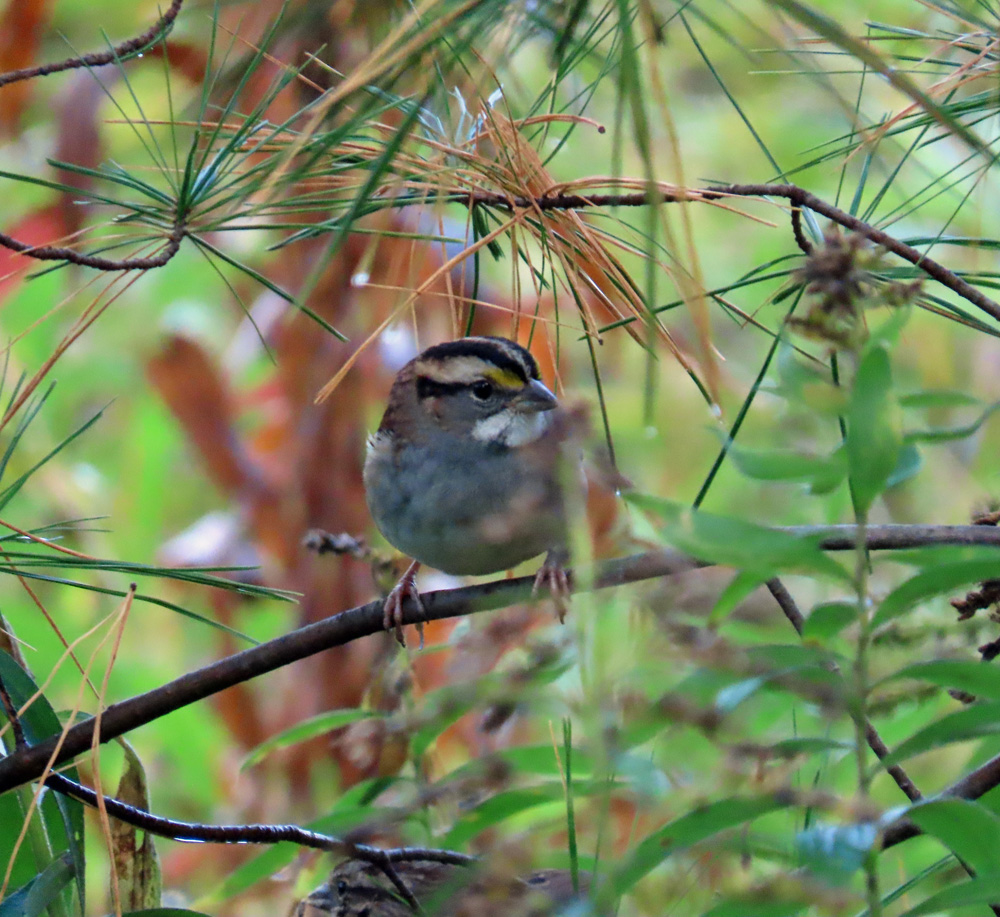
Heading north on the reservoir with the still air punctuated by the songs of Ovenbirds and White-throated Sparrows .

Heading north on the reservoir with the still air punctuated by the songs of Ovenbirds and White-throated Sparrows .

I’m not great at bird call identification but had dozens to chose from as I cruised along — I think I had 25 species in the first 15 minutes.  Kayaks let you cruise up close to the shore and approach some birds rather closely.  I was gliding toward a perched Belted Kingfisher for a photo but made the same mistake I can make on land: I moved too quickly raising the camera and spooked him.

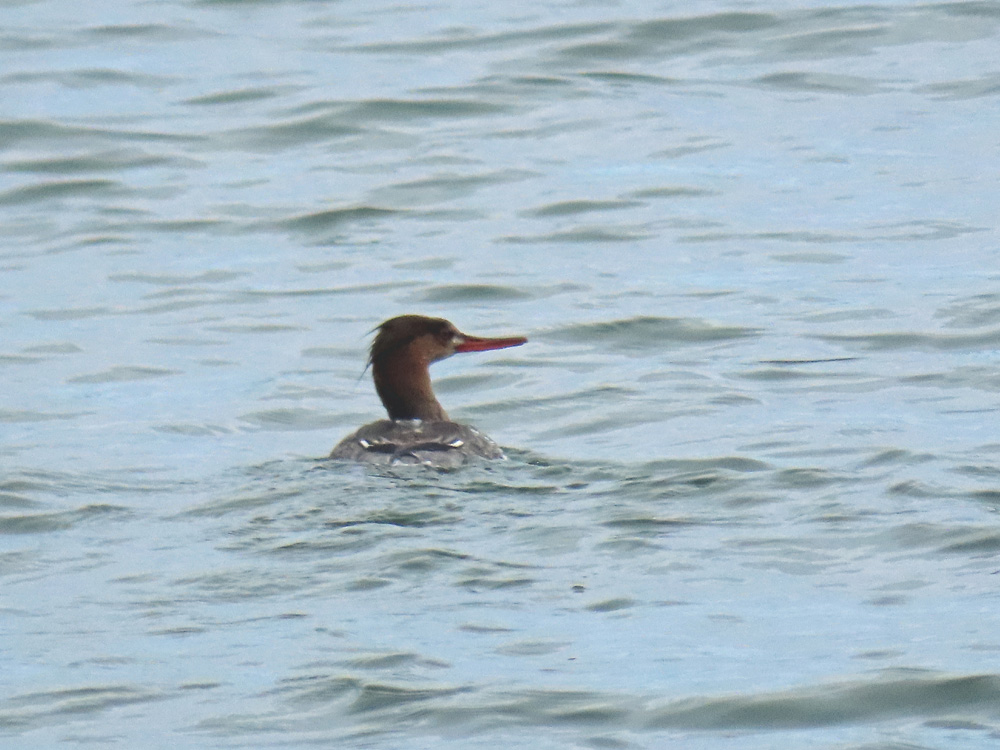
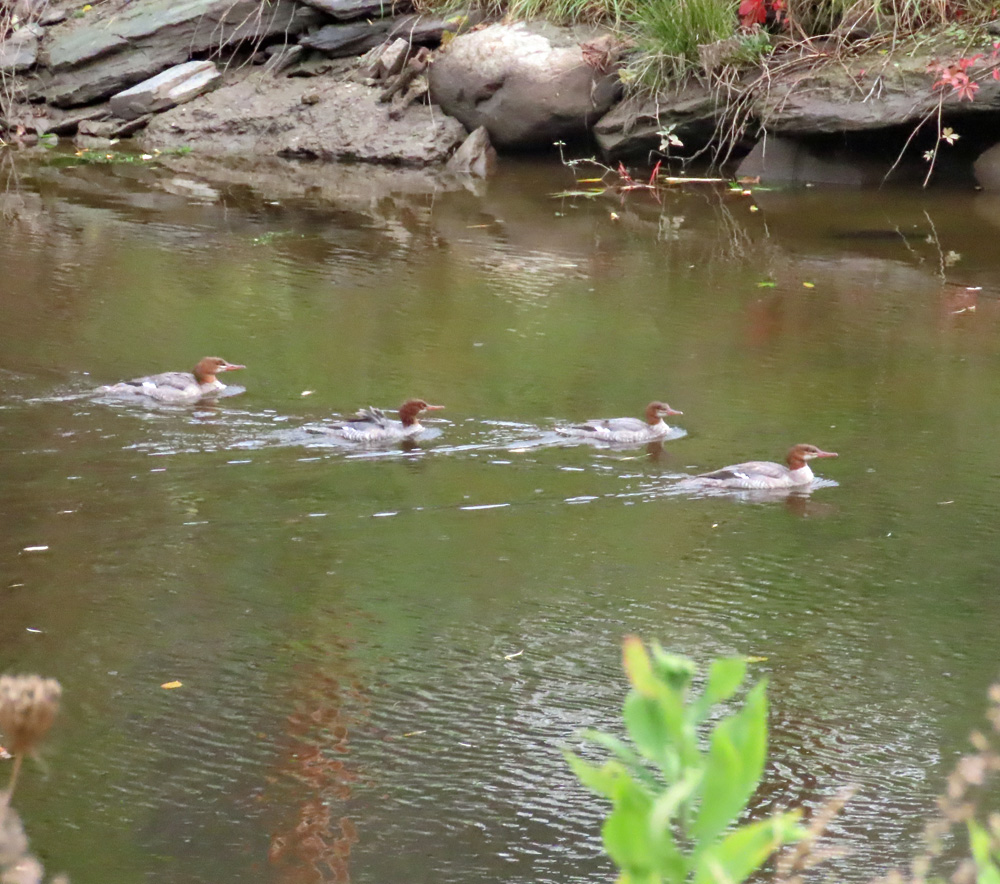
Up ahead, a Common Merganser was feeding in the shallows.  I approached her slowly, hardly paddling, and she seemed undisturbed, but just easing away from this big approaching object.  Here’s a shot I took from the kayak.

It's a tough life being a small migratory bird. Studies estimate that half of all adult Ovenbirds die each year. The oldest known Ovenbird was seven years old.

It’s a tough life being a small migratory bird. Studies estimate that half of all adult Ovenbirds die each year. The oldest known Ovenbird was seven years old.

Merg1W

The North Branch River runs into the reservoir on the north end resulting in a short stretch of quiet water with narrow banks and overhanging trees.  It was easy to cruise up to warblers and sparrows — I got some great looks at a Mourning Warbler.

Returning, I spooked two beavers out for an early sapling breakfast and approaching the takeout ramp, saw a gull that seemed out of place.  It let me get pretty close so it was either used to people or not feeling well.  I snapped a few shots and let it be.

A Ring-billed Gull on the shore, perhaps waiting for me to feed it.

A Ring-billed Gull on the shore, perhaps waiting for me to feed it.

It was a great paddle and I logged 35 species, getting a mild exercise session in while enjoying a perfect Vermont morning.  It was the first, but won’t be the last, birding by kayak outing of the year.  Nice way to multi-task.

{ 1 comment }

Teacher, Teacher, Teacher

Ovenbirds seem to thrive in our woods.  Each morning, I hear six or more calling back and forth and sometimes, there seems to be even more.  But to see them is another thing.  They can be right next to you calling but if they don’t move, they blend with the forest floor and the low branches.  I always am surprised at how small they are – given their loud voice.  The other morning, two were courting or fighting, and not only did I get a good look, but one perched on a branch 10 feet away.  Of course, it was on of the few dog walks were I left my camera home.

Yesterday morning, I got lucky.  I saw a cooperative Ovenbird who sat still long enough for me to find him in the branches and take a couple of shots.

It's a tough life being a small migratory bird. Studies estimate that half of all adult Ovenbirds die each year. The oldest known Ovenbird was seven years old.

It’s a tough life being a small migratory bird. Studies estimate that half of all adult Ovenbirds die each year. The oldest known Ovenbird was seven years old.

You can see just a bit of the orange crown bordered by black stripes.

You can see just a bit of the orange crown bordered by black stripes.

The other fun fact from my perspective is that Ovenbirds are usually low – on the forest floor or low branches.  They are great for birders, like this one, with a pinched neck nerve.


{ 3 comments }

Planning a House Wren Party

I have made and put out bird houses for the last three years, hoping to attract a pair of Eastern Bluebirds, but I have not even attracted a Tree Swallow.  Zip.

This spring, I took down the houses I had scattered throughout our woods, cleaned them up and changed some fronts where red squirrels had gnawed the holes.  I then mounted them in the open around my bee yard, hoping that the openness and light would make up for a few lost bees.

About two weeks ago, I spotted a House Wren checking out a couple of the boxes and bringing a twig to one of them.  Then, nothing.  Last week I checked the boxes and there was no activity in any of them.  However, two days ago, I noticed a House Wren again checking one out, and as I watched, she brought all sorts and sizes of twigs to the box and proceeded to build a nest.

Some of her twig selections were on the optimistic side.

Some of her twig selections were on the optimistic side.

"Is this more like it, oh critiquer?"

“Is this more like it, oh critiquer?”

"And by the way, that hole you cut isn't round, ol' wood butcher!"

“And by the way, that hole you cut isn’t round, ol’ wood butcher!”

So, Cornell lists the gestation period from 9 to 15 days.  Hopefully in a week or so, we’ll have a hatch of little wrens.  Of course, I’m bringing to new hives with about 60,000 bees to her front yard today.  I suspect, if she’s on the nest, there’ll be no conflicts.
In the 13 years we have lived here, we’ve only had a few nests here and there that we knew about.  We’ve never had one in a bird house.  Hope springs eternal for a few new HOWR’s as neighbors in late May.
If you enjoyed this post, please consider leaving a comment and subscribing by RSS feed or via email to have future articles delivered to you.

{ 1 comment }

Flashes of Red

For the last several weeks, we have had dozens of Purple Finches coming to the feeder and just hanging out in the trees around the house.  They remind us of the influx of Common Redpolls we got last winter. Like them, finches chow down on sunflower seeds big time.  It’s wonderful to hear them sing each morning as I walk the dog — they seem to go on forever and their melodies are delightful.  They have gotten more red in their appearance and are parading in full breeding plumage these days.  Here’s one on our apple tree last evening.

Purple Finches not only sing like angels but are beautiful this time of year.

Purple Finches not only sing like angels but are beautiful this time of year.

Today, I birded early with the dog and got an email from Mary with a subject:  ”At The Feeder.”  Because of poor reception on the iPhone, the message did not download — but I suspected what she was writing about.  When I got home, I got cell coverage off our home system and read as I sat in the truck in the garage:  ”Rose-breasted Grosbeak!!!”

We’ve been hoping for some orioles because birders in the area have been seeing a few.  Of course, the bird never showed again as I prepared for a doctor’s appointment in Hanover.

Several hours later, after successful lab test results, I got a text from Mary:  ”He’s back again.”   Of course, I was an hour and a half away in another state.

Arriving home in the afternoon, I hoped our friend was not just passing by.  Sure enough, about a half hour after I got home, I saw him in the apple tree.  What a handsome addition to a tree already laden with Purple Finches (and a few apple blossoms.)  So, he’s County Bird 95 and we are hopeful that he’ll stick around and nest in the neighborhood.

"Hey, are you pointing that camera at me?"

“Hey, are you pointing that camera at me?”

If you enjoyed this post, please consider leaving a comment and subscribing by RSS feed or via email to have future articles delivered to you.

{ 0 comments }

Savannah Sparrows

Yesterday morning, I went up to the aptly-named Sparrow Farm in East Montpelier for a repeat visit to a spot where I picked up five new County birds yesterday.  The area is a fine combination of wetland, farm fields, and forest and has a nice variety.  It’s a favorite mountain biking trail but early in the morning, no one is around.  I got another FOY as I ended the outing by crossing a large hayfield.  Perched on a clump of last fall’s hay was a small brown bird, indistinguishable through the binoculars.  It let the dog and I get closer and I could hear and see it singing — sort of a buzzy call.  It was a pretty Savannah Sparrow.

A Savannah Sparrow at the Sparrow Farm.

A Savannah Sparrow at the Sparrow Farm.

Later, I went up to the airport to do a little work on my plane and then took a walk with the dog to check out grassland birds there.  A sparrow came flying across the runway and perched on the perimeter fence not far from our position.  It was my second SASP of the day.

At the E.F. Knapp airport in Berlin, VT.

At the E.F. Knapp airport in Berlin, VT.

So, now I am looking for White-crowned Sparrows which have been reported in the County.  There’ll likely be a few other species, like Vesper, that I will watch for as we head toward summer.  It really helps, this time of year, when the sparrows sing, to help me sort out those little brown jobs.

{ 0 comments }