Category Archives: Birds

Northern Shrike — The Butcher Bird

One of the winter birds that I have yet to see and add to my life list is the Northern Shrike.  We’ve been away much of the last three winters but there’s also been a fairly reliable visitor, which we call the “Appleby’s Shrike,” hanging out in the trees near the popular Berlin, VT restaurant.  Most of my birding friends have seen it but for me, it’s just one of those, “Oh, you should have been here an hour ago” birds.  Close encounters during the winter months I’ve been around.

I’ve seen many Loggerhead Shrikes in my Southwest journeys  —  this winter, one of my goals is to see my first Northern Shrike here in Vermont.  I mentioned that in a Winter Birding – Bring It On post last month.
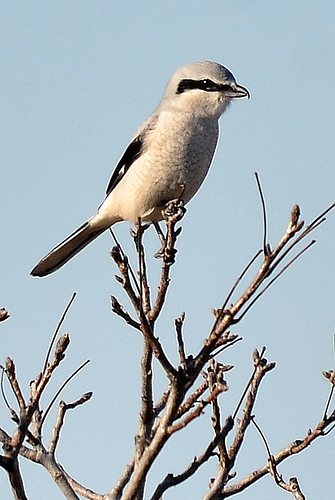
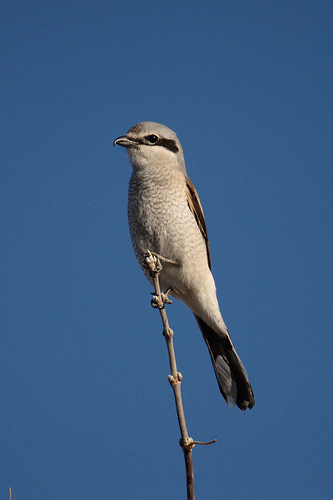
The shrike hunts by perching atop a tall shrub or tree at the edge of a field where it surveys the surrounding area for songbirds, insects, and small mammals.

The Northern Shrike is a songbird that is slightly smaller then a robin. They breed up up in the Arctic Circle of Alaska and Canada. During the winter you may find them around your feeder if you live in the northern half of the United States. Unlike the other birds they are not there for the nyjer thistle, cracked corn or other type of seed.

A predatory songbird, the Northern shrike sits on an exposed perch and watches for insects, small birds and mammals, or reptiles.  They do not have the powerful talons that raptors use to catch their prey — they grab their prey with their feet, and kill by biting through its victim’s neck. They will impale prey, sometimes while still alive,  on the barbs of a fence or large thorns. They often kill more prey then they can eat, which is how they received the scientific name Lanius excubitor, roughly translated this means butcher watchman. This species is known to pierce its prey onto thorns, sticks, fences and other pointed objects where it will either immediately eat its catch, or leave it impaled to be eaten at a later time.

The main field marks which help to easily identify the Northern Shrike are its stout bill which curves at the tip, and its distinctive black mask which goes from the base of the bill through the eye and to the side of its large head.  Generally speaking, its upper portions are gray and the underneath are an off-white/soft gray with a faint barring on its chest.  Its wings are black with white patches.  The Northern Shrike is a medium sized song bird, yet when it flies by, at first glance one generally thinks it may be a out-of-season Northern Mockingbird because of the similar coloring; however, once you see the curved bill and black mask you know that you have seen a rare visitor from the north.  I’m already looking every time I go past the turn for Applely’s.

Note:  Vermonter Tom Slayton wrote a wonderful article on Northern Shrikes last year.

Image by cheepshot

If you enjoyed this post, please consider leaving a comment and subscribing by RSS feed or via email to have future articles delivered to you.
Smart Birds Stash Stores, Thwart Thieves

We know that squirrels make the most of fall’s plenty by hoarding nuts for the winter, but the fact that birds also store, or cache, food goes largely unappreciated. Through clever observation and experiments, biologists have found that food caching (from the French cacher, “to hide”) has developed to a high art in some birds.

Take the chickadee, for instance. Chickadees put tens of thousands of food items a year into short-term storage. They usually retrieve and eat the food in the space of several days. Each food item is cached in a different place to make it difficult for thieves to steal all the food at once. When hiding a new item, they remember their previous storage sites and avoid placing caches too close together.

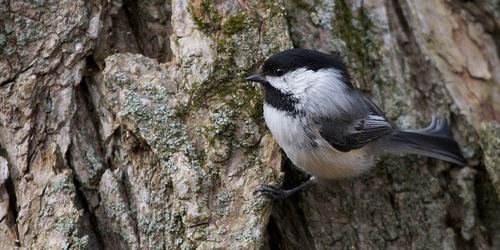
The Black-Capped Chickadee hides seeds and other food items to eat later. Each item is placed in a different spot and the chickadee can remember thousands of hiding places.

Chickadees remember each hiding place for around a month, even though they may be scattered widely across a bird’s territory. Research shows they use visual cues to navigate back to each of their cache sites by a combination of larger landscape features, particularly verticals, and use of the sun as compass. Smaller local details are not as critical, probably because these often change in a forest. When retrieving food, they remember which sites have been emptied, either by them or by robbers, to avoid fruitless searching.

How does a tiny bird have such brain power?

Chickadees begin to store food at the onset of fall, when seeds become abundant. At the same time, the region of the brain that handles spatial memory (part of the hippocampus) starts to grow in size by producing new brain cells to handle the huge amount of cache data. It continues to grow as more food is cached. Come spring, reliance on food stores drops, caching dwindles, and the brain area shrinks. Brain cells use a lot of energy, so to conserve resources the extra cells last only as long as they are needed. Brain growth is tied to food availability, since captive chickadees that receive plentiful food year-round do not undergo seasonal brain changes…

(Read whole article by Li Shen, an adjunct professor at the Dartmouth Medical School and the chair of the Thetford, Vermont, Conservation Commission)

Image by qmnonic

If you enjoyed this post, please consider leaving a comment and subscribing by RSS feed or via email to have future articles delivered to you.
Southern Birds

Mary and I drove three hours southeast to northern Massachusetts yesterday and it is like we became southerners.  Not only have we changed stick season’s chilly rain and fog for mid-seventies and pretty foliage, I’m hearing and seeing birds that I thought I had seen the last of until spring.  Seven Eastern Bluebirds this morning!

I have a walk from Jen’s house that I take nearly every morning I’m visiting — it’s a little over a mile down a busy road lined with oaks and often, very birdy.  I got out yesterday morning early before the homeowners got their leaf blowers going, and before the traffic picked up.  In spite of fog and a little drizzle, what a mix of bird noises greeted me.

We get a lot of Tufted Titmice here and I love their feistiness and constant chipping and singing.  They are sparse in our Vermont woods but dozens were out and about, and a couple were pretty brassy, watching me at about eye level.   I heard, and saw the whole woodpecker gang, missing only a Pileated.  The other real noisy bird was a crew of White-breasted Nuthatches joined by a couple of Red-breasted cousins.  Here’s the list from the hour-long walk:

Cooper’s Hawk  2
Red-bellied Woodpecker  2
Yellow-bellied Sapsucker  1
Downy Woodpecker  3
Hairy Woodpecker  1
Blue Jay  2
American Crow  1
Black-capped Chickadee  13
Tufted Titmouse  6
Red-breasted Nuthatch  3
White-breasted Nuthatch  6
Eastern Bluebird  6
American Robin  6
European Starling  12
Yellow-rumped Warbler  2
Dark-eyed Junco  6
Northern Cardinal  4

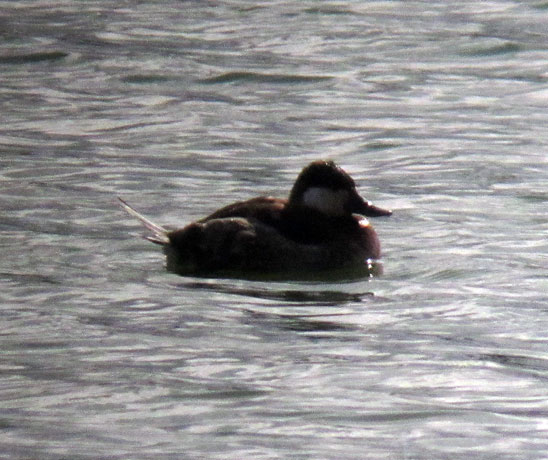
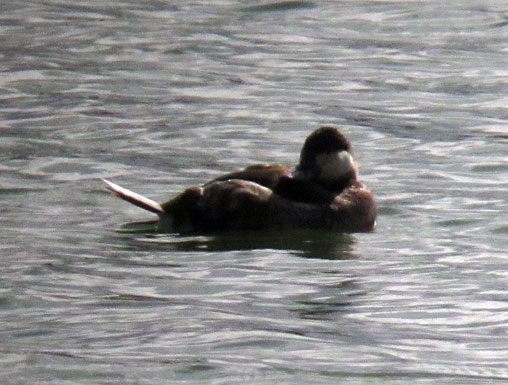
Later, Mary and I drove over to Cherry Hill Reservoir after doing some errands.  There were lots of ducks on the water but the light was horrible.  We did see a cooperative Northern Mockingbird who posed on a fence rail for quite some time, but flew off just as I got my digiscoping rig set up.  We also saw a duck species I hadn’t seen since 2010 in Texas — Ruddy Duck.  I took some photos through the scope but the light is not helpful other than for identification.

Ruddy Duck

Ruddy Ducks are one of the “stiff-tailed” ducks.

We are going to be here for several more days so I hope to get out to Plum Island and up the Cape Ann to see what migration may be bringing in. Check back here for results.

Bird Larders – storing up for winter

I’ve been watching birds cache food this week. The days are shorter, and the birds are preparing for the next season. The nuthatches prefer the hulled sunflower, and they’re choosing the heavier seeds as those are the ones higher in fat content. Their activity begins very early in the day. The titmice are taking one seed at a time and seem to cache higher in the trees than the nuthatches. The chickadees are caching in the middle of the day, and their pantry of seeds is in a knothole in a maple.

This caching behavior has its advantages. They’ll retrieve the larder of seed on days when the weather isn’t suitable for them to for forage. Their warehouses are available when the long winter settles upon them and other sources are no longer abundant, and yes, their memories are sharp!

(written by Sue McGrath of Newburyport Birders)

Brown Creepers Make Me Smile

Walking in the woods yesterday afternoon, I heard a loud “see” call. I thought it might be a White-throated Sparrow or even a Dark-eyed Junco but as I searched, I saw a little brown bird climbing up a White Pine. It flew over to the lower part of another tree and started climbing as I watched.

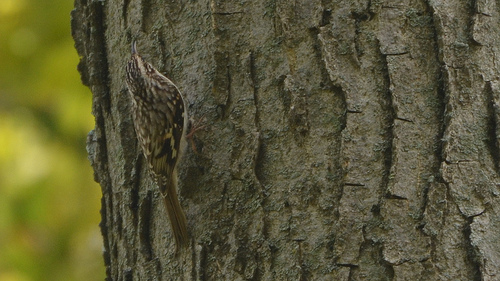
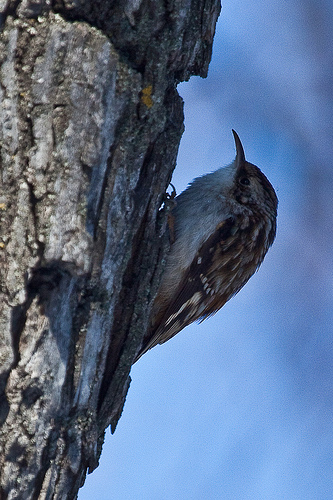
Brown Creepers blend in with the tree trunk and can be hard to spot.

Some of my friends have lost their upper range and can’t hear Brown Creepers but fortunately, in spite of being around jets and other planes, I can pick them out.  It helps because they can be really tough to see.  You sometimes can pick them up when they fly or if they expose their white belly.

Getting a look at the white belly helps spotting these elusive birds.

They seem to be oblivious to birders and once you pick them up, it’s fun to watch them spiral their way up a tree, picking bugs out of the bark with their curved beak.  They seem to balance like a woodpecker with their long tail as the work on a stubborn piece of bark.  Every so often, I’ve seen one going up as a White-breasted Nuthatch works its way down.  We have quite a few Brown Creepers in our woods – they are one of species that hangs around so I look forward to their antics this winter.  They are one my favorite birds.


Brown Creeper (top image) by Wildreturn    Lower image by David-Mitchell

If you enjoyed this post, please consider leaving a comment and subscribing by RSS feed or via email to have future articles delivered to you.
A Birder’s Band for Vermont?

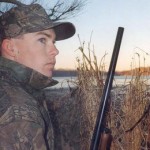
Young Duck HunterThe onset of waterfowl hunting has spawned a lively discussion on VTBirds about ways for birders to get more credit for supporting conservation efforts.  As I blogged last month, we get little respect from our contributions for Federal duck stamps and even Ducks Unlimited memberships.  My friend Scott put it like this on the list:

The thing is that the current system doesn’t provide a clear way for state and federal managers to know whether the purchaser of a duck stamp is extractive** or non-extractive oriented (or both) in his / her interests.

Consequently, when conservation issues come before legislative or administrative bodies, the voice of all those who might have non-extractive ideas / wishes are very difficult to measure, whereas the licenses and stamps are widely quoted as the constituency interested in extractive issues.

This is not to say that extractive and non-extractive conservationists don’t have many opinions in common.  Nor to suggest that there are not many of us who support both extractive and non-extractive organizations and activities.  There are.

It is just that there is a huge body of non-extractive recreationalists, citizen scientists, hikers, birders, feeder-watchers, lepidopterists, dragonfly lovers, park visitors, etc. who really don’t currently have a place at the table.

A non-extractive conservation support button, stamp, tag, etc. would give that audience a way to have its presence quantified and votes counted.  To me, that has great value.

**  Scott explains: To me, these seem like a nice terms to delineate between environmental management practices that are purposed to provide harvestable populations vs. those that are designed to maximize diversity / conserve ecosystems.  The words Hunters and Birders tend to polarize and divide.  People may be both, and have both objectives in mind in certain circumstances.

One of the interesting references in the discussion is the program in Maine to sell bands for binoculars to support bird conservation.  They describe like this:

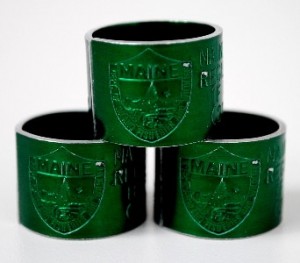
Maine’s hunters and anglers through license fees and equipment taxes have paid for the bulk of these efforts. With declining funds available for non-game and endangered species work, our bird conservation efforts now also depend on Maine’s birding community to help conserve what you care about.  For years bird bands have helped biologists understand migratory bird population trends and habitat needs. Now the Maine Birder Band is available as a tool for wildlife watchers of all stripes to support the non-game and endangered species conservation efforts of your Wildlife Department.

The Maine Birder Band can be proudly worn on your binocular strap to show your support for bird conservation. The number on each band will be registered to the buyer, and bands include a phone number where lost and recovered optics can be reported allowing us to notify the registered owner.

So, there has been some constructive posts on this subject on the list serve and it is obvious that many Vermont (and elsewhere) birders are willing to put their money where their mouth is.  We’ll see where this goes but it’s good to get a positive discussion going.

hunter photo by thefixer       birder band photo  Maine Inland Fisheries and Wildlife

If you enjoyed this post, please consider leaving a comment and subscribing by RSS feed or via email to have future articles delivered to you.

Winter Birding — Bring It On

As I noted last week, we are being bankrupted by the influx of Pine Siskins that mob our feeders, leaving their small poops all over everything, and making the Black-capped Chickadees wonder what hit them.  Yesterday, I saw about 25 Dark-eyed Juncoes feeding on the edges of the gravel driveway and thought, “It’s only mid-October but winter birds are here.”

Today, walking in cold foggy woods with rain dripping from the few remaining leaves, I thought more about it.  Still too dark to see much, it made me rely on my ears and I started to tick off the birds out and about.  First, a Hairy Woodpecker called and then I heard it drumming.  Then, one of the many Chickadees called Chicka-dee-dee-dee-dee and others gave their a high pitched “see” call.  A far off American Crow cawed and I heard a Red-breasted Nuthatch.  After a quarter-mile of silence, we flushed a Ruffed Grouse.

As I mentally ticked off the winter bird list, I came up with these that I expect to see in our backyard and woods:

  • Black-eyed Juncos
  • Pine Siskins
  • Blue Jays
  • Hairy, Downy and occasionally Pileated woodpeckers
  • Red-breasted and White-breasted Nuthatches
  • Brown Creepers
  • American Crows
  • Black-capped Chickadees
  • Purple Finches
  • Evening, Pine, and Rose-breasted Grosbeaks
  • Tufted Titmice
  • American Robins
  • Common Redpolls
  • Ruffed Grouse
  • Wild Turkeys
  • Winter Wrens
Northern Shrike

Northern Shrike is one of my target birds for this winter. There was one hanging out locally last year but I missed it.

I’d like to see Snow Buntings but will look elsewhere, same for Northern Shrikes and Rough-legged Hawks.

So I figure that I can see 10 or 15 species on most of my dog/birding walks or skiing outings this winter.  That’s a nice prospect, as is the possibility of some of the recent rare visitors to this area such as Northern Hawk Owl, Snowy Owl, and Varied Thrush.  Since we’ve traveled south for the last three years, I look forward to my first serious winter of birding in Vermont.  I hope I don’t have to eat those words in March.

Shrike photo by dfaulder

Won’t Get Fooled Again

I’m heading to Massachusetts next week and plan to do some birding and the Who song, “Won’t Get Fooled Again” comes to mind.  Here’s the way I described it a couple of years ago:
“Camera ready, I walked through the sand dunes at Salisbury Beach State Reservation to the Ipswich River, hoping not to spook any waterfowl.  My dog, Penny, was just ahead, nosing through the beach grass.  At once, I spotted a flock of water birds up in a cove — they looked like scoters through the binoculars.  I took a couple of quick shots and veered away, not wanting the dog to hassle them.  Little did I know that they were tethered decoys!
 
No wonder those birds didn’t spook, they are decoys

I walked down the beach and the Vizsla got involved with a Common Eider, and as I was getting her out of the water and starting back to the truck, this tall guy with binoculars strode up and asked, “Have you caught any scoters yet?”  Huh?  I guess my blank look gave him the answer so he continued, “Oh, I guess you’re not part of the team.”

Now my curiosity was piqued and I peppered him with questions.  I’d seen a number of boat with guys wearing camo and I thought they were hunters — but didn’t see any shotguns.  They were nosing into the group of scoters, and I had really wondered what was going on.

Black scoters, White-winged scoters, Surf Scoters, and a Common Eider rest on the Merrimac River

My visitor had just arrived from British Columbia — he was a wildlife biologist brought in to help.  He explained that it was a project by the Gorham, Maine BioDiversity Research Institute and the team was trying to capture a dozen female white-winged scoters.  They had mist nets set up and were also trying to snag scoters from the boats.  His job was to determine the age of the scoter.  They had a vet on the team to implant a satellite transmitter in the bird’s cavity.

We talked a bit about the importance of tracking individual birds to see better how migration patterns work – I noted a recent report I’d seen on perigrine falcons and how interesting it was.

It was cold and windy and he had work to do so I let him go but watched for a while — from the warmth of the truck.  Those scientists were earning their money — it was nasty weather – fit for ducks.

“Have you got a transmitter on board?”

It was a wonderful chance encounter with an interesting research operation.  And while it is tough for me to sort out the three kinds of scoters we see in this area, I’ll probably never see another one in the air without thinking, “have you got a transmitter on board?”

Decline of American Kestrels

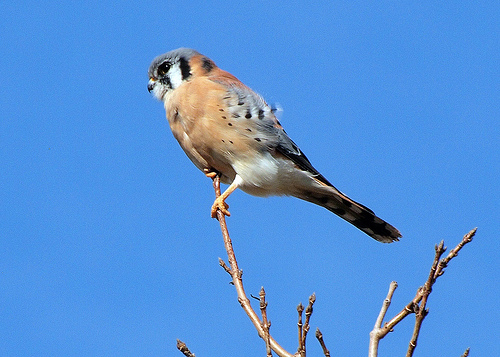
American Kestrel“One autumn day, 15 years ago, I found myself perched on a ladder that was leaning against a highway sign on Interstate 89 somewhere in Vermont. There was a wooden box clamped to one of the sign poles at least 15 feet off the ground, although fear may have exaggerated that memory. I was providing a little autumn house-keeping for one of those nest boxes so it’d be ready when the kestrels returned to breed the next spring,” writes guest blogger Madaline Bodin in Adirondack Almanack.

“The box was one of 10 kestrel nest boxes then deployed along the interstate by the Vermont Agency of Transportation, or VTrans. It’s a feel-good project started in 1995 with $40, some scrap wood, and plenty of volunteer hours from VTrans employees, who built the boxes on their own time. Since then, about 90 kestrels have fledged and four orphaned young were fostered in the boxes. That’s a lot of bang for the buck, or rather, a lot of birds for the box.

“The American kestrel – found in New York, Vermont and New Hampshire (and throughout North and South America) – is the smallest falcon in North America. They are tiny for a raptor – about the size of a blue jay – but are fierce predators…..

“Fifteen years ago, three of the highway nest boxes hosted breeding kestrels. There was hope that more of the boxes would be used as kestrels discovered them. They haven’t, but that may be because there just aren’t enough kestrels around to use them. Kestrels are in slow decline in much of North America and have been for over 30 years, but are currently listed as a species of “least concern” on the endangered species list….”  Read whole article here.

photo by John Picken

Introducing the Birds of Paradise

This fall, the Cornell Lab of Ornithology and National Geographic are bringing the Birds-of-Paradise Project to the public with a coffee-table book, a major exhibit at the National Geographic Museum (opening November 1), a documentary on the National Geographic Channel (airing at 10:00 p.m. ET/PT November 22), articles in the Cornell Lab’s Living Bird magazine and National Geographic magazine, and National Geographic Live lectures across the country. Her’s an advance look.