Category Archives: Birds

Do You Drink Bird-Friendly Coffee? Cornell Offers Guidance

Imagine you walk into the neighborhood coffee house for your morning cup of joe, and on the counter is a tip jar with a sign reading, “$ for wintering warblers” with a photo of a Chestnut-sided Warbler in a tropical forest.  You’d drop your change in, right? Any proud bird watcher would do their part for the wellbeing of the sprightly warblers that delight us so much come spring.
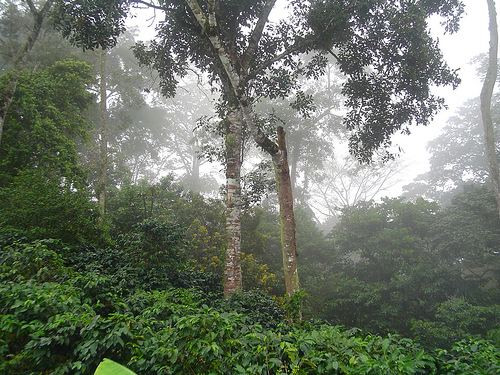
Coffee bushes

Shade grown coffee bushes in the cloud forest. Copan Coffee Tour – Finca Santa Isabel, Copan Ruinas, Honduras

It’s not such a stretch of the imagination, York University researcher Bridget Stutchbury told a packed audience at the Cornell Lab’s Monday night seminar series last week. Many of the colorful songbirds that are just now leaving us for the winter, including warblers, tanagers, orioles, and grosbeaks, will spend the next five months in and around shade coffee plantations in Mexico and Central and South America.

But only if the birds can find them. Shade-coffee plantations—particularly ones that grow coffee under a natural forest canopy—are increasingly being deforested, leaving North American migrants with fewer places to spend the winter. The good news, Stutchbury said, is that you can have your dark roast and your songbirds too if you buy sustainable coffee, particularly Bird Friendly coffee.

Read the excellent article by Cornell Lab science editor Gustave Axelson

Photo credit: Adalberto.H.Vega

If you enjoyed this post, please consider leaving a comment and subscribing by RSS feed or via email to have future articles delivered to you.
Stock up on Niger Seed, the Siskin Boys (& Girls) are in town

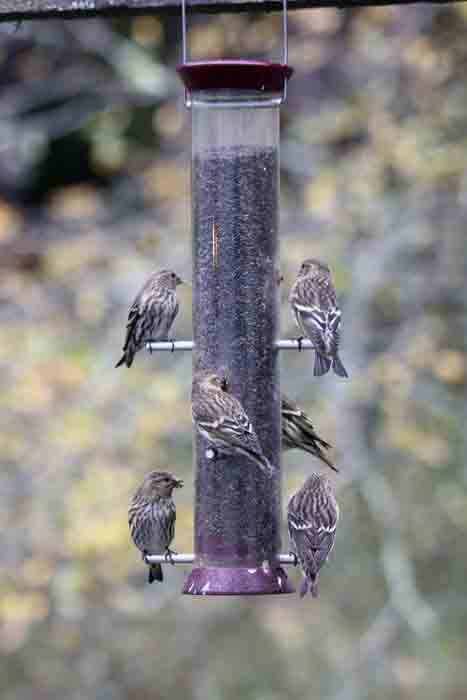
Pine Siskins at thistle feederWe take in our feeders at night to avoid bear and raccoon problems. (A big raccoon visited two nights ago, startling me as I went out to check a noise on the back deck.  It was a eye level – but fortunately the dog didn’t see it in the dark.

A few mornings earlier, as I hung up the bird feeder and thistle feeder at daybreak, I immediately had a dozen Pine Siskins flitting about, waiting for me to leave.  The same thing has happened all week — we have an onslaught of Siskins — as do other parts of New England in reading the eBird reports and list serves.

Pine Siskins are fun to watch but rather drab, after months of American Goldfinch watching.  

Here’s what the Cornell Lab of Ornithology says about them:

This nomadic finch ranges widely and erratically across the continent each winter in response to seed crops. Better suited to clinging to branch tips than to hopping along the ground, these brown-streaked acrobats flash yellow wing markings as they flutter while feeding or as they explode into flight. Flocks are gregarious, and you may hear their insistent wheezy twitters before you see them.

A Canadian ornithologist, Ron Pittaway, each year issues a  Winter Finch Forecast.  He notes that there is a “widespread tree seed crop failure in the Northeast” this year.  We may have a lot of visitors this winter — we’re already seeing a lot of Purple Finches and Dark-eyed Juncos.

This is the first winter in the last four that we are staying in Vermont — might be a good one for winter avian visitors.  My feed store friends are going to love me.  

Peregrine Falcons — The Outside Story

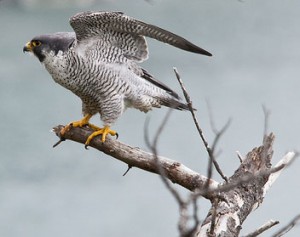
When asked to name the fastest animal on earth, many people will respond “cheetah.” But it is the peregrine falcon – a cliff-dwelling raptor –that holds that title with the ability to reach speeds of 200+ MPH as they stoop (dive) in flight. (The cheetah tops out at a mere 70 MPH).
Equally remarkable is the fact that this speed demon of the skies was nearly wiped out 50 years ago; its recovery ranks among the great success stories of conservation biology and endangered species management.
Historically, the eastern peregrine falcon population was centered in New England and the Adirondack Mountains, ranging south along the spine of the Appalachians to western Georgia. In 1940,the population was estimated at 350 pairs; by the mid-1960s, the species was completely gone from the region, a victim of the devastating pesticide DDT…..
Read the complete article by Steven D. Faccio from The Adirondack Almanac
Photo credit   USFWS Headquarters

Duck, Geese — Hunting Season is Near

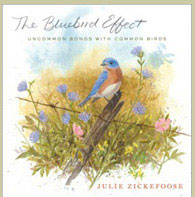
I have been reading Julie Zickfoose’s fine book, The Bluebird Effect.  It’s a series of stories about bird rehabilitation and observation and is the kind of book that is nice to take your time reading.  I have it on the iPad and read a chapter or two a week.  Her chapter “Love and Death among the Cranes” brought back some memories from last year and raised some issues on hunting and birding.

Last year, we travelled to the Southwest with our Airstream trailer.  We were planning to come down I-81 and when I heard of a rare Hooded Crane hanging out with the Sandhill Cranes at the Hiwassee Wildlife Refuge in Tennessee.  I blogged about it — we saw hundreds of cranes and a Ross’s Goose but the Hooded Crane was not around while we were there.  What I did see was Sandhill Cranes in fields everywhere and learned that Tennessee was considering opening up a hunting season for them.  (They delayed the decision for a couple of years.)

Julie writes passionately about the controversy in her book and on her blog.  I’m not anti-hunting but do have issues with the shooting of majestic birds like Sandhill Cranes and Snow Geese.  And now, our local little pond, a quiet water supply for Vermont’s capitol city, is not only now opened for non-motorized boating but also probably duck and geese hunting.  Hundreds of birders are angry, worried, depressed, feeling helpless, or all of the above.  It makes me wonder why I have a duck stamp on my binoculars.

The storyline goes like this:  Birders and other frequenters of National Wildlife Refuges should purchase a $15 Federal Duck Stamp each year in order to gain free admission to refuges. Conservationists buy Federal Duck Stamps because they know that the stamps are, dollar for dollar, one of the best investments one can make in the future of America’s wetlands. For every dollar you spend on Federal Duck Stamps, ninety-eight cents goes directly to purchase vital habitat for protection in the National Wildlife Refuge System.

So, every year, I buy a duck stamp at the Parker River National Wildlife Refuge (even though I have a life-long Senior Pass) and put it prominently on my binoculars.  The word is that the majority of stamps are bought by non-hunters but even if that is the case, we get little or no credit in surveys.

Here’s how blogger Mike puts it:   When the U.S. Fish and Wildlife Service puts together the National Survey, it ascribes zero dollars of Duck Stamp purchases to wildlife watchers. Zero. If you can find the statement in the National Survey that acknowledges that some of the Duck Stamp money comes from wildlife watchers, I’ll eat my beloved Midwest Birding Symposium hat (or more likely just some wild duck.) But that’s not going to happen.

So, when I go to Parker River or over to Lake Champlain and hear the guns booming just outside the refuges, I’ll try to remember that money from licenses, shells, stamps, etc goes toward habitat and that hunters love birds as much as we do — with a nice bottle of wine on the side.

Quieter Woods

Things are pretty quiet these days in our woods as I walk the dog on our trails — aside for some deer watching us nearly every walk and numerous red squirrels and chipmunks, the activity has died off as birds prepare for migration and winter.  The Chickadees are still chipping away and I watch them for visiting warblers honing in on their local knowledge.  Blue Jays are as raucous as ever and lately, Red-breasted Nuthatches have been calling away as they forage.

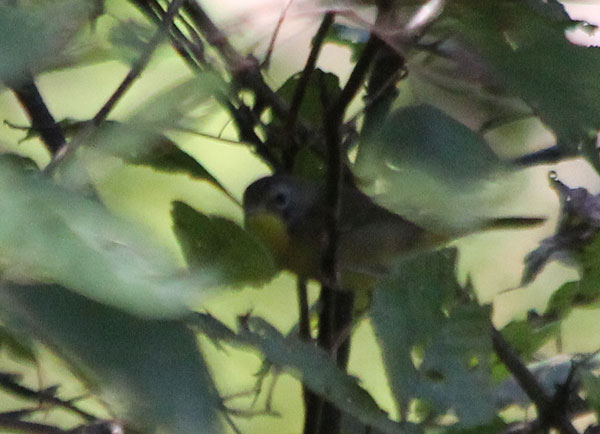
There are some spots along the way where I have seen Common Yellowthroats all summer.  They are still here but never sing and even chip less frequently.  I can tell where they are from the movement of the bushes where they hide and every so often, get a glimpse of one — as the shot below illustrates.

A Common Yellowthroat hiding in the bushes.

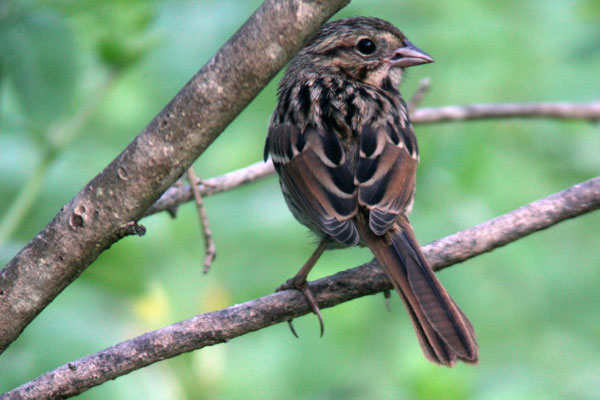
Song Sparrows are also still here but furtive in their movements.  They no longer sing from the top of bushes but we have a nice crop of juveniles getting fattened up for their trip south.  They tend to sit a little more cooperatively like this guy that I photographed a few days ago.

A young Song Sparrow

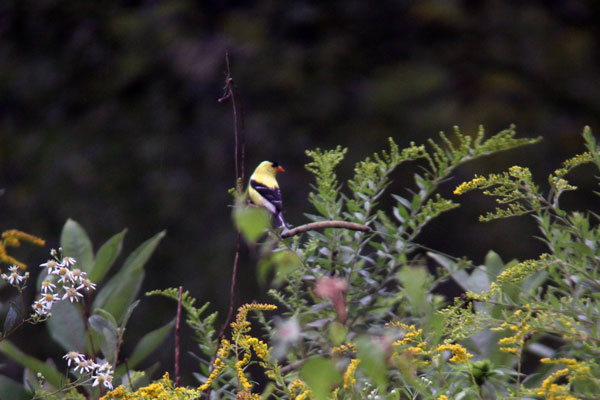
It has been interesting watching the American Goldfinches at the feeder.  Some have bright new plumage, others are pretty ratty looking as they molt.  All seem to be loading up with food and I expect that soon their boisterous arrivals and departures — a spectacle of gold and black — will be out of here.

Dozens of American Goldfinches adorn our backyard but they’ll be off before long.

The White-Throated Sparrows don’t sing their “Peabody, Peabody, Peabody” call that livens up our woods all spring and summer but they are around with a new crop of youngsters.  They may head out but we’ll have their northern cousins here all winter.

A White-Throated Sparrow hiding from the camera

I read an interesting article on fall birds by Kenn Kaufman in the latest Bird Watcher’s Digest.  I had never thought about the fact that many more birds migrate in the fall than the spring (due to the hatches during the spring/summer).  Kenn notes that due to the foliage, the duller plumage, and lack of singing, that birding is much harder in the fall — and thus to some a welcome challenge, and to others — a “forget about it” time for birding.   I’m going to take a hard try at picking out the warblers as they come through but I already know it’s going to be frustrating.

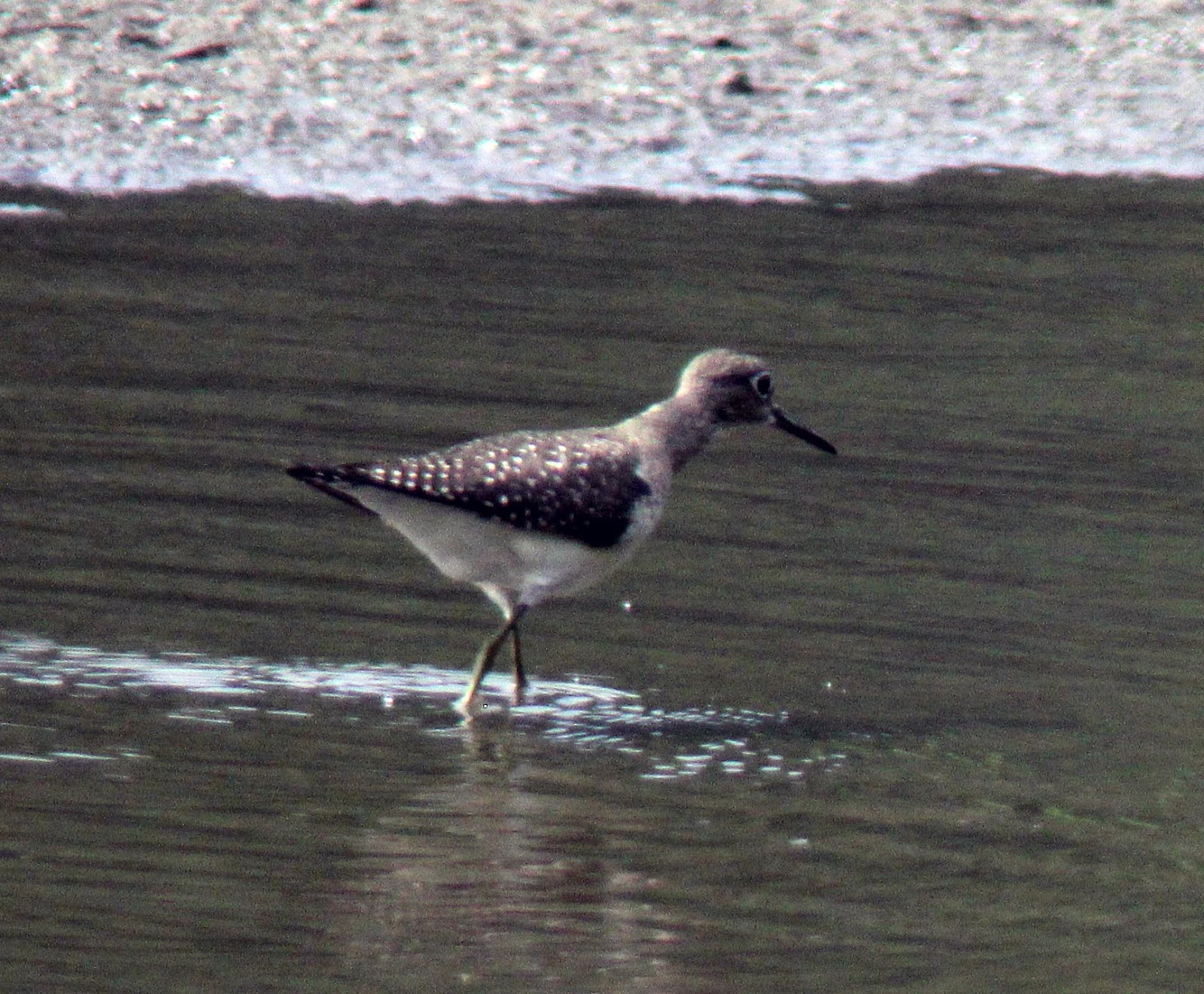
A Solitary Sandpiper

We don’t have a lot of shorebird habitat hotspots in central Vermont so we make do with puddles in cornfields, small mudflats along the rivers and ponds, and other spots where water gathers.  We go over to Lake Champlain or down into Addison County for real shorebird birding.

However, this time of year when stuff is starting to move, we’ll sometimes spot a long-billed migrant in the county.  One spot I like is just down the road from a gathering spot we all love — The Red Hen Bakery — consisting of a little pull off busy Route 2 right beside the Winooski River.  There are often ducks there and today, a sole little wading bird.

I had the dog with me in the front seat and she wanted to join the action as I scanned the river and set up my scope.  I took a few so-so digiscoped shots (the sun was not a big help) and looking over the shots, realized that it was a Solitary Sandpiper.  No big deal per se but the first one for me this year and a nice looking bird.  And by itself — oh yeah, solitary.

Brown Thrasher – Undercover Expert


Brown Thrasher – Undercover Expert by Sue McGrath 

The Brown Thrasher is an actor, robed in reddish hue, not in the distinguished gray like the catbird or the mockingbird.  As noted in Chris Leahy’s information packed and engaging resource,  The Birdwatchers’ Companion, the Brown Thrasher doesn’t beat or thrash with its long tail and doesn’t thresh with its long, curved blade of a bill.  The bill allows it to forage deep in thickets and last season’s leaf litter by sweeping the detritus and soil away and then pecking, probing and seeking insects, snails, toads, frogs, seed, beetles, fruits and nuts.   

I watch them intently as they pass in jerky flight along the vegetated edges roadside and take cover.  The ruddy hue makes them difficult to see undercover. 

I smile when I hear their smack call which I liken to a loud kiss ~ that “tcheh” call note of this mimic.  I regularly focus on Brown Thrashers as they cross low over the road at Parker River National Wildlife Refuge.  My concern for them heightens when the beach-goers stream to the Refuge’s and Sandy Point’s beaches.  I’ve studied them for hours as they fly in and out of the shadbush, serviceberry, shadblow, viburnam and beach plum thickets at this important and renowned birding area. They appear unsettled and uncomfortable in the open; they’re in their element when undercover. 

The Brown Thrasher has several monikers: Brown Thrush, Eastern Roadrunner, Sandy 
Mocker, Ferruginous Mockingbird, Planting Bird and Red Mavis. 

The Brown Thrasher has a slender bill, and the lower mandible has yellow at the base.  Its face is gray; its eyes are yellow.  Those white wing bars and yellow legs are easy to discern and focus on. Its tail is long, rounded and keel-like.  It’s known as a large, boldly patterned, long-tailed skulker that loves the thickets.  Both sexes are rich,bright rufous with buff to white underparts with black streaking.  The Brown Thrashers are conspicuous due to their large size  [9-12 inches].  With a wingspan of 11-13 inches, they are seen well as they dart low, barely undulating, in front of my car.  I’ve invested time watching them dust bathe roadside when I’m heading to Sandy Point. 

The male Brown Thrasher’s rich, musical and varied song is one of duplicity,   a series of long phrases separated by pauses. This mimic has a large song repertoire and is the only thrasher routinely seen in the northeast. 

By the second or third week in April, the males arrive.  Once on territory, the vain male will perch high vertically and announce the breeding season.  The male is on territory ahead of the female, and often his song is delayed for a few days. When the female arrives, the male’s song of doubleness begins.  Once a mate is secured, the pair limit their movements and begin nest building.   The mated male sings a softer song.  The female shapes the nest, and both male and female bring in the nest 
construction supplies – twigs, grapevine, rootlets, grass and dry leaves.  The nest is a hefty, dense parfait with many tiers – often four –  first twigs, then dry leaves, grapevine and paper compose the second tier; the third tier is stems, twig roots with soil, and the fourth tier is rootlets without any dirt attached.  I’ve watched them beat the roots on the hot, black pavement and shake them to remove the dirt. The nest’s outside diameter measures 12 inches; the inside diameter is 3 – 4 inches; the inside depth is 1 inch. 

Often the nests are in thorny shrubs below 12 feet; but most often they are at  2 – 7 feet.  I found an active nest on the ground once.  2 – 6 eggs are laid that are white to pale blue with faint to heavy speckles and muddy brown markings. The Brown Thrasher is aggressive around the nest like a highly-skilled defenseman on the “Atlanta Thrashers”… 

The nestlings are helpless with downy tufts; they fledge between 10 to 14 days, earlier than Gray Catbirds and Northern Mockingbirds.  The male has charge of the fledglings, affording the female the opportunity to produce 2 – 3 clutches.  If there isn’t a second or third brood, the pair divide the care of the fledglings, sometimes moving the young to separate areas. 


Article is from the June Newburyport Birders Newsletter
Image by ibm4381